Revolutionary cultural movements are rarely organized. Instead, they emerge organically from a stew of disparate, often opposing forces united by shared goals.
Such was the case with the Harlem Renaissance, and its birth, evolution, and impact are the captivating subjects of Once Upon a Time in Harlem, a documentary by William Greaves (screening at this year’s Toronto International Film Festival ahead of its Oct. 16 theatrical debut) that was left unfinished for 54 years until his son David completed it. A time capsule, history lesson, and heady hangout movie all rolled into one, it’s an invigorated portrait of radical change as the byproduct of art, politics, and roiling intellectual debate.
In August 1972, actor-turned-documentarian Greaves invited every living Harlem Renaissance luminary to an afternoon gathering at Duke Ellington’s home. The reunion brought together a wide range of distinguished guests, from composer Eubie Blake, poet Arna Bontemps, and painter Aaron Douglas to writer Richard Bruce Nugent, librarian Regina Andrews, and journalist Gerri Major, many of whom had not seen each other in decades and were eager to revisit the era.
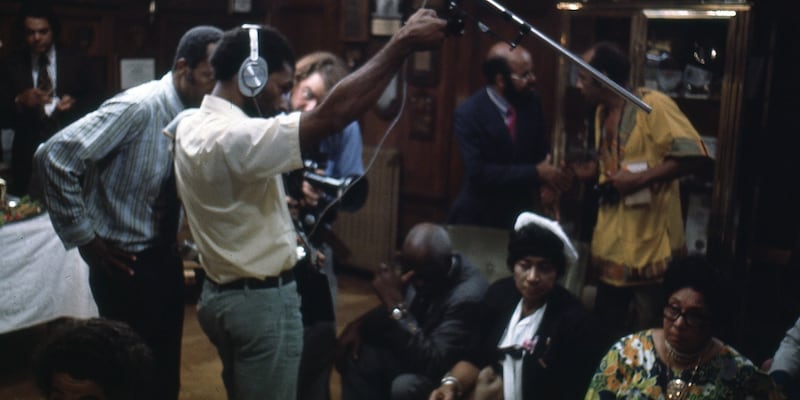
Composed primarily of footage shot that day, Once Upon a Time in Harlem situates itself amid the countless conversations that followed, beginning with separate cocktail-party chats and ending with a giant living-room discussion in which voices fight to be heard amid the passionate din.
Greaves juggles his numerous points of interest by identifying each with on-screen text and utilizing split screens and archival media—film footage, photographs, printed writing, and narrated poems—to capture the multifaceted spirit of both the contemporary and bygone moment.

James Van Der Zee’s photographs are the jumping-off point for Once Upon a Time in Harlem, providing visual context for the 1920s in which these men and women flourished. And at subsequent intervals, the jazz that helped redefine the period cascades across the soundtrack.
Greaves’ chief focus, however, is the indelible faces and the things they have to say about the past and what it means for the (1972) present. Fortunately, his participants are a charismatic group, all the more engaging because they don’t always agree with one another.
Whether it’s Ida Mae Cullen castigating attendees for not properly mentioning her esteemed poet husband Countee Cullen, or painter Romare Bearden criticizing Harvard professor and author Nathan Huggins for giving the arts short shrift in his book Harlem Renaissance, Once Upon a Time in Harlem isn’t afraid of contentiousness.

That lends the proceedings a liveliness that’s at once dramatically stimulating and, more crucially, authentic to the Renaissance itself. The film makes clear that the trailblazing “Negro New Movement” emerged from an array of angles, opinions, and personalities that didn’t always mesh. In the process, Greaves’ documentary functions not merely as a snapshot of a historic get-together, but as a case study in transformation born as much of conflict as of harmony.
Greaves shoots Once Upon a Time in Harlem with an off-the-cuff spontaneity, his camera crowding into chats such that his boom mic operator—stretching to make sure he catches speakers’ comments—intermittently appears in the frame. His filmmaking has a rough-around-the-edges quality that heightens the impression that we’re crashing an exclusive soirée.
Moreover, there’s an energy to the material that escalates as the liquor flows and the dialogues become more specific and heated. That combustibility, though, is shrewdly tempered by Greaves’ decision to step away from the main event to conduct one-on-one interviews with a handful of individuals, in which they expound on their careers and contributions to the Renaissance.
Of those, the most compelling is Leigh Whipper, who at 96 years old is frail in body but sharp in mind, and who discusses his roots in minstrel shows and vaudeville before, at Greaves’ urging, reciting a lengthy monologue—by memory and with a grandness and forcefulness that belies his age—from one of his movie roles.

Whipper is so magnetic that he just about steals Once Upon a Time in Harlem. Still, he’s far from the only fascinating figure in Greaves’ doc. Be it Major remembering being spit on by a white Cotton Club patron or George Schuyler defending his article “The Negro-Art Hokum”—which was rebuked by Langston Hughes’ “The Negro Artist and the Racial Mountain”—there are riveting artists and intellectuals around every corner.
Racial discrimination is, unsurprisingly, a regular topic in Once Upon a Time in Harlem, and yet just as enthralling are related conversations about Black Americans’ relationship to Africa (some believe in it more than others), the origins of the theatrical productions and musical compositions that helped usher in a wave of groundbreaking art, and the modern generation’s apparent disinterest in their ancestors’ struggles and achievements.

Bouncing from one subject to the next, the film’s winding deliberations—all of them colored by the speakers’ egos—coalesce to form a tapestry of ideas and attitudes about race, prejudice, perseverance, innovation, and enlightened invention.
At a scant 100 minutes, Once Upon a Time in Harlem invariably gives short shrift to almost all its trailblazers. One craves more details about their acclaimed (and under-appreciated) lives, whether it’s Blake’s pioneering time in the theater (highlighted by the landmark Broadway hit “Shuffle Along”), Andrews’ experiences supporting the Renaissance’s most famous writers, or Ted Poston’s tenure as a reporter for The New York Post.

There’s so much hinted at over the course of the film that—despite it conveying plenty through astutely selected scenes and telling inferences and juxtapositions—it often plays like an appetizer rather than the main course.
That said, if Once Upon a Time in Harlem stokes a hunger for a more expansive Ken Burns-style historical recap, that’s simply a testament to the charm of its characters, both on their own and as a motley collective. The fact that they seem to disagree as often as they agree is proof that, far from a united monolith, the Harlem Renaissance was a diverse movement driven by a common desire for Black rights, respect, and independence.

Greaves’ film commemorates it with reverence that never tips into mawkishness, and in doing so, it serves not only as an entertaining celebration but also as a lasting reminder that the future is unwritten and waiting for brave, smart, and creative souls to put their signatures on it.