MAGA’s Most-Hated Action Star Goes on Another Bloody Killing Spree
“Reacher” star Alan Ritchson partners with Owen Wilson in this chaotic buddy comedy.

Reacher star Alan Ritchson has assumed the mantle previously held by Arnold Schwarzenneger and Dwayne “The Rock” Johnson as Hollywood’s premier larger-than-life bruiser—all while caustically speaking out against President Donald Trump and making himself an enemy of the commander-in-chief’s MAGA acolytes.
Yet neither his brawn nor his tough talk can salvage Runner, a Midnight Run-y buddy action comedy of minimal imagination and less excitement that’s not to be confused with last week’s Gal Gadot-headlined The Runner. Pairing Ritchson with a motormouthed Owen Wilson, it’s a second-hand affair that runs out of gas almost as soon as it kicks into gear.

Owen Wilson.
Angel Studios
Ritchson’s primary calling card is his enormous physique, and Runner (Sept. 11, in theaters) wastes no time showing it off—while establishing that he also has feelings. Decorating a lock as he practices French via a smartphone app, his character, Hank Malone, is a despondent hulk with a sad past. Nonetheless, his mood brightens somewhat at an AA meeting where he receives a coin for being sober for a year.
Afterward, he carries out his daily courier tasks, which include transporting a sleazy government minister to a cabinet meeting and taking possession of a rare and valuable parakeet.
Hank is the “resident yank” in Brisbane, Australia, but he’s soon joined by fellow countryman Ben Bishop (Wilson), who arrives down under from Honolulu with a special item in tow: a liver in a state-of-the-art temperature-controlled organ preservation system (i.e., a medium-sized silver cooler that beeps when it gets hot).
Sign Up for Our Obsessed Newsletter
By clicking “SUBSCRIBE” you agree to our Terms of Use and Privacy Policy.
This is for a young girl at a Gold Coast hospital who’ll die if she doesn’t receive it this very day, and despite being puzzled by Ben and his directions—since they contradict what he’d been told—Hank embarks on this mission with Ben, who must deliver the package himself.
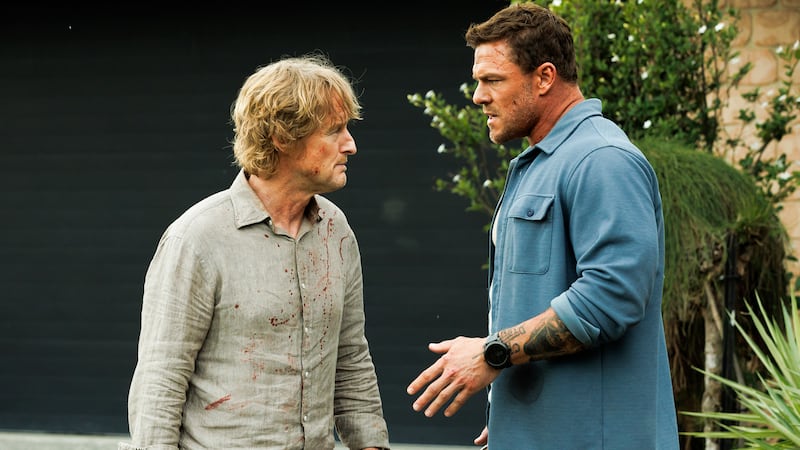
Owen Wilson and Alan Ritchson in Runner.
Angel Studios
Considering that Hank’s depression is due to the dead daughter whose picture hangs in his car’s sun visor and whom he abandoned because of his drinking—in the process ruining his relationship with since-remarried Monica (Geraldine Hakewill)—his undertaking is an obvious vehicle for redemption.
Director Sam Waugh (Expend4bles, Hidden Strike) and writers Miles Hubley and Tommy White aren’t interested in originality, just familiar easy-bake narrative beats and dynamics. Hank and Ben are a conventional odd couple, with the former gruff and silent and the latter chipper and chatty. Their clashes, however, are tepid, eliciting zero laughs as they go back and forth about Hank’s verbose bird and Ben’s love-it-or-leave-it personality.
Wouldn’t you know it, no sooner has the pair hit the road than they’re pursued by dark Land Rovers. The reason bad guys are on their tail is that Ben’s liver is only compatible with the rarest blood type on the planet—known as “golden blood”—and is thus worth a million dollars on the black market. The baddie who covets it is Damian (Rodrigo Santoro), a drug cartel psycho who’s flanked by countless biker-gang minions and who grins and rants with equal fervor.
He’s a maniacal villain in a film that’s deliberately cartoonish, and his attempts to pilfer the liver from Hank and Ben result in the first of several action sequences that are heavy on gimmicky CGI camerawork and light on invention.
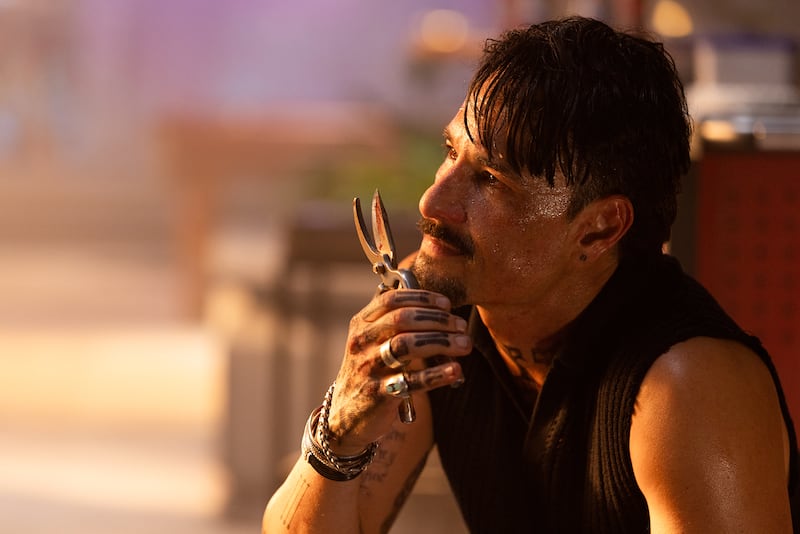
Rodrigo Santoro.
Angel Studios
A climactic “oner”—facilitated by clunky digital effects that render it a glorified demo reel—is representative of Runner’s empty flashiness, and Waugh’s tale is too pedestrian to develop its own identity. The majority of the film involves Hank and Ben traveling about the city trying to evade enemies and reach the hospital, where the sick kid’s mom, Kate (Leila George), frets and fumes about the urgency of her child’s situation.
Nothing about that aspect of the story is compelling, nor is the revelation that Damian isn’t after the liver for profit. Instead, he covets it because his kingpin mother Donna (Adriana Barraza) also needs it to survive—the sort of convenient plot point that’s as believable as the fact that she’s holed up in a remote warehouse that, aside from her medical area, is decorated like a bar.
That Ritchson is playing a quasi-superheroic He-Man is never in doubt, so it comes across as absurd overkill to have him tell Kate, “I’m not a man that people successfully mess with.” Grimacing sternly as he strives to save a young girl’s life—thereby earning himself redemption and, perhaps, a new family?—the star capably smashes and bashes a host of anonymous henchmen.
Except for a scene in which he uses a spinning police car tire to incapacitate adversaries, however, Waugh fails to orchestrate noteworthy action. Culminating with a Boss Battle that makes no sense in multiple ways, it serves up a sloppy brand of mayhem.
Throughout, Wilson strains so hard to be funny that his sweat seems to be a byproduct of that exertion rather than his chaotic circumstances. Yet the film’s absence of humor isn’t totally the comedian’s fault, given that the script is AI-grade generic. Waugh keeps the material moving, but Runner is a lifeless retread that isn’t jolted to life by Ritchson throwing dudes against walls and blasting them to pieces with shotguns or by Wilson blabbing at a mile a minute about all manner of nonsense.
Runner’s decision to kill off one of its main characters is its sole convention-bucking surprise, although that twist feels random and unnecessary. Waugh’s main priority is granting Hank the schmaltzy salvation he deserves, and in the end, he indulges in excessive bittersweet treacle that causes his saga to resemble one of Angel Studios’ faith-based offerings. Deliverance from clichés, alas, is not forthcoming, even if Ritchson’s performance comes close to selling the proceedings’ final cornball moments.
Having transformed himself with Reacher into a one-man brand defined by menacing might, droll wit, and noble intentions, the actor doesn’t crash and burn with Runner so much as spin his wheels, rehashing his popular schtick without novel modifications.
The film won’t damage his reputation as pop-culture’s reigning goliath, but—no matter Hank’s constant motion and ultimate emotional and psychological growth—it depressingly opts for stasis over evolution.
Obsessed with pop culture and entertainment? Follow us on Substack and YouTube for even more coverage.

Got a tip? Send it to The Daily Beast here.
Register below to read this article for free or subscribe
to unlock unlimited access to The Daily Beast.
Monthly
$1
First month then $5.99/month
Annual
$35
First year then $59.99/year
Premium
$79
First year then $119.99/year
*Substack access provided by the next business day, using your subscription email. Choosing the Premium plan constitutes your permission to share your subscription email with Substack and your agreement to Substack’s Privacy Policy.
Already have an account? Sign In
Looks like you already have a subscription!
You're all set!
Thanks for subscribing.
Sign in or create an account
Login dialog
Loading comments…