
Jesse Eisenberg’s A Real Pain (which earned Kieran Culkin a Best Supporting Actor Oscar) was a nimble balancing act, infusing its somber Holocaust-themed drama with the sarcastic and neurotic wit for which its writer/director, as an actor, is known.
Attempting to pull off the same trick twice, alas, proves beyond his reach, as The Debut (screening at the Toronto International Film Festival) leans heavier into surreal comedy and yet never finds a suitable tone for its wannabe-moving and sorta-kinda satiric tale of a housewife who goes looking for herself on the stage.
Julianne Moore’s game lead performance aside, it’s a case study in simultaneously going too far and not far enough.
In a small New Jersey town that’s as unreal as everything else in (and about) the film, Mona Friedman (Moore) coasts through a stay-at-home life in which she’s ignored and dismissed—often with a condescending sneer—by her husband Howard (Better Call Saul’s Patrick Fabian) and her twin kids, who are on the precipice of leaving for college.

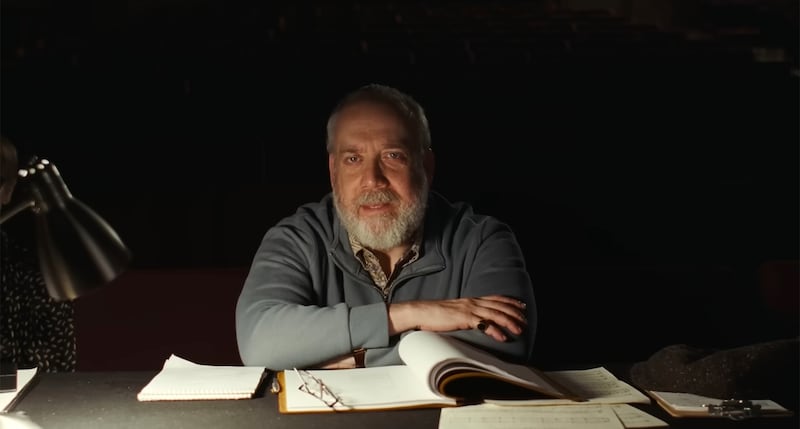
For reasons that are never dramatized, Mona auditions for the small part of an apartment building superintendent named Miss Danielle in a community theater production of the musical Nosy Neighbors, whose director Jerry (Paul Giamatti) is renowned in the area for being equally tough and gifted.
Mona has no talent, and her audition is a flop, but, as befitting her zombie-ish headspace, she still hopes she can nab the gig. Weeks later, she visits the theater, and Jerry curtly informs her that rehearsals are already in full swing with their reliable favorite, Serena Cherry (Bernadette Peters). In response, Mona drives home and weeps madly in her driveway. However, a few hours later in the middle of the night, Jerry calls with out-of-the-blue news: Serena has abandoned them—Mona is now Miss Danielle.
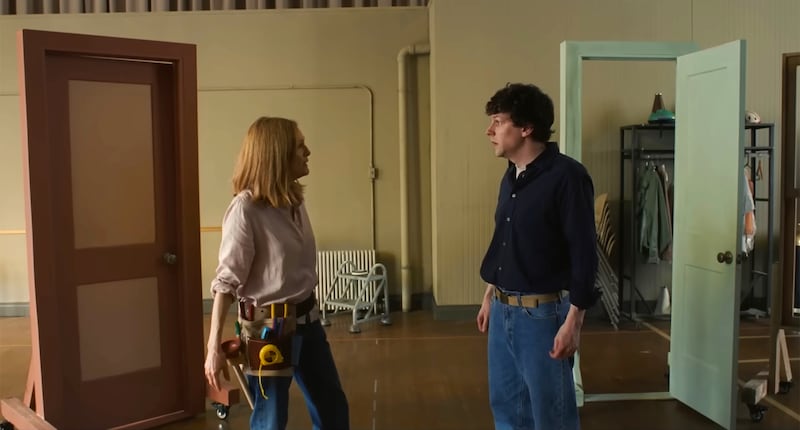
Eisenberg’s staging of this momentous turn of events makes it seem like Mona is hallucinating, and that impression persists when she arrives at the theater the following morning, and the show’s assistant director Piotr (Eldar Isgandarov) and star Stef (Halle Bailey) treat her with over-the-top kindness.
Yet the longer it continues on the same weirdo wavelength, the more it becomes apparent that Mona’s circumstances are not a figment of her deranged-by-domestic-misery imagination—rather, everyone’s bizarrely chipper enthusiasm and supportive behavior is merely part and parcel of the film’s preferred heightened form of reality.

This revelation isn’t quite disappointing (since casting everything as a dream would be hackneyed), but it is baffling, given that it renders the proceedings knowingly phony. Worse, it’s simply not funny, due to Eisenberg refraining from pushing the action into completely bonkers territory.
The reason for his restraint is that, despite courting laughs, he wants audiences to empathize with Mona as a kindhearted victim who’s striving to break free from her chains. That’s a largely futile endeavor, what with Mona behaving like a dazed-and-confused archetype who’s too mannered to come across as a fully formed person.
The Debut is more assured when it comes to playfully poking fun at musicals; the finest moment in the entire affair is a peripheral gag in which a character enters a scene and promptly, clownishly drops two armfuls of bowler hats. As Jerry and company begin rehearsing, Nosy Neighbors comes into focus as a goofy version of a particular, classical form of Broadway entertainment. While Eisenberg’s affection for the medium undercuts his skewering, the accuracy of his sendup is enough to elicit smiles, if not outright chuckles.

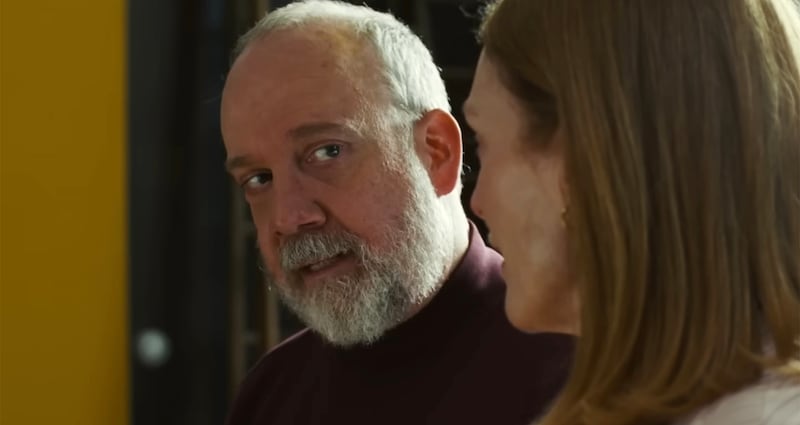
Giamatti is never unamusing, and Jerry’s imperious habit of telling underlings to take a break but to not depart the premises is a choice recurring joke. Still, whereas he initially appears to be a familiar contentious type, The Debut can’t decide just how much of a hardass he should be, and it ultimately settles on…a little bit.
Such wishy-washiness is emblematic of Eisenberg’s latest, whose high note involves Jerry getting fed up with Mona’s quiet woodenness and, during a one-on-one workshop, pushing her to tap into her character, only to extract a profane fierceness from the newbie actress that’s hilarious precisely because it takes things to 100.
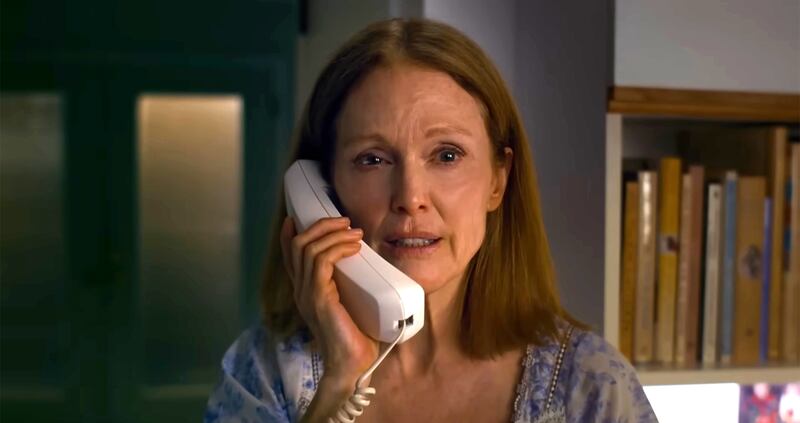
The rest of The Debut, unfortunately, strains to be wacky, indulging in fantastical craziness that never crosses the line into actual insanity. However, the fault doesn’t lie with Moore, who gives it her all as the increasingly committed Mona. Convinced by Jerry that identification with Miss Danielle is imperative—a process that entails a nocturnal trip to New York City, where she breaks into a building—Mona does whatever she can to get in touch with her inner superintendent, and the Oscar-winning headliner laughs, cries, and freaks out with maximum (and intermittently dazzling) gusto.
Playing her as a desperate and lonely woman trying to use art as a vehicle for transformation and identity formation, she gets as close as Eisenberg’s script will allow to breathing believable life into her protagonist.

That’s not, in the final tally, close enough. As her screws gradually come loose, Mona mutates into a parodic method actor, but The Debut refuses to wholly embrace absurdity, leaving it stuck in an uncomfortable, and eventually tiresome, middle ground. Stef, Piotr, and Eisenberg’s cast member Todd are sketches at best, as is Fabian’s Howard, who’s so inconsequential (other than as a motivating plot device) that it’s no great loss when he’s casually forgotten about by the story. Like the film as a whole, these supporting figures are partially conceived, negating any possibility that one might care about them.
On a couple of key occasions, Mona’s face is drenched in bright angelic light which provides—as does a climactic heavenly vision—a common theatrical link between her saga and Nosy Neighbors. Regrettably, the gesture doesn’t work, nor does the aww-shucks uplift sought by its conclusion.
The Simpsons did a superior version of this tale thirty-four years ago with “A Streetcar Named Marge,” and in a compact half-hour that drew clearer lines between its amateur thespian’s (individual and familial) plight and the show she joins.
Moore is such a multifaceted artist that, with her closing number, she almost makes one forget about the material’s skimpiness. For all her effort, though, her Mona is just a slightly gonzo cliché in a film without the nerve to pull out all the comedic stops.