Rand Paul Is Giving Us a Filibuster Tutorial, So Let’s Pay Attention
Rand Paul’s doing it the old-fashioned way—talking all day and night. Peter Beinart on a principled stand.

Chris Maddaloni/Getty
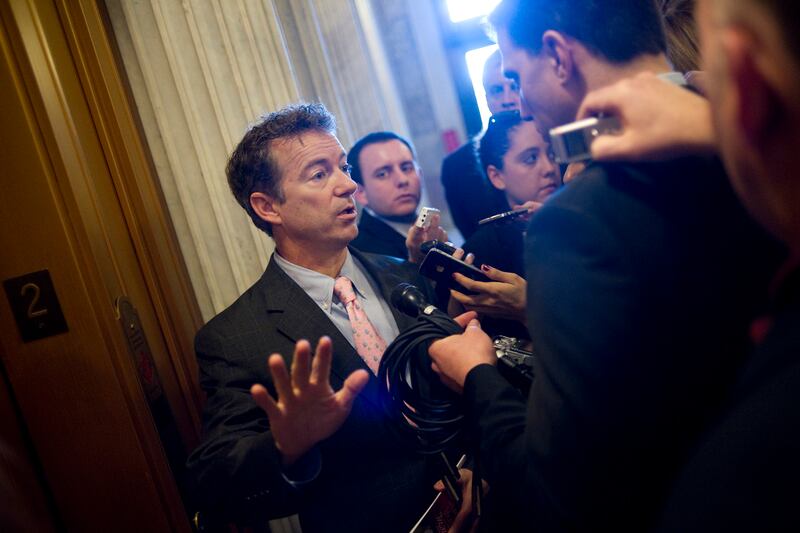
In filibustering John Brennan’s nomination to head the Central Intelligence Agency, Rand Paul is giving a tutorial on what it means, or should mean, to be a member of the U.S. Senate.
First, he’s actually filibustering. Until the 1970s, filibustering meant standing at your Senate desk and talking nonstop, day and night, to prevent your colleagues from taking a vote. But in recent decades, and especially in the Obama era, real filibustering, which is hard, has been replaced by virtual filibustering, in which senators simply declare their opposition to taking a vote and then go about their normal business. Once filibustering became easy, it became common. Now most important legislation requires not 51 but 60 votes to pass the Senate, as that’s the number required to break a filibuster. Last month, Republicans voted to deny a vote to Chuck Hagel, President Obama’s nominee for secretary of defense, and then went on vacation for 10 days.
But Paul, to his credit, is doing it the old-fashioned way. He’s talking all day and night, relieved occasionally by sympathetic senators temporarily willing to pick up the slack. And he’s doing so on a matter of principle, not partisanship: the Obama administration’s refusal to categorically rule out a drone strike on an American citizen on American soil.
During the Hagel fight, John McCain acknowledged that part of the GOP’s opposition stemmed from bitterness that Hagel had put his outrage over the Iraq war ahead of his party loyalty to President Bush. For Paul, it’s completely different. He voted for Hagel, and for Obama’s secretary-of-state pick, John Kerry. And he’s gone out of his way to implicate his own party in the drone policies he’s denouncing, declaring, “I would be here if it were a Republican president doing this. Really the great irony of this is that President Obama’s opinion on this is an extension of George Bush’s opinion.”
Paul’s filibuster is also germane to the guy he’s filibustering, since as Obama’s counterterrorism adviser, Brennan has overseen a massive expansion of lethal drones. That’s another sharp contrast with the Hagel filibuster, during which McCain and Lindsey Graham said they would prevent a vote until they got more information about the attacks in Benghazi, Libya, a disaster Hagel had absolutely nothing to do with.
Get the best of The Beast delivered right to your inbox
By clicking “SUBSCRIBE” you agree to our Terms of Use and Privacy Policy.
Paul knows he can’t ultimately stop Brennan’s nomination, but by delaying it in a dramatic way, he’s getting the media—especially the television media—to talk about drones, a subject with massive national-security and constitutional implications that got almost no attention at Hagel’s hearing. Paul is also shaming those Democrats who had denounced Bush’s unchecked presidential power but put their civil libertarianism in a blind trust once Obama entered the Oval Office.

Some liberals still find it hard to rally behind Paul, given his hostility to the welfare state and ambivalence about the 1964 Civil Rights Act. But throughout American history, liberals worried about what Arthur Schlesinger called “the imperial presidency” have made common cause with conservatives whose views on other subjects they found abhorrent. Arkansas Sen. William Fulbright, for instance, didn’t just muse about the Civil Rights Act’s constitutionality a half-century later, he voted against the bill itself, along with the other key civil-rights legislation of the 1960s. But he also warned prophetically against the Bay of Pigs and Lyndon Johnson’s 1965 invasion of the Dominican Republic and oversaw the hearings that helped expose the folly, and horror, of America’s war in Vietnam.
Unlike those Washington conservatives who only object to centralized government power when the government is trying to regulate business or help the poor, Paul is reminding his fellow Republicans that the power to wage war is the most dangerous government power of all. He’s reminding Democrats that no president can be trusted with the unrestrained power to kill, not even one you like. And he’s reminding Americans that senators can still stand on principle, even when it costs them their sleep. Not bad for one day’s, and night’s, work.
See more of our coverage in your search results.

Got a tip? Send it to The Daily Beast here.
Register below to read this article for free or subscribe
to unlock unlimited access to The Daily Beast.
Monthly
$1
First month then $5.99/month
Annual
$35
First year then $59.99/year
Premium
$79
First year then $119.99/year
*Substack access provided by the next business day, using your subscription email. Choosing the Premium plan constitutes your permission to share your subscription email with Substack and your agreement to Substack’s Privacy Policy.
Already have an account? Sign In
Looks like you already have a subscription!
You're all set!
Thanks for subscribing.