
Health and Human Services Secretary Robert F. Kennedy Jr. has lashed out at a New York Times reporter who published a damning exposé claiming he had “checked out” of his Cabinet job.
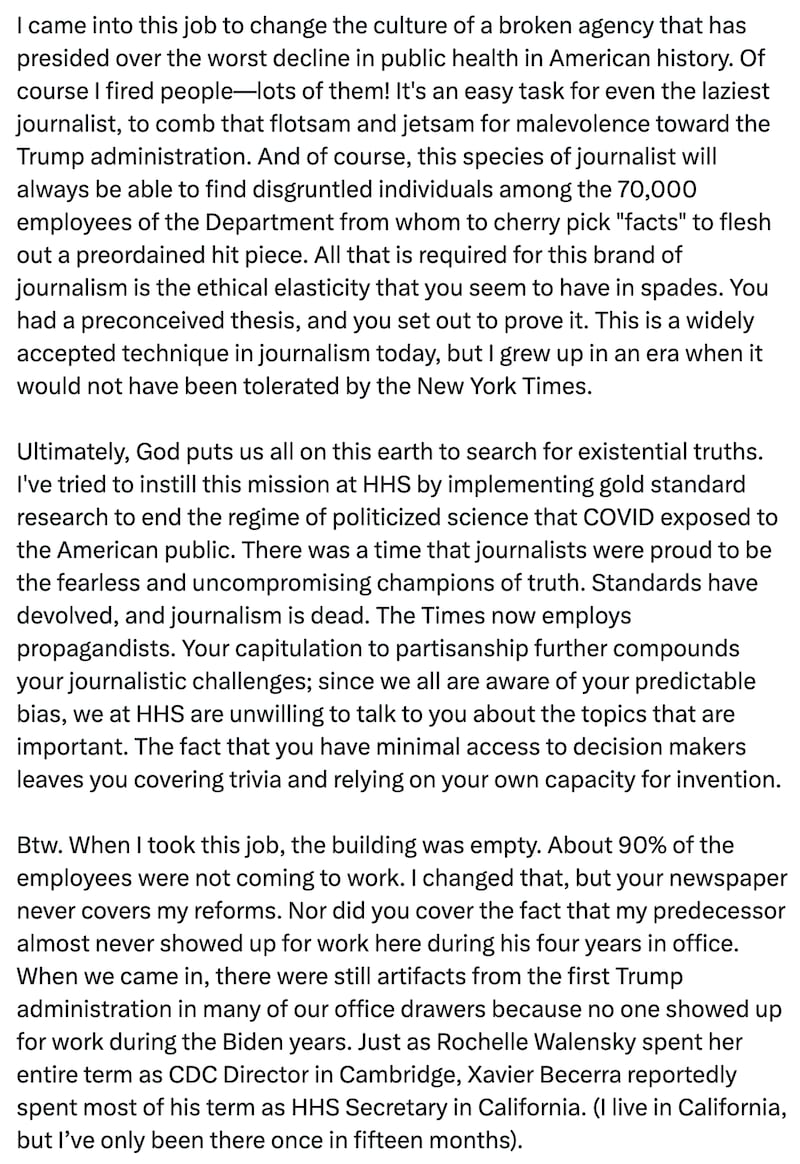
In an 870-word screed on X, Kennedy went on a tirade against the Times’ Sheryl Gay Stolberg, who covers the vaccine skeptic and his Make America Healthy Again movement for the paper, accusing her of publishing “unfair, inimical, and inaccurate” allegations.

Kennedy took issue with many of the details in the report published on Sunday. This included claims that he has little interest in overseeing the full range of responsibilities at the Department of Health and Human Services because he would rather focus on his own priorities, such as issuing food recommendations and trying to prove that vaccines are harmful.
The report also alleged that when Kennedy arrives at the Health Department’s Washington, D.C., headquarters around 10 a.m. after going to the gym, he spends much of the day “disengaged” and “scrolling on his phone” before leaving around 4 p.m.
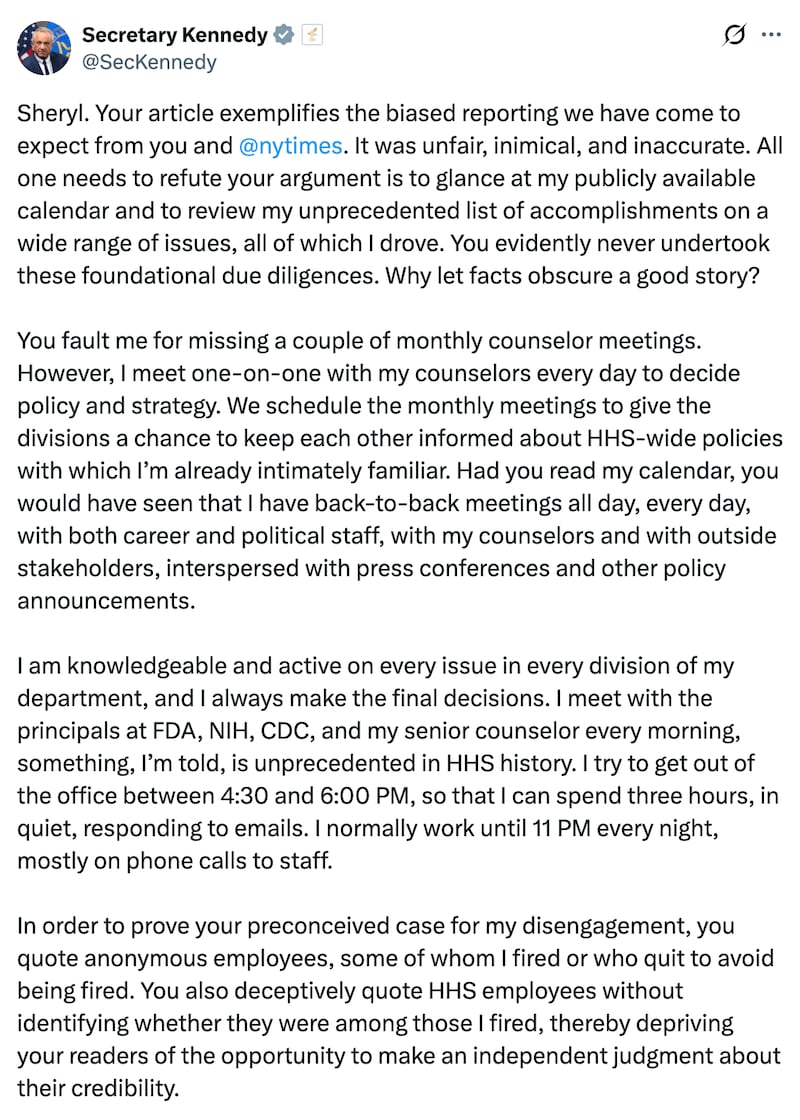
“I am knowledgeable and active on every issue in every division of my department, and I always make the final decisions. I meet with the principals at FDA, NIH, CDC, and my senior counselor every morning, something, I’m told, is unprecedented in HHS history,” Kennedy wrote.
“I try to get out of the office between 4:30 and 6:00 p.m., so that I can spend three hours, in quiet, responding to emails. I normally work until 11 p.m. every night, mostly on phone calls to staff. In order to prove your preconceived case for my disengagement, you quote anonymous employees, some of whom I fired or who quit to avoid being fired. You also deceptively quote HHS employees without identifying whether they were among those I fired, thereby depriving your readers of the opportunity to make an independent judgment about their credibility.”
In response, a NYT spokesperson told the Daily Beast: “The Times set out to examine Secretary Kennedy’s leadership and management style in light of numerous vacancies within the Department of Health and Human Services and concerns internally about his detachment from key issues and officials.
“The secretary declined an interview request and did not address detailed questions before publication about his approach to running the department. This article is based on conversations with a dozen people who have worked directly with Mr. Kennedy during his tenure as secretary. We are confident in our reporting.”

Kennedy also hit out at the Times for reporting the story by seeking out disgruntled staff members from among the department’s 70,000 employees in order to “cherry pick ‘facts’ to flesh out a preordained hit piece.”
“All that is required for this brand of journalism is the ethical elasticity that you seem to have in spades,” he added. “You had a preconceived thesis, and you set out to prove it.”
Elsewhere, the Times reported that Kennedy has done little to work with the Centers for Disease Control and Prevention (CDC) amid fears of an Ebola outbreak in the U.S., including offering no public comment on the disease.
Kennedy is also running his department with an almost skeletal leadership team, including not replacing Dr. Marty Makary, the former commissioner of the Food and Drug Administration (FDA), who resigned last month, or the acting chief of the National Institute of Allergy and Infectious Diseases.
“You would never accept a major corporation operating this way,” Michael T. Osterholm, director of the University of Minnesota’s Center for Infectious Disease Research and Policy, told the Times.
“If the CEO lacked deep expertise in the company’s business and the leaders of its most important divisions were missing, investors would revolt,” Osterholm added.
.