The 2012 Election’s Sleeping Giant: Fight for Control of the Senate
Just as important as the presidential race is who takes control on Capitol Hill. Patricia Murphy reports.
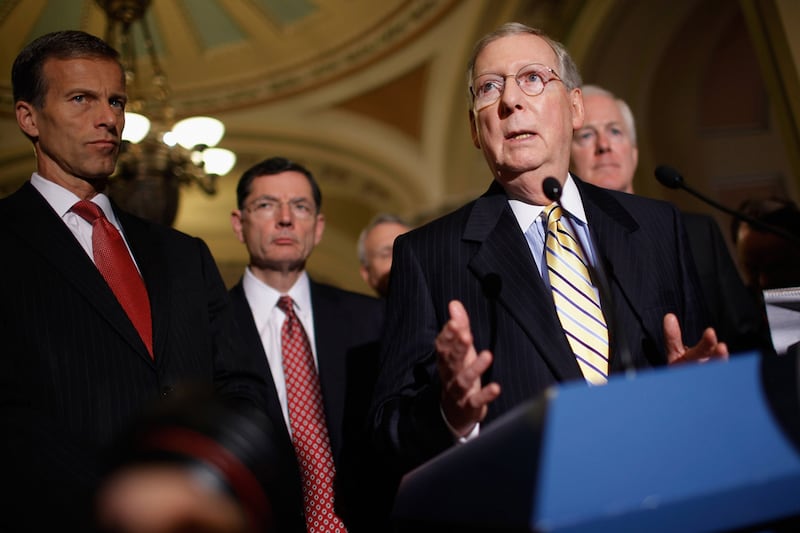
Chip Somodevilla / Getty Images
Get the Beast Digest newsletter delivered straight to your inbox
By clicking “SIGN UP” you agree to our Terms of Use and Privacy Policy.
The fight for the White House is an epic, expensive, and hugely consequential battle for power in Washington. But for Republicans and Democrats, the presidential race is just a part of what they say they need to do on Election Day to move their agendas forward. The other half of the equation: winning control of the U.S. Senate.
While many expect the Republicans to maintain control of the House, a Republican victory in the Senate would eliminate what the GOP points to as the single largest roadblock for their plans to repeal health-care reform, overhaul Medicare, and cut taxes for individuals and businesses at every level.
A GOP-controlled House and Senate would essentially stop a second Obama term in its tracks, while a Republican Congress would put a Romney presidency—with his tax-cutting, regulation-slashing, health-care-repealing to-do list—on a fast track.
The stakes are just as high for Democrats, who are seeking both to cement the gains they made under Obama and to continue to act as a check on the House GOP. Even if Romney were to win the White House over Obama, a Democratic Senate could still keep much of the Republican agenda from ever reaching his desk.
“A President Romney is not going to want to have to deal with Harry Reid as majority leader,” Sen. John Cornyn (R-Texas) told The Daily Beast. “That would be perhaps the beginning and the end of Romney’s legislative agenda. So I think it’s very important that we have a Republican majority in the Senate to work with a new Republican president.”
It’s Cornyn’s job as the head of the National Republican Senatorial Committee to deliver a GOP majority in the Senate in 2012. With 23 of the 33 seats up for grabs currently controlled by Democrats, Republicans went into 2012 with high hopes about their chances to pick up the four seats they need to flip control of the Senate.
But a series of recruiting successes for the Democrats and a handful of surprise retirements and upsets for Republican incumbents have evened the playing field for Democrats and made the future control of the chamber anyone’s guess.
Matt Canter, communications director for the Democratic Senatorial Campaign Committee, pointed to the Tea Party’s continued influence in state-level GOP politics as a boon to Democrats’ 2012 efforts, pointing to moderates like Sen. Richard Lugar in Indiana, who lost his primary to Richard Mourdock, a Tea Party–backed conservative whom Democrats say they’d much rather face in November than Lugar.
“Because of the Tea Party impact, more reasonable, common-sense Republicans are getting scared out of the party,” Canter said. “Democrats have a tougher map, and the spending is tougher for us when we’re getting outspent 4 to 1 by outside groups. But at the end of the day, we have better candidates who will make better senators.”
Jennifer Duffy of the Cook Political Report calls control of the Senate after Election Day “an even-money shot,” singling out Sen. Olympia Snowe’s retirement in Maine and the entry of conservative Democrat Heidi Heitkamp into the North Dakota race as the key events that have put seats up for grabs that should have been easily Republican.
While voters in Wisconsin and Arizona still have to pick their nominees in primaries this month, Duffy pointed to Senate races in Montana, Virginia, and Massachusetts as being crucial to deciding the balance of power in November. Those races are so close now that they make the final outcome of the Senate nearly impossible to predict.
“It’s a 50-50 proposition,” Duffy says. “Republicans will pick up seats, I just don’t know if it will be enough to win back the Senate.”
Although Duffy and other analysts are unusually reluctant to predict a winner, both Democrats and Republicans are so confident of winning the Senate that they have pushed major pieces of legislation like funding the federal government past December’s lame-duck session and into the new year, when both sides believe they’ll have one of their own as president and control the Senate, too.
“I don’t even countenance it—I think we’re going to pick up seats in the House, we’re going to win the White House and we’re going to win back the Senate,” said Rep. Tom Price (R-Ga.), chairman of the Republican Policy Committee, who listed cutting individual and corporate taxes, repealing health-care reform, and decreasing “regulatory oppression” as the first items Americans would see move in a GOP-dominated Washington.
Price, like many Republicans, said the last two years of near-total gridlock on Capitol Hill were not the result of a lack of bipartisan compromise but of a shortage of people who agree with House Republicans on the other side of the Capitol about the right direction for the country.
“Every one of us thought coming in on Jan. 1, 2011, that we would have a willing partner on the other side of the Capitol,” Price said. “And that hasn’t been the case. I look forward to working with a Senate that wants to do those kinds of things and a president who recognizes their necessity.”
See more of our coverage in your search results.

Got a tip? Send it to The Daily Beast here.
Unlock a year of full access to The Daily Beast for $35.
Monthly
$1
First month then $5.99/month
Annual
$35
First year then $59.99/year
Premium
$79
First year then $119.99/year
*Substack access provided by the next business day, using your subscription email. Choosing the Premium plan constitutes your permission to share your subscription email with Substack and your agreement to Substack’s Privacy Policy.
Looks like you already have a subscription!
- Account (completed)
- Payment (completed)
- Confirmation (completed)
You're all set!
Thanks for subscribing.
- 1Account
- 2Payment
- 3Confirmation
Sign in or create an account
Register below to read this article for free or subscribe
to unlock unlimited access to The Daily Beast.
Monthly
$1
First month then $5.99/month
Annual
$35
First year then $59.99/year
Premium
$79
First year then $119.99/year
*Substack access provided by the next business day, using your subscription email. Choosing the Premium plan constitutes your permission to share your subscription email with Substack and your agreement to Substack’s Privacy Policy.
Already have an account? Sign In
Looks like you already have a subscription!
- Account (completed)
- Payment (completed)
- Confirmation (completed)
You're all set!
Thanks for subscribing.
- 1Account
- 2Payment
- 3Confirmation