The Best Bollywood Films
Now that Slumdog Millionaire has won Best Picture, Hindi cinema stands poised to finally make the international crossover. Anu Chopra reveals the five essential classics any burgeoning Bollywood fan should see.

Everett Collection
Get the Beast Digest newsletter delivered straight to your inbox
By clicking “SIGN UP” you agree to our Terms of Use and Privacy Policy.
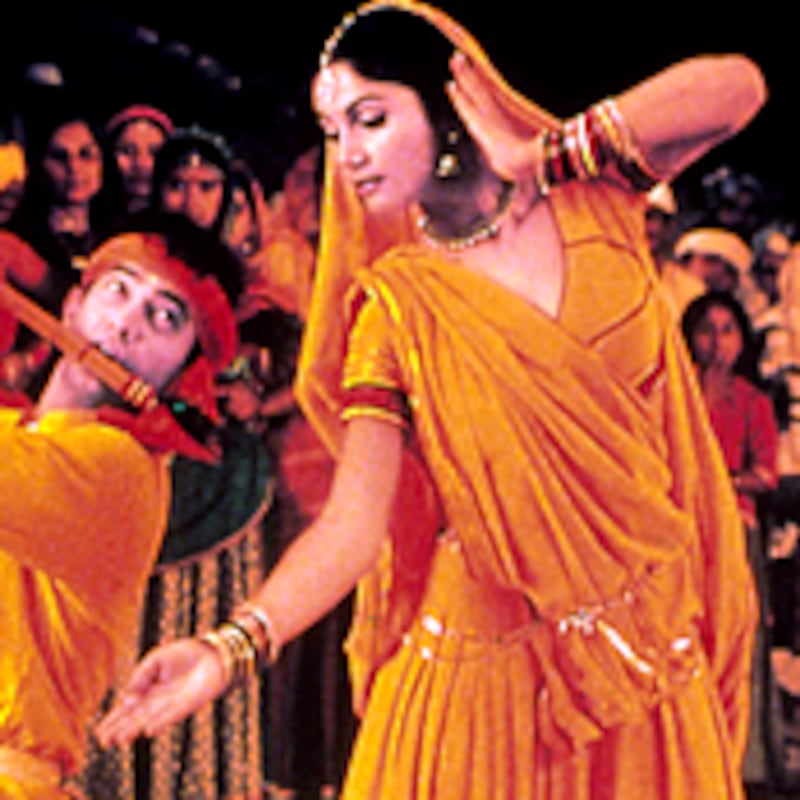
Bollywood—or the Hindi film industry centered in Mumbai—makes 200-odd movies a year for an estimated annual audience of 3.6 billion worldwide. And yet, with a wider audience than Hollywood blockbusters, Bollywood’s films have yet to make a big impact stateside. Now, with the coronation of Danny Boyle’s Bollywood-tinged Slumdog Millionaire as Best Picture, classic Hindi films may reach a whole new audience. Consider the following five films a crash course in Indian cinema.
Mother India (1957): The first Indian film to be nominated for an Oscar, Mother India is the story of a village woman who single-handedly raises her two sons. When the younger one, whom she loves more, becomes a dacoit (armed robber) and threatens the honor of the village, she is forced to kill him. Mother India gave Hindi cinema some of its most enduring themes: the mother as the iconic moral center, the rebel son, the importance of honor and sacrifice. The film is an epic drama with powerful performances, big emotion and soaring music.

Mughal-e Azam (The Great Mughal, 1960): It took director K. Asif 15 years and 15 million rupees (about $300,000) to create this spectacular historical about Anarkali, a dancing girl in the court of the great 16th-century Mughal Emperor Akbar. Historians have dismissed Anarkali as fiction, but the legend around her suggests a tempestuous affair with Prince Salim. The emperor opposes the affair and eventually Anarkali sacrifices herself to save the prince. Mughal-e Azam tells this story with spectacular visuals, thundering dialogue, divine music, and arguably Hindi cinema’s most erotic love scene. The prince and the dancing girl, played by two of India’s greatest stars Dilip Kumar and Madhubala (said to be lovers at the time), are shot in tight closeup as he slowly caresses her face with a feather.

Sholay (Flames, 1975): “There has never been a more defining film on the Indian screen,” director Shekhar Kapur said of Sholay, “Indian film history can be divided into Sholay BC and Sholay AD.” Labeled a "Curry Western," Sholay is the story of two small-time thieves who are hired by a landowner to capture the dreaded dacoit Gabbar Singh, who has massacred the landowner’s family. With its rugged landscapes, rousing action sequences and rough-hewn textures, the film echoes Sergio Leone and Akira Kurosawa. But these borrowed elements are skillfully blended with the required Hindi movie tropes: high emotion, supersize characters, and songs. Sholay ran consecutively for five years in one Mumbai theater. Even today, it is Bollywood’s gold standard.

Dilwale Dulhania Le Jayenge (The Braveheart Shall Take the Bride, 1995): DDLJ, as it is widely known, is the is the longest-running film in Indian cinema—14 years after release, it is still playing at a theater in Mumbai. DDLJ is the story of two second-generation Indians in London, who fall in love over a month-long trip on the Eurail. The hitch—the girl is already engaged to a boy in India. But her tenacious new suitor follows her home, stays in her village under a false identity and eventually, after many tears and some blood has been shed, convinces her family that he is worthy. DDLJ, a heady cocktail of European locations and rustic Indian traditions, upholds family authority and affirms that idea that Westernization need not affect an essential Indian identity. It captured the zeitgeist of an India booming after economic reform and became a monster hit.

Lagaan—Once Upon a Time in India (Land Tax, 2001): Lagaan, an exhilarating epic set in British India, was the third Indian film to earn an Oscar nomination. Lagaan pits a group of feisty villagers against their tyrannical British rulers. The villagers accept a wager to play a game of cricket against the British. If they lose, they will pay extra land tax, but if they win, they will be excused from the tax for three years. In a rousing climactic match, the self-taught cricket players take on their ruthless masters and win. With a running time of three hours and 42 minutes, Lagaan is a marathon to watch, but the propulsive narrative, peppered with A. R. Rahman’s thumping soundtrack, doesn’t sag. Lagaan is new Bollywood at its best.

See more of our coverage in your search results.

Got a tip? Send it to The Daily Beast here.
Unlock a year of full access to The Daily Beast for $35.
Monthly
$1
First month then $5.99/month
Annual
$35
First year then $59.99/year
Premium
$79
First year then $119.99/year
*Substack access provided by the next business day, using your subscription email. Choosing the Premium plan constitutes your permission to share your subscription email with Substack and your agreement to Substack’s Privacy Policy.
Looks like you already have a subscription!
- Account (completed)
- Payment (completed)
- Confirmation (completed)
You're all set!
Thanks for subscribing.
- 1Account
- 2Payment
- 3Confirmation
Sign in or create an account
Register below to read this article for free or subscribe
to unlock unlimited access to The Daily Beast.
Monthly
$1
First month then $5.99/month
Annual
$35
First year then $59.99/year
Premium
$79
First year then $119.99/year
*Substack access provided by the next business day, using your subscription email. Choosing the Premium plan constitutes your permission to share your subscription email with Substack and your agreement to Substack’s Privacy Policy.
Already have an account? Sign In
Looks like you already have a subscription!
- Account (completed)
- Payment (completed)
- Confirmation (completed)
You're all set!
Thanks for subscribing.
- 1Account
- 2Payment
- 3Confirmation