A top doctor has shot down the White House’s excuse for releasing an incomplete medical report that was missing crucial details about Donald Trump’s health.

The president’s personal physician wrote in a memo released late Friday that various diagnostic tests had revealed Trump—who turns 80 this month—was in “excellent health,” but it failed to provide the results of those tests, several doctors told The Wall Street Journal.
The memorandum also listed three medications, including aspirin, without specifying the dosage. The White House told the paper that it was normal to provide incomplete summaries of medication lists “abbreviated for readability and relevance.”
Dr. Jonathan Reiner, a cardiologist and professor of medicine at George Washington University, shot back in a post on X.com that the official explanation was simply “not true.”
“The medication list provided by the president’s doctor is assumed to be a complete list, not just the medications the White House wants the public to know about,” Reiner, who was former Vice President Dick Cheney’s cardiologist, wrote. “What medications were omitted?”
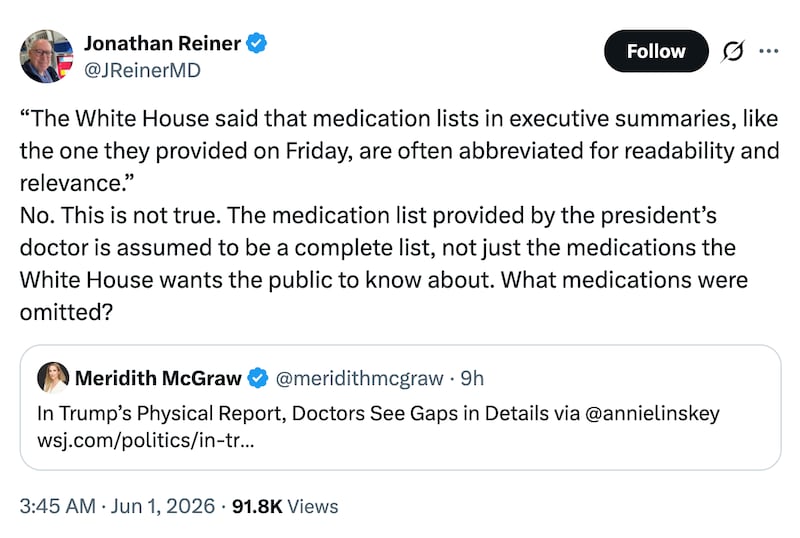
The White House’s full statement to the Journal said that, “The absence of discussion regarding a specific medication, dosage, or historical medical condition should not be interpreted as a lack of monitoring or treatment.”
In another logic-defying explanation, it said that the lack of specific test results should be seen as “confirmation” that no clinically meaningful abnormalities were identified.

Doctors interviewed by the Journal said the report was “almost too good to be true” for someone Trump’s age.
“This seems to be a filtered narrative,” vascular surgeon Dr. William Shutze told the publication.
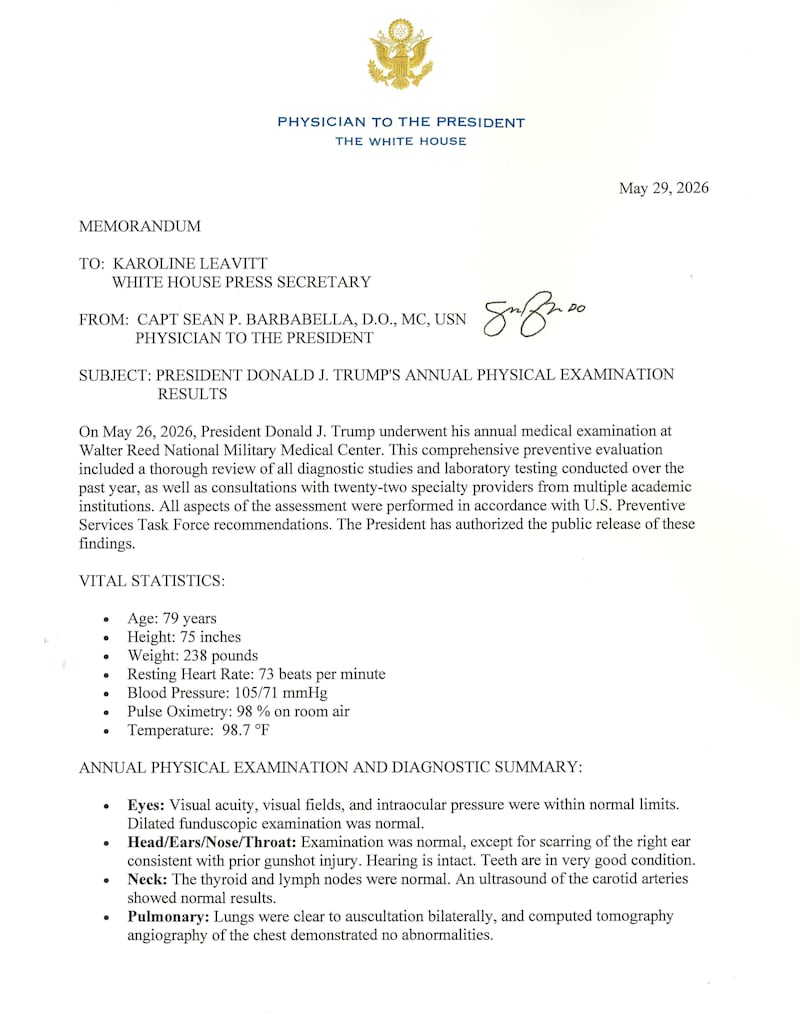
The memo said Trump had undergone a coronary CT angiography, which checks for narrowed or blocked arteries in the heart, as well as an ultrasound of the carotid arteries, an echocardiogram, and an AI-enhanced electrocardiogram analysis.
Trump’s physician, Capt. Sean Barbarella, wrote that tests had showed no “abnormalities,” and that cardiac chambers and valves were “normal,” without providing the specific metrics that led to those conclusions.
The memo didn’t specify how much plaque was revealed by the carotid ultrasound, even though most people have at least some build-up, or whether there was narrowing of the arteries, multiple doctors said.
In a statement to the Daily Beast, White House Communications Director Steven Cheung criticized Reiner and other doctors who have weighed in on Trump’s health.
“Outside doctors wildly speculating about an individual’s health, especially when they aren’t a patient, is reckless and goes against the oath they took,” he said. “Instead of getting quoted for articles for their own financial gain, they should focus on their own patients’ health.”
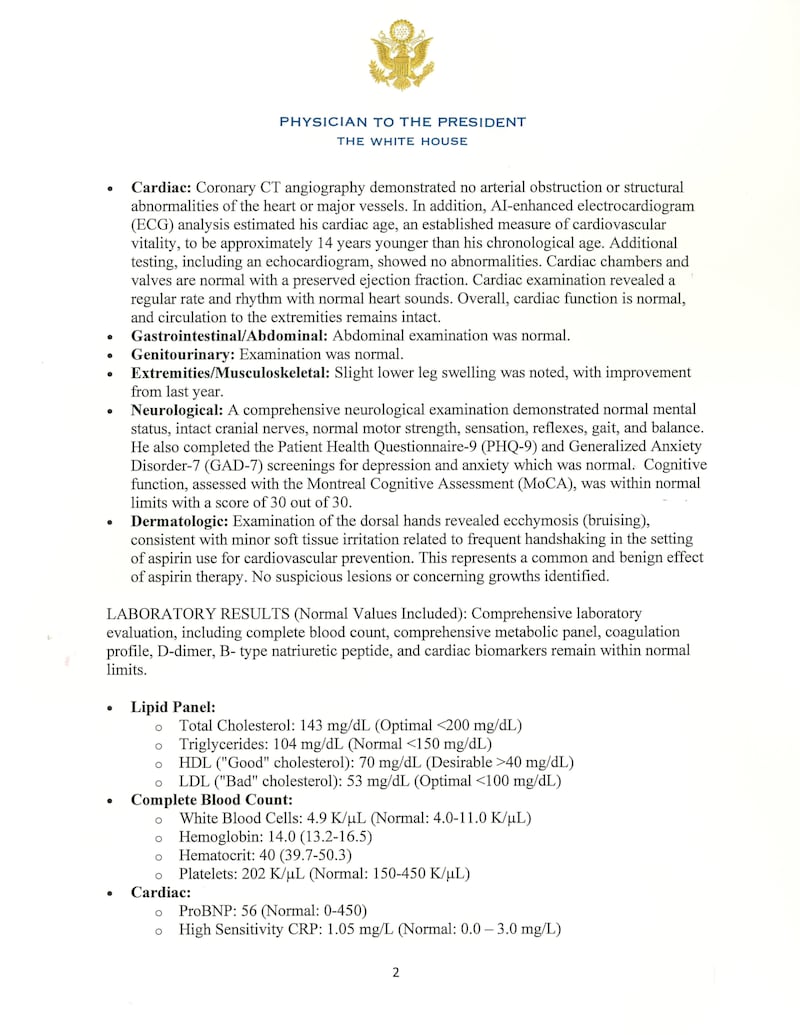
The memo claimed that the AI-enhanced electrocardiogram had estimated Trump’s cardiac age at 14 years younger than his chronological age, a finding that Reiner told CNN’s Laura Coates Live had made him and his cardiology colleagues laugh.
Trump’s cholesterol numbers also stood out as being suspiciously good for an elderly man who subsists on fast food and hates exercise.
His HDL, or “good cholesterol,” number was 70 mg/dL, while his LDL “bad cholesterol” number was 53 mg/dL.
Dr. Daniel Torrent, a Georgia vascular surgeon, told the Journal those were pretty much “the best cholesterol numbers you’ll see” and that medication alone doesn’t usual achieve such favorable results.
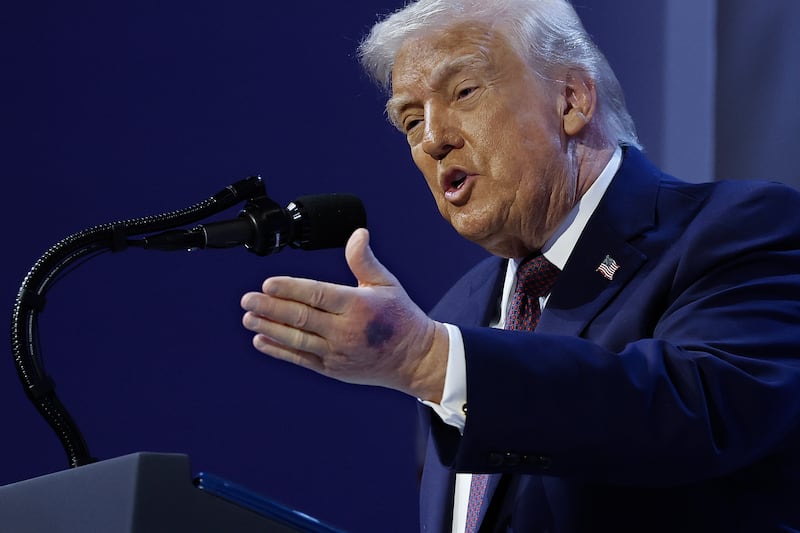
The president has been plagued by various health problems since returning to office, including bruised hands, ankle swelling, a neck rash, slurred speech, and the inability to stay awake during high-stakes summits.
He has nevertheless bragged about the results of his physicals, including repeatedly boasting about acing a “high difficulty, Cognitive Test,” four times in a row.

In fact, the MOCA test administered to the president is a dementia screening tool, not an IQ test, that only measures normal cognitive performance, not intelligence, and is designed to be easy for a normally functioning adult.