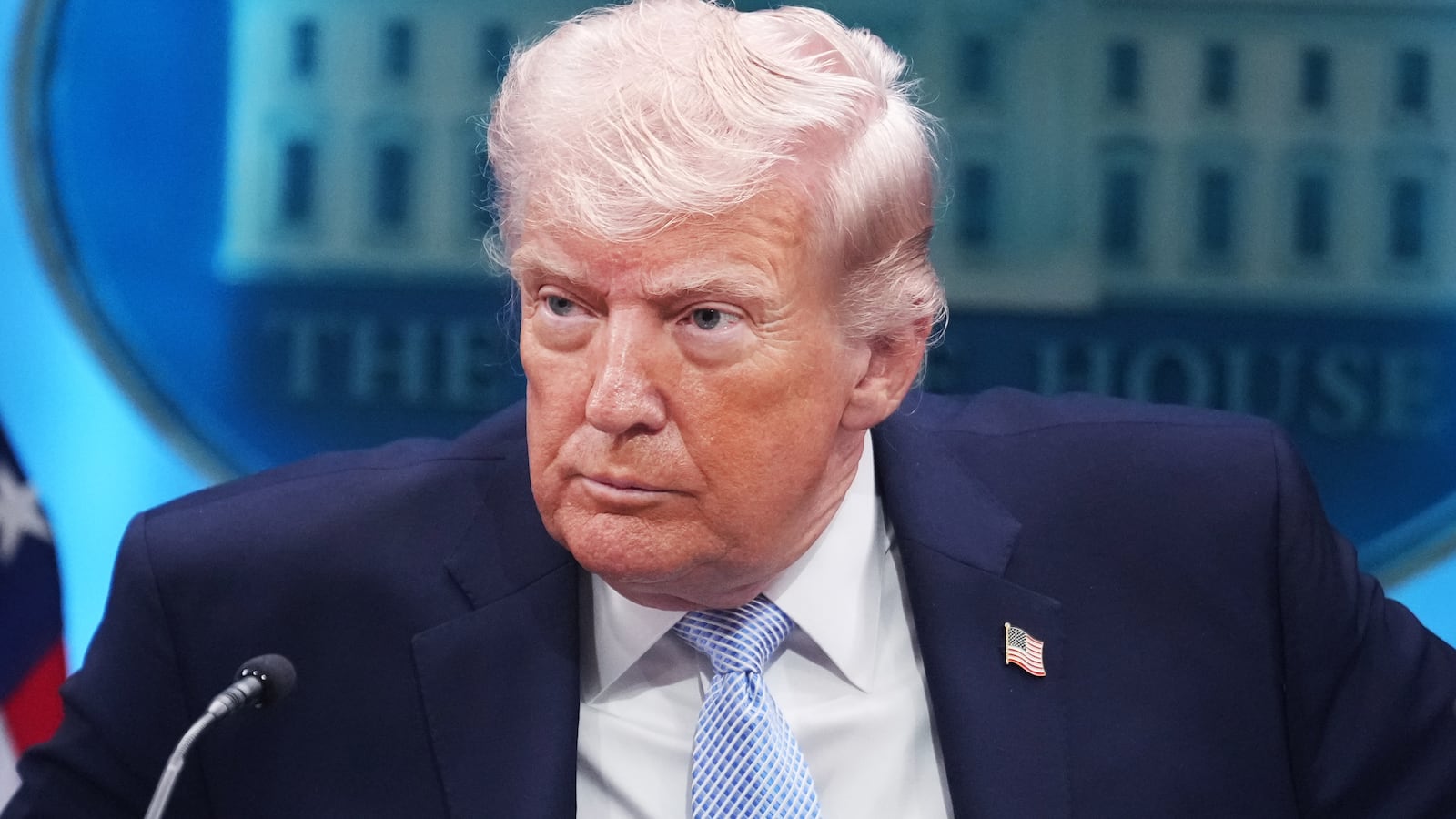
President Donald Trump has admitted that Iran controls the Strait of Hormuz, as Tehran announced that the vital waterway is now open for shipping.
In an all-caps Truth Social post on Friday morning, the president declared: “IRAN HAS JUST ANNOUNCED THAT THE STRAIT OF IRAN IS FULLY OPEN AND READY FOR FULL PASSAGE. THANK YOU!”

He was referring to the Strait of Hormuz.
Iranian Foreign Minister Abbas Araghchi had broken the news minutes earlier. However, he added an important caveat that Trump omitted: while the strategically important waterway was “declared completely open,” he said that is only true for the “remaining period of ceasefire.”
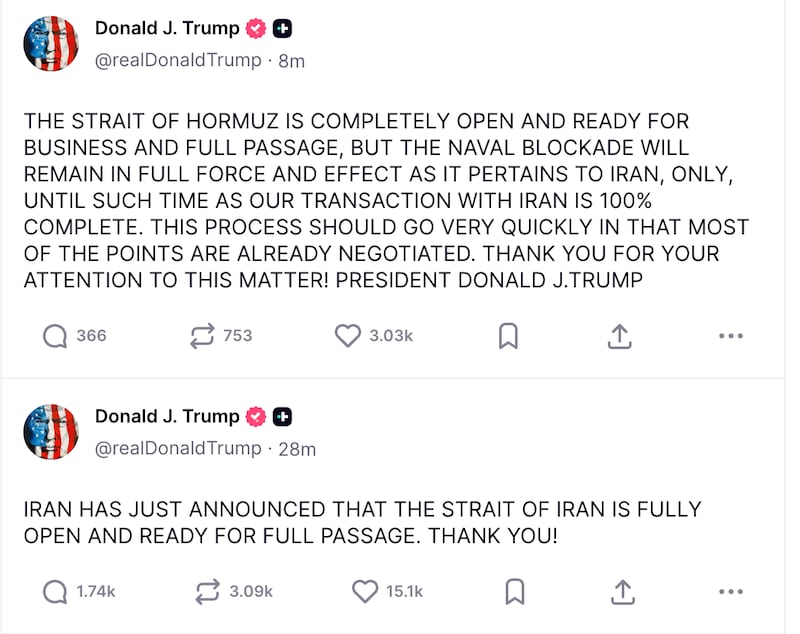
Trump followed up with his own caveat. Roughly 20 minutes after his first post, he offered an all-caps update about his naval blockade on the Strait. “THE STRAIT OF HORMUZ IS COMPLETELY OPEN AND READY FOR BUSINESS AND FULL PASSAGE, BUT THE NAVAL BLOCKADE WILL REMAIN IN FULL FORCE AND EFFECT AS IT PERTAINS TO IRAN, ONLY, UNTIL SUCH TIME AS OUR TRANSACTION WITH IRAN IS 100% COMPLETE,” he ranted.
Trump, 79, added: “THIS PROCESS SHOULD GO VERY QUICKLY IN THAT MOST OF THE POINTS ARE ALREADY NEGOTIATED.”
Oil prices moved sharply lower after the news. Brent crude fell below $90 a barrel after trading above $98 earlier in the day, while U.S. benchmark NYMEX light sweet crude also declined. Before the conflict, Brent crude was trading just under $70 a barrel. It rose above $100 in early March and peaked at more than $119 later that month.
“Iran has agreed to never close the Strait of Hormuz again. It will no longer be used as a weapon against the World!” Trump insisted in one of 10 posts about the conflict on Friday morning.
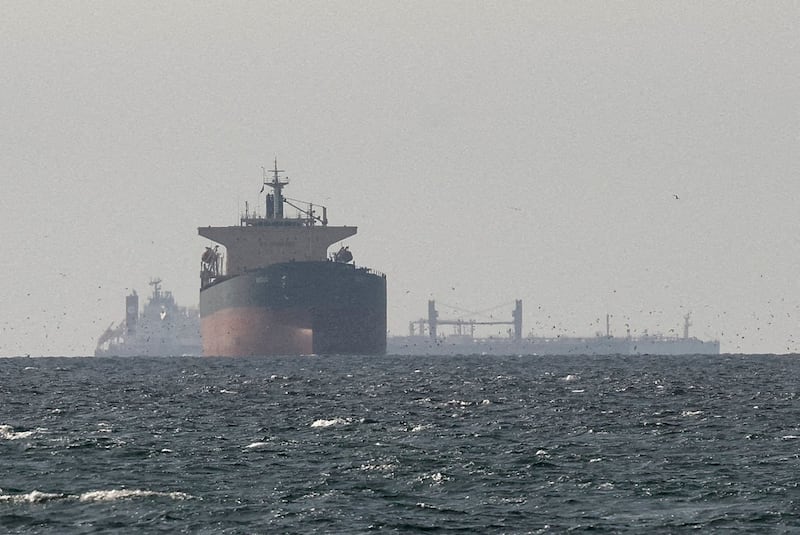
The Strait, which connects the Gulf and its produce to the rest of the world, was initially closed by Iran to gain leverage in peace talks. Its forces attacked ships attempting to pass through and also laid sea mines, leading to turmoil in the markets.
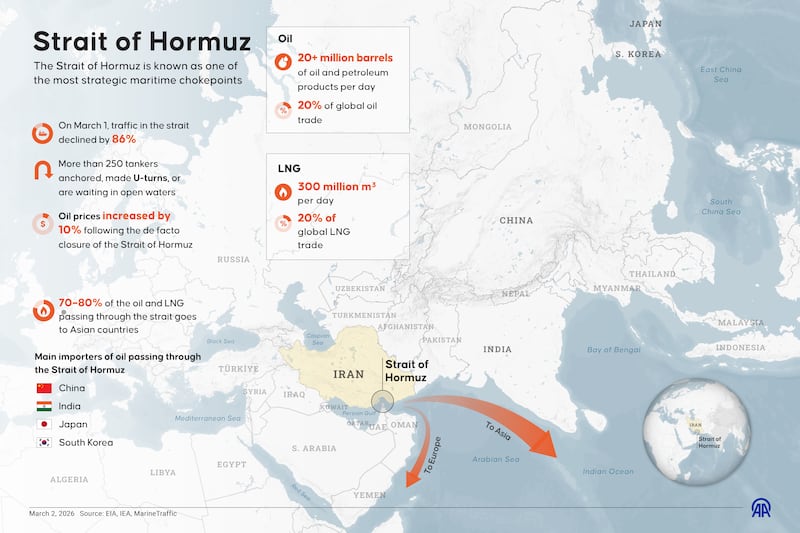
As part of its peace proposal, Tehran demanded control of the Strait—something it didn’t have before Trump launched “Operation Epic Fury” on February 28. Despite Iran exerting control over the channel, its shipping lanes are located primarily in Omani territorial waters, and only partially in Iranian territorial waters.
The lanes are governed by international maritime law and the United Nations Convention on the Law of the Sea (UNCLOS).
Earlier this week, Trump announced that the U.S. would blockade the waterway, using the Navy. Therefore, Trump saying Iran has declared its opening gives weight to the regime’s claims over the water and hands Tehran an important optics victory.
Indeed, in his statement, Araghchi suggested that Iran was in the driving seat. “In line with the ceasefire in Lebanon, the passage for all commercial vessels through [the] Strait of Hormuz is declared completely open for the remaining period of ceasefire, on the coordinated route as already announced by Ports and Maritime Organisation of the Islamic Rep. of Iran,” he said.
The two-week Iran-U.S. ceasefire is due to expire in five days, on April 22. There is also a ceasefire between Israel and Lebanon, which started on Thursday evening.
Israel has been conducting strikes in the country, targeting the Iran-backed Hezbollah militant group. The group has been responding in kind.
Earlier this week, Israeli and U.S. officials insisted that the U.S.-Iran ceasefire does not apply to Lebanon. However, Secretary of State Marco Rubio hosted direct talks between Israeli and Lebanese envoys in Washington, D.C. on Tuesday.
And, shortly before midnight on Wednesday, Trump announced that the leaders of Israel and Lebanon would hold talks for the first time in more than three decades.
Then, on Thursday, he announced that the nations agreed to a 10-day ceasefire. “Again! This deal is not tied, in any way, to Lebanon, but we will, MAKE LEBANON GREAT AGAIN!” he confirmed on Friday in another Truth Social post.
Trump told Fox Business’s Maria Bartiromo on Tuesday that if Iran is “smart, it will end soon.”