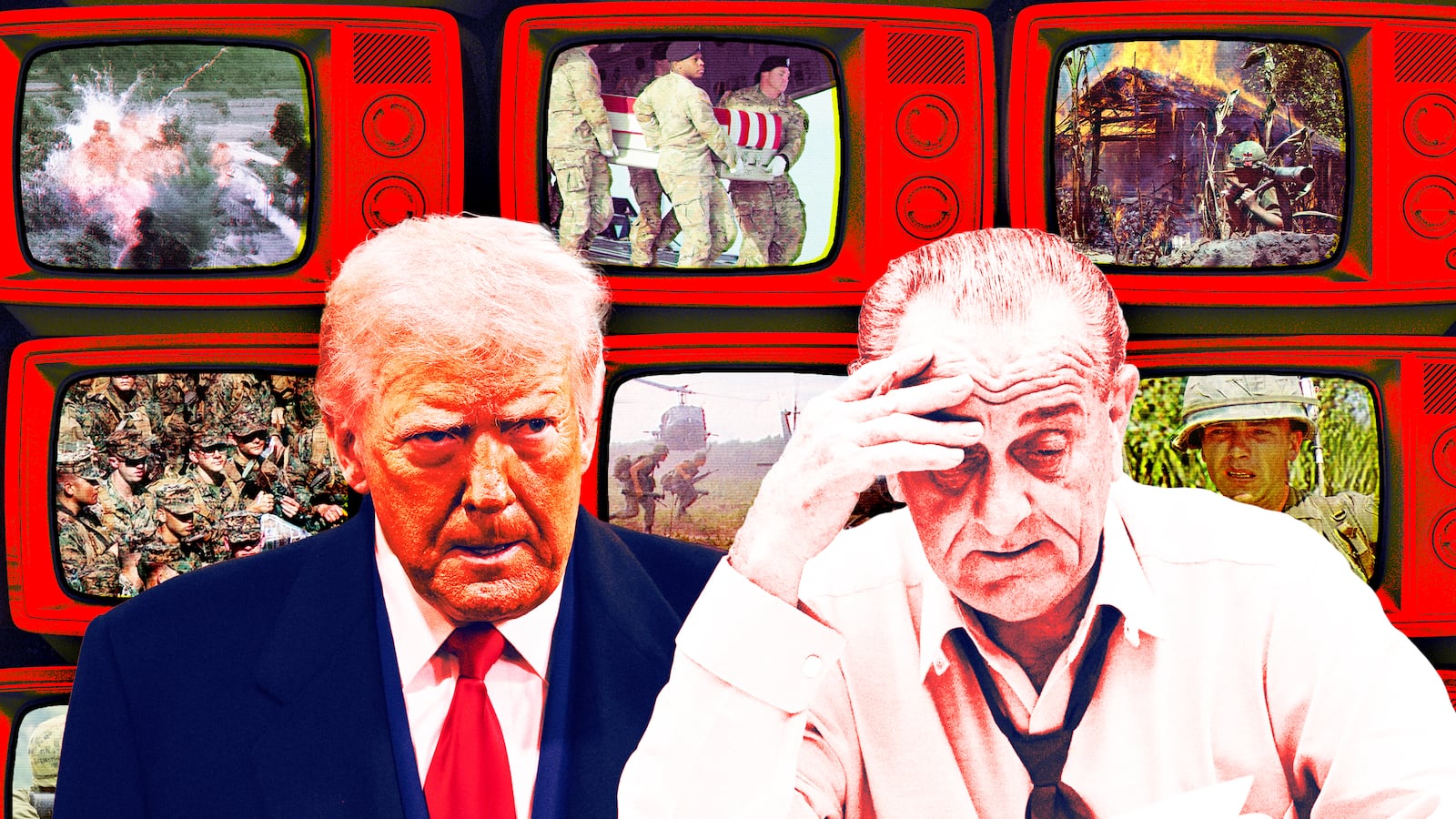
In the 1960s, President Lyndon Johnson had three large TV sets bolted into the walls of the Oval Office, one tuned to each network—there were only three in those days: ABC, CBS, and NBC. He feverishly monitored all of them, often simultaneously. It was the behavior of a man who understood, viscerally, that the story being told about the Vietnam War, which became his war, was as important as the war itself.
And he slowly, and painfully, lost control of both the war and the narrative. Some six decades later, President Trump is experiencing the same failure.

There is no room on the gold, gewgaw-covered walls of Donald Trump’s Oval Office for such a setup, but we know from his constant whining that he, too, is a creature of television, obsessively watching Fox, CNN, and MSNBC—maybe a peek at the increasingly "MAGA-coded" CBS News too—and then raging at all of them on Truth Social through the night.
We know he watches, because he can’t stop telling us how awful it all is.
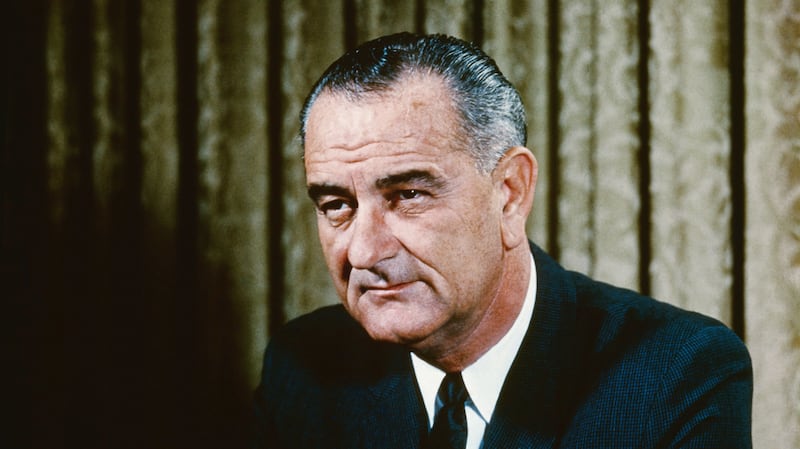
When Walter Cronkite returned from Vietnam in February 1968 and told his audience the war had become a stalemate, understood by most Americans as a disaster, Johnson turned off the set and said quietly, “If I’ve lost Cronkite, I’ve lost middle America.”
Two months later, he announced he would not seek reelection. It was the moment his presidency, despite landmark achievements on civil rights and anti-poverty programs, collapsed under the weight of a story (and, yes, a conflict) he could no longer control.
Now we are watching Trump take to Truth Social in 2026, declaring that news outlets covering the Iran war should be “brought up on charges for TREASON.” He has accused CNN and The New York Times of acting as distribution arms for Iranian propaganda, and of deliberately wanting the United States to lose.

Even more alarming, his FCC chairman has threatened to pull broadcast licenses over coverage the administration deems unfavorable, or, as he put it, a “hoax.” The paranoia is familiar–and dangerous.
To understand why both men went to war with the press, you have to understand who they were. In each case, their psychology consumed their policy. Johnson and Trump are, at their cores, the same archetype: larger-than-life men who need to dominate every room they enter and be loved by everyone they’ve just dominated. LBJ’s “Johnson Treatment” was legendary; rank physical intimidation, fingers in the chest, face inches from yours until you agreed, or at least pretended to. Trump’s version is public rather than private, played out on social media and at rallies, but the apparatus is identical: bluster, humiliation, relentless pressure until the other side folds.
Both men built careers on it. Both believed it could bend reality itself.
What neither could tolerate was the one thing a free press exists to provide—honest accounting. Johnson was recorded in the White House calling network executives “commies,” accusing reporters of being controlled by the Vietcong, and insisting that journalists like CBS’s Morley Safer, who filmed Marines burning Vietnamese villages, were enemies of the state.
For Johnson, Vietnam was not just a foreign policy failure. It was deeply personal—an attack on his legacy, his manhood, his place in the American story. He had inherited the war from John F. Kennedy, a glamorous president adored and mourned by the country; he deeply resented the Kennedys’ polish and the fawning media coverage they received.
But the more aggressively he attacked journalists, the more stubbornly they reported. The more he insisted America was winning, the more devastating the Tet Offensive felt to Americans watching the footage at home.
The credibility gap he accused the media of creating, he built himself, piece by piece, lie by lie, until the distance between the official story and reality became impossible to bluster past.
Sound familiar?

Trump is now following a similar path. The treason accusations, the license threats, the fantasies of enemy coordination, each is an attempt to bully reality into submission. None will hold.
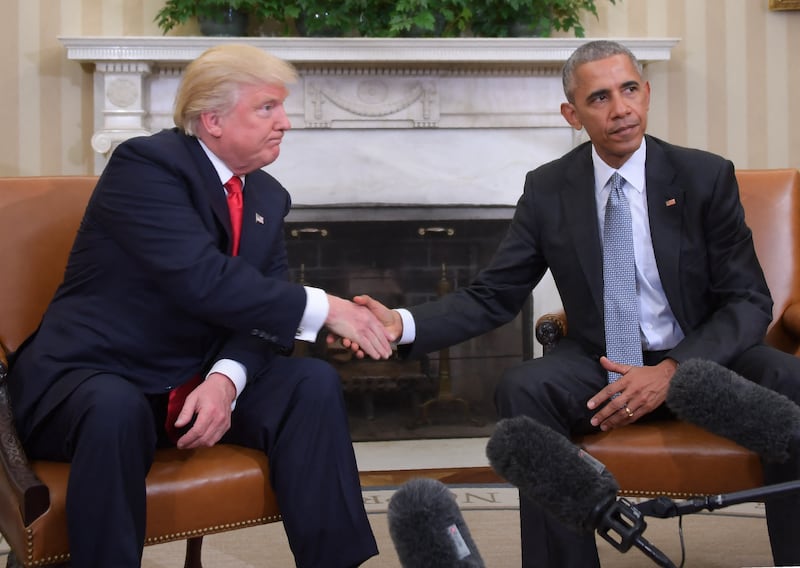
Trump’s showboating over the Iran war carries the same warped weight. He has spent his second term staking his identity on the projection of American dominance, the tough man who finished what weaker men started. And like Johnson, Trump has a glamorous foil in Barack Obama.
There is, however, one critical difference. Johnson had Cronkite to contend with, a single, unimpeachable voice, long considered “the most trusted man in America.” His credibility was too vast to dismiss.
Today’s media landscape has no such figure. It is fragmented with podcasts, cable panels, blowhards, and algorithmically sorted audiences. The shared national narrative that once existed has splintered.
If a network anchor turned decisively against the war today, it might barely register. The “MAGA-curious”Tony Dokoupil, CBS’s current news anchor, responded to a viewer on Instagram lamenting that the network had lost its “Tiffany shine” by saying that he promised to be “more accountable and more transparent than Cronkite.” He is no Cronkite, this much is clear. Consider his ratings, after all.
Instead, what Trump is likely to face is a slower and more insidious erosion. Accumulating footage. Coffins returning home. Disillusioned troops. And members of his administration jumping ship.
Johnson watched three screens as the war slipped from his grasp. Trump has more screens, more voices, and more noise, but it’s the same story: one he can’t control, and one that will end in infamy.