First, he announced a ballroom to upgrade the White House event space.
Then, he revealed the ballroom was really just a facade for the military facility he was quietly building below.
And now Donald Trump has admitted what some have long suspected: that the 80-year-old billionaire is also constructing a series of bomb shelters underneath the so-called “People’s House” to protect an elite few.
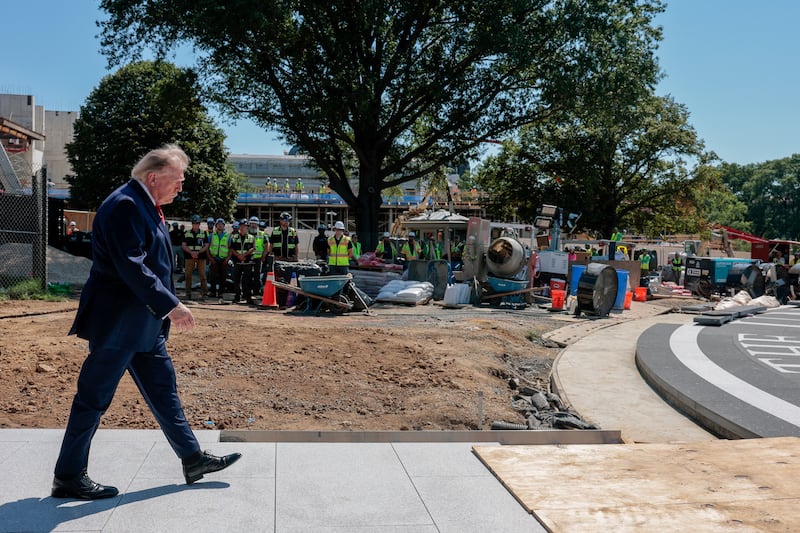
Days before the Supreme Court rules on whether the project can go ahead, the president took reporters on an impromptu tour of the White House grounds on Wednesday to show off progress on his latest vanity project: a new granite helipad on the South Lawn.
For more than 20 minutes, the president boasted about his renovation skills, talked up the beauty of the ballroom and waxed lyrical about the different types of stone he was using for the new helipad.
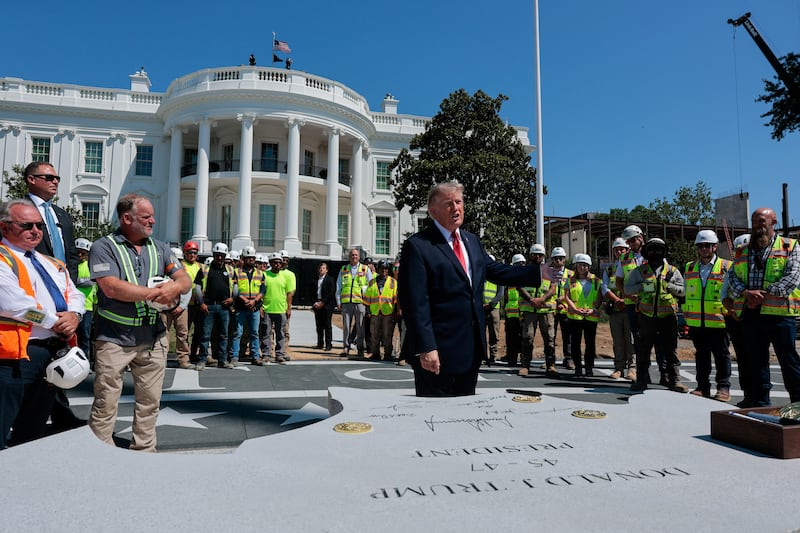
But as he led reporters across the construction site, the president also acknowledged that special guests of the White House would soon be able to enjoy cocktails on the South Lawn before using his brand-new event space—and potentially even its bomb shelters.
“They get out of the car and they walk down this path... and they can have cocktails and everything outside of the White House, and then they go into the ballroom. Even the military, they can use it like that,” Trump told reporters.
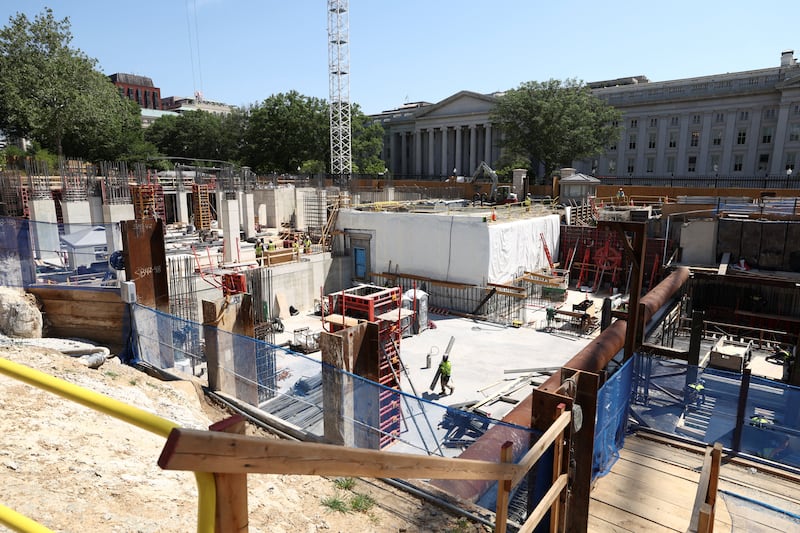
“The ballroom is so much a military component with the drones and the bomb shelters and everything else that we have in there.”
The tour is believed to be the first time Trump has touted the development of “bomb shelters” as part of his ever-expanding vanity project.
The ballroom began as a modest event-space renovation costing an estimated $200 million, but has since morphed into something much larger, with a price tag of about $400 million and counting.
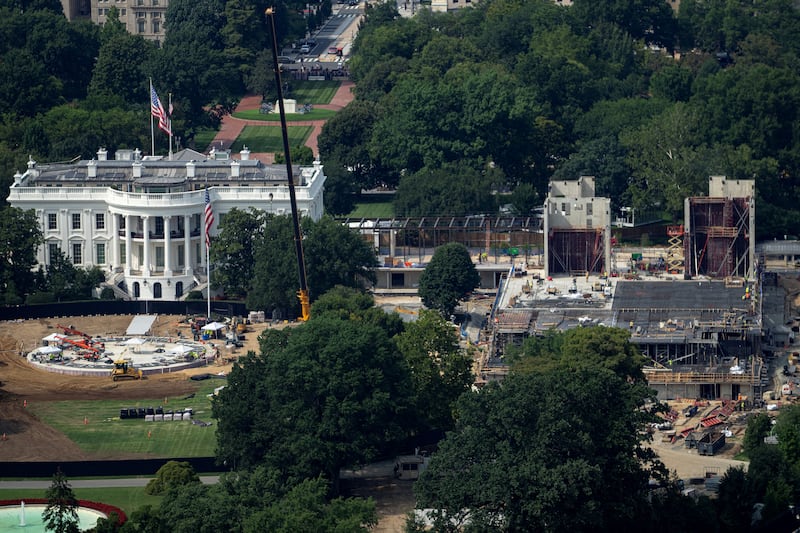
Trump admitted on Wednesday that he initially wanted to keep the military components and bomb shelters a secret, and had even warned the group suing him over the ballroom that it would result in the public learning too much.
But now that the details are out in the open, he insisted the project was necessary.
“Before we started work, the military came to see me, and they said, ‘Sir, we have an opportunity to do something incredible here, and we’ve been trying to do it for 100 years, but we’ve never had an opportunity like that.’ So I had to make that decision. I said, “Look, go ahead, design what you want,” he told reporters.

The project took a hit earlier this month after a federal judge blocked above-ground construction, declaring that Trump could not unilaterally demolish parts of the White House or reshape federal property without approval and funding from Congress.
The president’s lawyers lodged an emergency application on Friday asking the Supreme Court to allow him to complete the project, arguing that the ballroom was a national security necessity and that any delay risked his safety due to the various threats on his life.
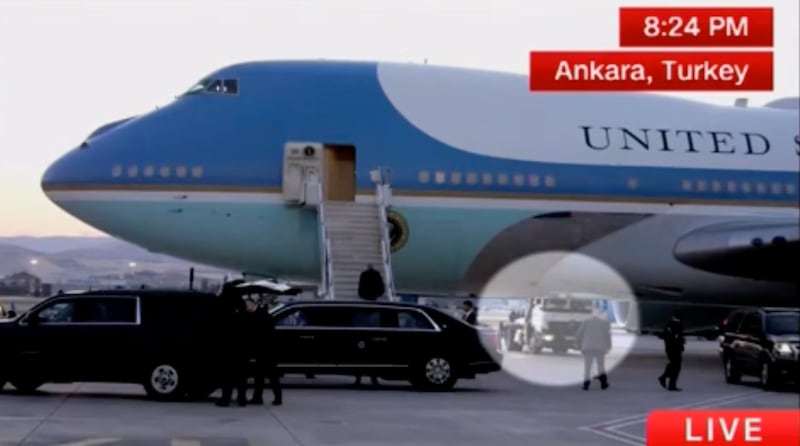
As part of the filing, the president used one of the most bizarre episodes of his term to make the case: the Iranian plot to target Air Force One with a missile, which involved Trump escaping in a catering truck to a safer plane with selected aides, while other senior administration officials were used as decoys.
The administration also argued that because it is using the same indestructible concrete used in nuclear power plants, it would be impossible to remove the ballroom even if ordered to do so.

“That line has long since been crossed,” said Solicitor General John Sauer.
The Supreme Court is due to rule on Friday. Asked if he believed the court would rule against him, Trump struck an optimistic tone, insisting the lawsuit by the National Trust for Historic Preservation, “should have never been brought.”
“I hope that doesn’t happen. I can’t imagine it happening… We’ve gotten tremendous architectural reviews. It’s beautiful,” he said.
But Trust chief executive Brent Leggs reiterated that the administration has “no unilateral legal authority—constitutional, statutory, or otherwise—to build a Ballroom on the site of the now-demolished East Wing, unless and until Congress expressly approves.”
“Each court that has reviewed this case has agreed with the National Trust. We hope the Supreme Court will uphold the rule of law by stopping this illegal project,” he said.