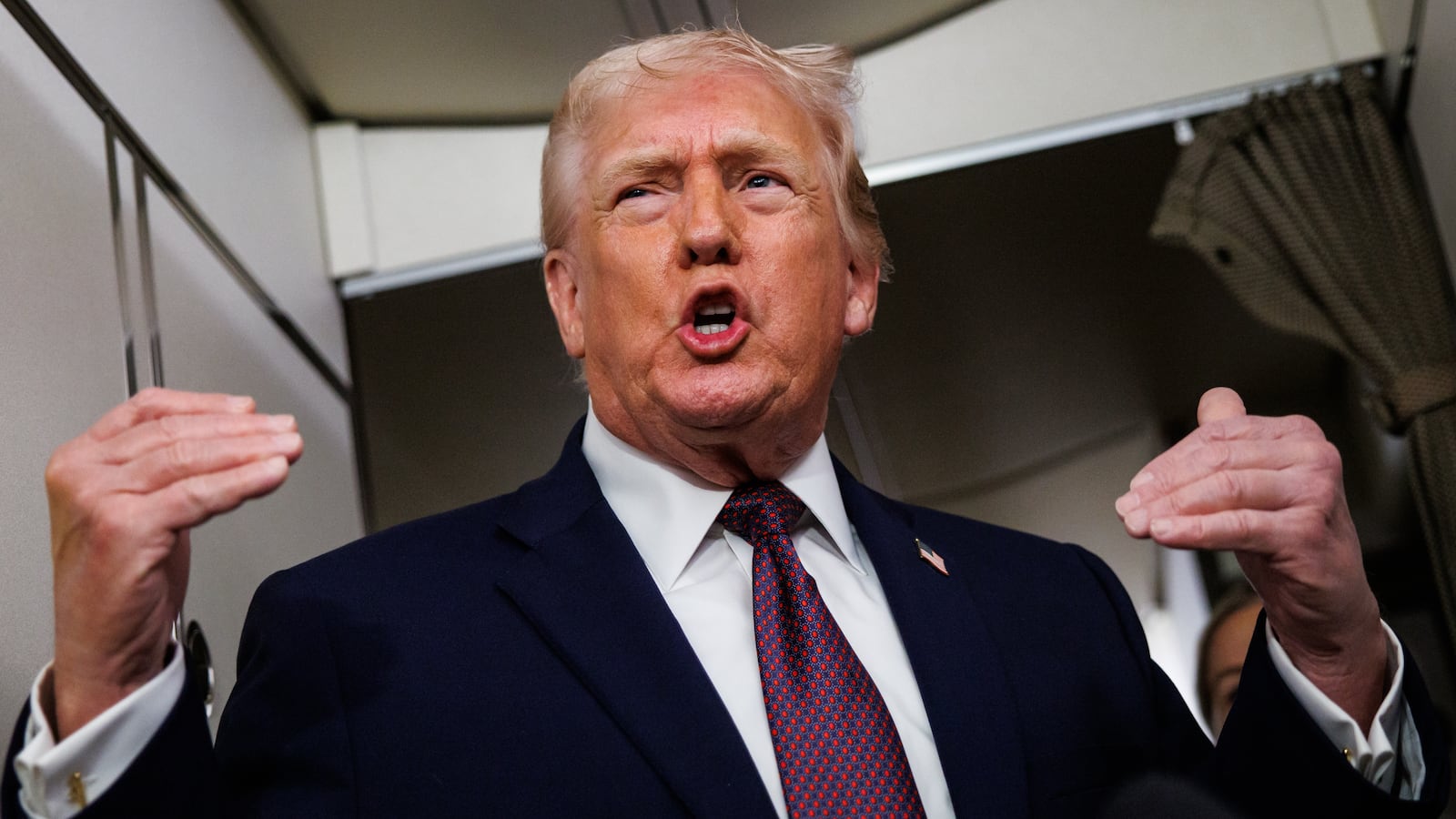
President Donald Trump claimed the U.S. would be “SCREWED” if the Supreme Court rules against his tariffs.
The White House has been bracing for the court ruling on the president’s signature economic policy to rake in billions of dollars.
The Supreme Court has indicated that its next date for releasing opinions will be Wednesday.
Trump took to social media on Monday to rant about the potential blowback if the court rules against him, and even suggested that repaying the tariff money wouldn’t be possible for years to come.
Trump wrote that the money the U.S. would have to pay back “would be many Hundreds of Billions of Dollars, and that doesn’t include the amount of ‘payback’ that Countries and Companies would require for the Investments they are making on building Plants, Factories, and Equipment, for the purpose of being able to avoid the payment of Tariffs.”
He claimed that when investments are added into the equation, it would amount to “Trillions of Dollars!”
“It would be a complete mess, and almost impossible for our Country to pay,” the president wrote. “Anybody who says that it can be quickly and easily done would be making a false, inaccurate, or totally misunderstood answer to this very large and complex question.”
The post appeared to contradict what Trump’s own Treasury Secretary Scott Bessent said in an interview with Reuters on Friday.

Bessent said the U.S. had more than enough funds to repay any tariff refunds should the court rule against the president’s tariffs.
“It won’t be a problem if we have to do it, but I can tell you that if it happens, which I don’t think it’s going to, it’s just a corporate boondoggle,” Bessent said.
Bessent said that while the U.S. has the funds, refunds would not go out in one day but could take as little as weeks or more than a year.
The U.S. Treasury had nearly $774 billion in cash on hand as of the close of business on Thursday. However, the president suggested it would take many years to refund tariff money.
“It may not be possible but, if it were, it would be Dollars that would be so large that it would take many years to figure out what number we are talking about and even, who, when, and where, to pay,” Trump wrote.
Last fall, the Supreme Court heard oral arguments, with even conservative justices casting serious doubt on the president’s argument for imposing widespread tariffs.
The nine justices must decide whether Trump’s use of emergency powers to impose them on imports from more than 100 countries around the world is legal.

The president declared an emergency when he announced he was imposing tariffs last spring. The administration argued tariffs were necessary to reduce the deficit and promote American manufacturing.
However, using a national emergency to impose tariffs was challenged by more than a dozen states and small businesses, which argued the president’s effort to impose the widespread tariffs bypassed Congress and its power over taxation.
Despite Trump’s post about having to pay back trillions due to investments, business commitments to the U.S. are not run through the U.S. Treasury but are private investments.