
The Department of Justice is investigating several trades curiously timed around major announcements from Donald Trump regarding his war with Iran.
At least four traders made a combined $2.6 billion in the oil market by wagering that oil prices would drop shortly before Trump made major moves, according to trade data from the London Stock Exchange Group shared with ABC News.
In one instance, traders bet more than half a billion dollars that oil prices would fall—just 15 minutes before the president, 79, announced he was holding off on threatened energy grid strikes against Iran on March 23.
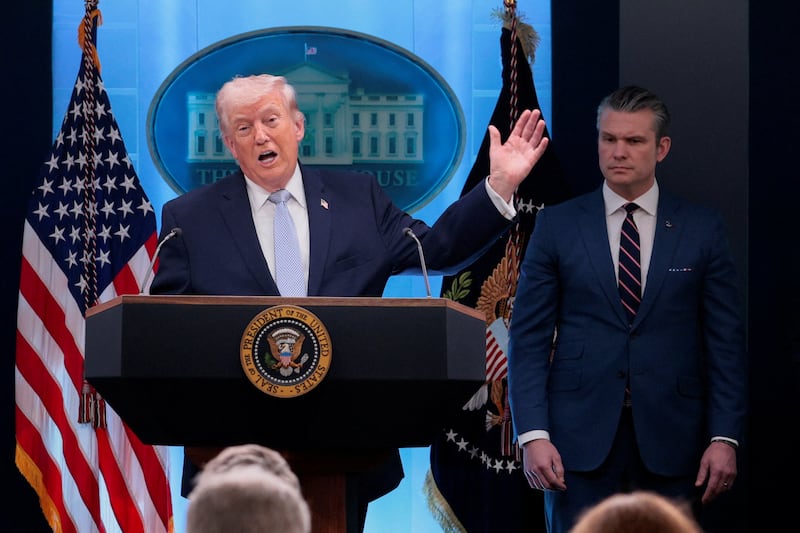
Two weeks later, on April 7, traders wagered a staggering $960 million that oil prices would fall—hours before the president announced a ceasefire. On April 21, fifteen minutes before Trump announced he would extend the temporary peace deal, traders bet $430 million that oil would fall.
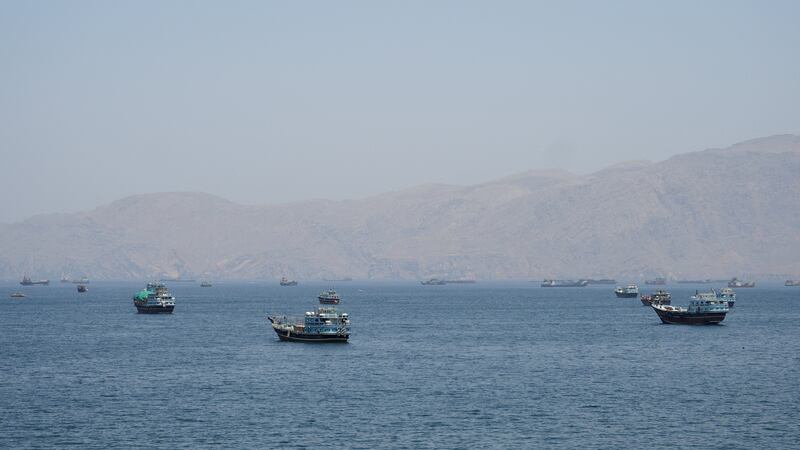
Trump isn’t the only one these suspicious bets are tied to. On April 16, traders bet $760 million that oil prices would fall. Twenty minutes later, Iran’s Foreign Minister Abbas Araghchi announced on social media that the Strait of Hormuz—the blockaded waterway through which a fifth of the world’s oil is transported—was open.
The Daily Beast has reached out to the Department of Justice for comment.
This isn’t the first time a string of mysteriously well-timed bets has coincided with the president’s decision-making. Last month, the White House sent staff a stern email reminding them that insider trading is a federal offense after a flurry of online bets cashed in on Iran strikes and the United States’ surprise abduction of Venezuela’s Nicolás Maduro.
“Recent press reports have raised concerns about government officials using nonpublic government information to place wagers on online prediction markets, such as Kalshi or Polymarket,” the email, which was sent on March 24 and was later obtained by CBS News, reads.
It goes on to say it is a “criminal offense for anyone to use nonpublic information to buy or sell these contracts,” adding that “government ethics regulations prohibit the use of nonpublic information for the private benefit of an employee or any other third party.”
“All White House employees are reminded that the misuse of nonpublic information by government employees for financial benefit is a very serious offense and will not be tolerated,” it concludes.
Prediction markets as a whole have profited from Trump’s signature flip-flopping, including the ones he has direct ties to. The president’s son, Don Jr., has a stake in Polymarket and serves as an advisor to Kalshi.
It remains unclear how much Trump Jr. has profited from Polymarket, a private company that does not disclose ownership stakes. But the value of the prediction market has surged nearly tenfold—to $9.6 billion—in the past eight months following an investment from a venture capital fund where Trump Jr. is a partner.