

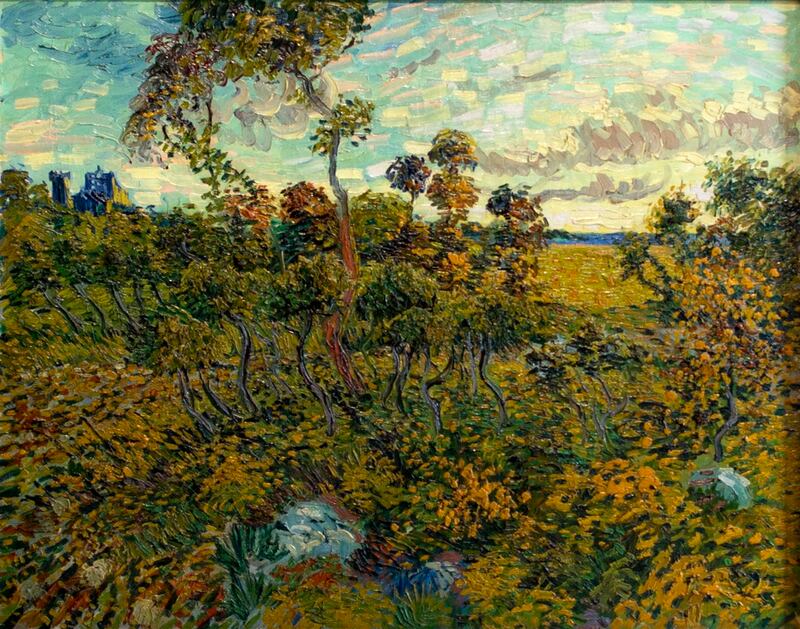
This “new” Van Gogh was announced this morning in The New York Times, with the title “Sunset at Montmajour.” (Click on the image to zoom in.) And as usual in these matters, the picture has in fact been in circulation for ages—all that’s “new” is that this time around, experts have decided that it is in fact an authentic van Gogh, as they denied when they were shown the same picture in 1991, and also back in 1908.
I buy the latest judgment (given the documentary evidence, it’s hard to see why the painting was seen as fake before), but it is always worth remembering that, as I’ve often said, the whole business of authentication is a mug’s game. For me, maybe the most interesting thing about the rediscovered piece is the letter of July 4, 1888, in which van Gogh describes the landscape he’d been inspired by the previous day: “It was romantic, it couldn’t be more so, à la Monticello, the sun was pouring its very yellow rays over the bushes and the ground, absolutely a shower of gold. And all the lines were beautiful; the whole scene had charming nobility.” It makes clear the huge influence on van Gogh of Adolphe Monticelli, a once-famous painter from Marseille whom Cézanne befriended and van Gogh idolized, and who has since almost disappeared from view. The letter—and the painting—also show that van Gogh had a conservative, traditional side, committed to old-fashioned ideas about Romantic beauty and the nobility of nature. With luck, the headlines generated by this pseudo-find will fight the popular idea of van Gogh as a lone radical who went out on a limb.
For a full visual survey of past Daily Pics visit blakegopnik.com/archive.