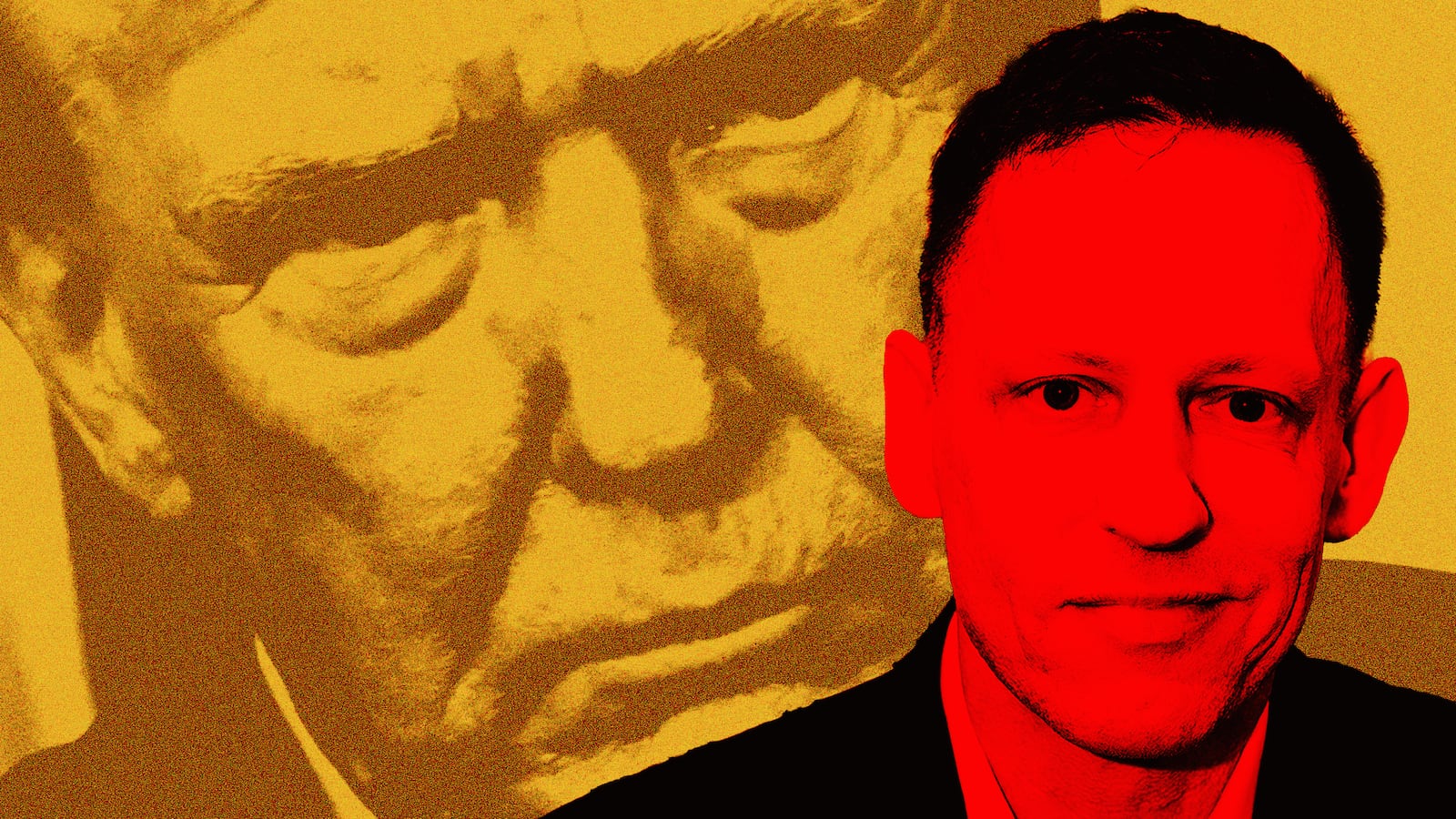
Peter Thiel may or may not be the antichrist. The jury is out, the evidence is circumstantial, the lecture series is ongoing and the man himself is too pale to read under direct lighting. What is not in dispute, however, is that Thiel dislikes the press, has always disliked the press, and now has a startup specifically engineered to make that personal.
The company is called Objection. It was founded by Aron D’Souza, a lawyer who worked alongside Thiel’s legal network during litigation against the firebrand tabloid Gawker—a campaign that used Thiel’s fortune to fund a sex tape lawsuit brought by the wrestler Hulk Hogan, culminating in a $140 million verdict that drove the news outlet into bankruptcy. It was sold as a principled stand for privacy; in reality, Thiel was settling a personal score. Gawker had outed him as gay years earlier. That case announced something important: if you had enough money and patience, you could bury a media organization. Objection is the industrialized version of that lesson, repackaged as a tech product.
The pitch is straightforward. For $2,000, anyone—the subject of a story, a competitor, a political opponent, a total stranger—can file a challenge against a published article. A team of Objection’s freelance investigators, which the company claims includes former FBI, NSA, and CIA personnel, then assembles an evidence file, while the reporter is invited to respond and submit their own documentation. The material is then handed to what Objection calls an AI tribunal: a jury of frontier language models from OpenAI, Anthropic, xAI, Mistral, and Google, supervised by a proprietary system branded a “Judicial-Purpose Transformer.” This body, if you can call it that, then issues a verdict on each ‘factual’ claim in the story.

Every ruling feeds into a public score called the “Honor Index,” a numerical rating attached to a journalist’s name, advertised by the company as a measure of their integrity, accuracy, and track record. In other words, the product is the punishment: an AI-laundered reputational mark that any future subject, PR firm, or political opponent can cite the next time that reporter’s byline appears on a story they’d rather bury. It sounds like accountability. What it actually creates is a punitive, deck-rigging system that operates outside the courts, outside press law, and outside any consensus standard of journalistic conduct. Anyone can trigger it. Nobody has to win anything. The score lingers either way.
The target isn’t bad journalism. Bad journalism has legal and regulatory remedies. Objection’s system, by design, rewards documentary evidence and penalizes everything else. A whistleblower becomes a liability. An anonymous source becomes a data gap. An investigation built on trust rather than files becomes, algorithmically, a less credible investigation.
None of this is accidental. Deterrence doesn’t require a verdict.

Now consider the environment this tool has been launched into. The Trump White House has treated press freedom the way it treats most inconveniences, as something a sufficiently aggressive spokesperson can make disappear. Karoline Leavitt, the White House press secretary, has elevated the daily briefing to something resembling performance art, if the performance were a 28-year-old telling seasoned journalists they are lying about things they witnessed personally. Federal agencies have defunded public broadcasters. Reporters have been excluded, restricted, and constantly reminded that legal pressure is always an option. The president has attacked even news outlets so reliably sympathetic to his agenda that their editors must find it genuinely confusing. The Wall Street Journal is a prime example. This is a paper that bent itself into genuinely impressive shapes to stay in his good graces, and got a $10 billion defamation suit for its trouble.
Still though, at this point the scrutiny of Trump’s administration runs from The Guardian to Tucker Carlson, a spectrum so wide it suggests the problem is not bias but existence. That fact is not lost on Thiel, who fits into this picture not as a bystander but as an architect.

His protégé, J.D. Vance, sits in the vice presidency — a position Thiel helped engineer through political donations, private counsel, and a sustained effort to make Vance the face of a movement that Thiel had long theorized but never personally embodied. Thiel backed Vance’s Senate run with $15 million. He introduced him to the donor networks that turned a middling Ohio campaign into a national platform. How a man who once compared Trump to Hitler ended up as his second-in-command is a question with several answers, most of them unsatisfying. The most honest one involves the translucent tech enthusiast with the checkbook.
And now the news has become unkind to Vance. Profiles describe him as powerless, peripheral, a man standing in the background of photographs while the people he was meant to impress make decisions without him. Vance has a title, a residence, and a schedule. What he lacks is anything resembling a job. The press has noticed. The coverage has been, to use the diplomatic phrasing, not great—and the less diplomatic phrasing, which has also circulated, is that the man Thiel spent millions grooming for the presidency is currently the most expensive potted plant in Washington. Republican polling is not, at this moment, a source of comfort for anyone with long-term ambitions, and the odds of Vance ascending to the presidency, whether through succession or election, grow slimmer in rough proportion to the administration’s approval ratings. A platform like Objection, arriving at precisely this moment, is worth reading in that context.
Thiel, to his credit, has always been more honest than his peers about his views on democracy. In a 2009 essay, he argued, rather unconvincingly, that freedom and democracy were incompatible.
He has funded a floating libertarian commune project. He has bankrolled a political generation. He appeared, briefly, as the model for a character in a television satire of Silicon Valley (aptly titled Silicon Valley), a sociopath obsessed with young blood transfusions, who viewed mortality as a competitor and other people as instruments. What the character caught, underneath the jokes, was something worth taking seriously: the portrait of a man who has spent decades methodically removing every check on concentrated power he could reach, and calling it philosophy.
That’s why anyone who values genuinely good reporting should object to Objection. Journalists don’t lose to this system by being wrong. Instead, they lose by being right about someone with money and the motivation to make the process expensive. The story that exposes a corporation loses not in a courtroom but in a war of attrition, where each round of review drains resources and signals to sources that association carries a cost.
This is the mechanism. It doesn’t require a billionaire’s fingerprints on every decision, only that the infrastructure exists, that reporters know it’s there, that sources know it’s there, and that knowledge changes how both of them behave.