After Waterloo

Saul Loeb, AFP / Getty Images
Get the Beast Digest newsletter delivered straight to your inbox
By clicking “SIGN UP” you agree to our Terms of Use and Privacy Policy.
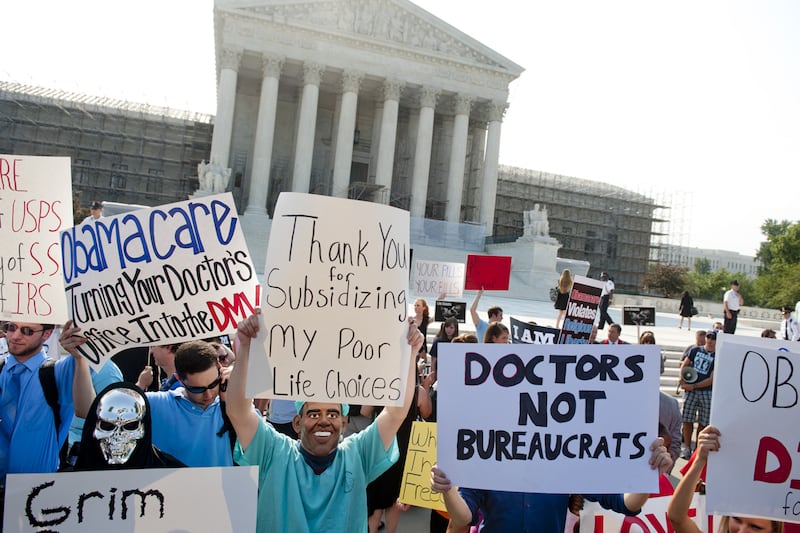
As I've argued below, conservative intransigence on healthcare in 2010 will look ever more reckless with the passing years. Republicans need to move rapidly to a more constructive approach. What would such an approach look like?
Obviously (super-obviously!) I speak only for myself, but here would be the main elements of my approach:
1) Universal coverage has been extended. It won't be retracted, and it shouldn't be retracted. Not only will universal coverage lift a wholly unnecessary misery from the lives of millions, improving the health and welfare of the whole population, but it will also be a spur to economic productivity. Ending the fear of loss of coverage will encourage people to launch new businesses and to change jobs.
2) We should want gradually to sever the connection between employment and coverage for the same reasons as Point 1.
3) We should want to merge the coverage system for under-65s and over-65s. Because over-65s are the largest healthcare consumers, the design of the post-65 program inevitably shapes healthcare for everybody. That design is perverse, freezing in place a fee-for-service model that inflates costs and multiplies procedures rather than maximizing health.
4) We should want to give states the decisive role in defining and shaping healthcare service within their boundaries. The defense of local design of services is an important role for conservatives.
5) We should want to control costs, and indeed to drive them down to levels prevailing in other advanced economies. If the US paid e.g. same 13% that Switzerland pays, rather than the present 17%, that would be the equivalent of getting the entire defense budget for free. Healthcare costs are the hidden drivers of so many US social ills. They explain why education costs run so high (because teachers get generous health benefits) and why wages have stagnated (because productivity gains increasingly are consumed by the cost of maintaining employee benefits).
6) It's important that healthcare be financed in ways that share costs broadly. Highly progressive financing of healthcare programs—as contained in the ACA—invites cost inflation. If the 1% are paying almost all the bill, why should the 99% care about cost control? Yet from the point of view of American growth and competitiveness, costs must not only be controlled, but actively driven down. Only when all feel the burden of cost will all agree on the importance of cost control.
I think that's a pretty conservative program, actually.
See more of our coverage in your search results.

Got a tip? Send it to The Daily Beast here.
Unlock a year of full access to The Daily Beast for $35.
Monthly
$1
First month then $5.99/month
Annual
$35
First year then $59.99/year
Premium
$79
First year then $119.99/year
*Substack access provided by the next business day, using your subscription email. Choosing the Premium plan constitutes your permission to share your subscription email with Substack and your agreement to Substack’s Privacy Policy.
Looks like you already have a subscription!
- Account (completed)
- Payment (completed)
- Confirmation (completed)
You're all set!
Thanks for subscribing.
- 1Account
- 2Payment
- 3Confirmation
Sign in or create an account
Register below to read this article for free or subscribe
to unlock unlimited access to The Daily Beast.
Monthly
$1
First month then $5.99/month
Annual
$35
First year then $59.99/year
Premium
$79
First year then $119.99/year
*Substack access provided by the next business day, using your subscription email. Choosing the Premium plan constitutes your permission to share your subscription email with Substack and your agreement to Substack’s Privacy Policy.
Already have an account? Sign In
Looks like you already have a subscription!
- Account (completed)
- Payment (completed)
- Confirmation (completed)
You're all set!
Thanks for subscribing.
- 1Account
- 2Payment
- 3Confirmation