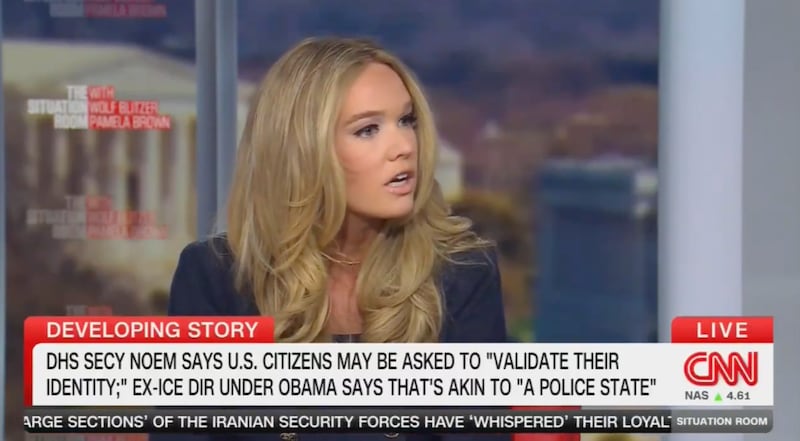
A DHS spokesperson unraveled on CNN when she was asked to explain the questionable claims the department has pushed about the killing of Renee Nicole Good—including smearing her as a “domestic terrorist.”
Tricia McLaughlin, Assistant Secretary of Public Affairs at the Department of Homeland Security, came unglued as she was asked for the truth about the Minnesota mom and the ICE agent who shot her to death, Jonathan Ross.
The department has maintained that Good, 37, was committing an act of “domestic terrorism” at the time she was killed.

Good’s attorneys, however, have stated that Good was simply driving home from dropping off her son at school when she was caught up in the scene.
“We said that this was domestic terrorism for a reason. This individual used a deadly weapon against our ICE law enforcement officer,” McLaughlin said on CNN’s The Situation Room with Wolf Blitzer and Pamela Brown.
Blitzer responded by saying that when DHS Secretary Kristi Noem “called this 37-year-old mother of three who was driving that car a ‘domestic terrorist.’ That really was outrageous.”
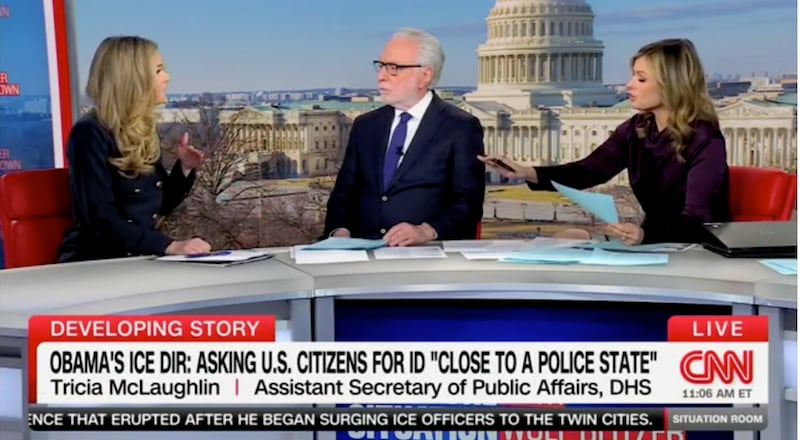
“[It] was an act of domestic terrorism. In no way is that outrageous. What we saw on the ground there, she had been stalking and harassing law enforcement throughout the morning, and then she went on to use her car as a deadly weapon,” McLaughlin claimed.
“She was driving by after dropping off her 6-year-old boy at school,” Blitzer said.
McLaughlin then asserted that that was “not true” and that she “had the facts on the ground.”
“At 9:30 a.m. Central Time, this is where that incident occurred, in Minneapolis. This individual, for hours before, had been stalking and harassing law enforcement, impeding operations,” McLaughlin said.
“Our law enforcement approached this individual’s vehicle as she was blocking in our law enforcement that is a federal crime,” she claimed, adding, “If you don’t listen to lawful commands of federal law enforcement, if you use your vehicle as a weapon, that is absolutely an act of domestic terrorism.”
Video footage and eyewitness accounts of the deadly altercation show a different story than the narrative the DHS is pushing.
ICE agents are seen swarming Good’s vehicle as she idled in the roadway. The federal agents yelled at her to get out of the car as she then slowly backed up, turned her wheel, and moved forward.
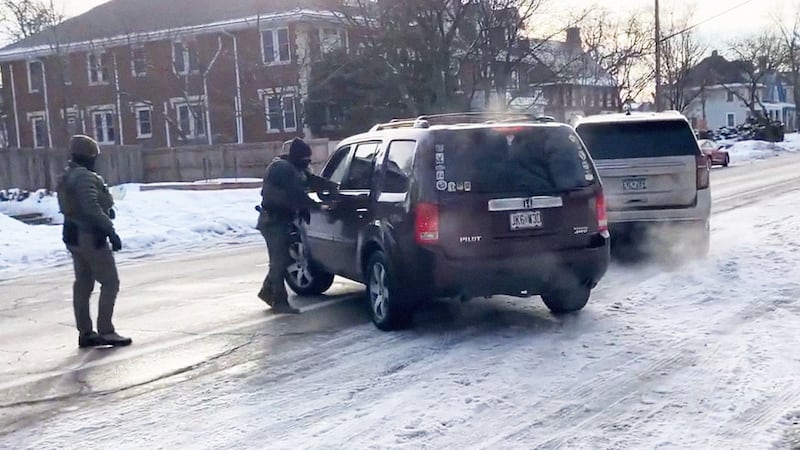
ICE agent Jonathan Ross then fatally shoots her three times, and the car crashes into a nearby parked vehicle.
One ICE agent can be heard calling her a “f---ing b---h” in the moments right after she was shot.

McLaughlin was also pressed about DHS’s claim that Ross suffered internal bleeding after killing Good.
“He’s on leave right now. He’s spending time with his family,” McLaughlin said of Good. “Obviously, this is a very difficult time for him and for his family. As we’ve confirmed before, he had internal bleeding and was sent to the hospital.”

“Can you, can you elaborate on that?” Brown asked. “Because doctors we’ve spoken to say, normally—and I’m not trying to minimize, I don’t know what the injury was—but they said normally, give internal bleeding, you would stay longer than a day. He was released the same day. Was this bruising? Or can you give us any better indication of what the injury was?”
“I haven’t spoken to this individual’s doctor; I just know he’s on leave. He was pretty banged up, internal bleeding, and we pray for him and his family,” McLaughlin said.
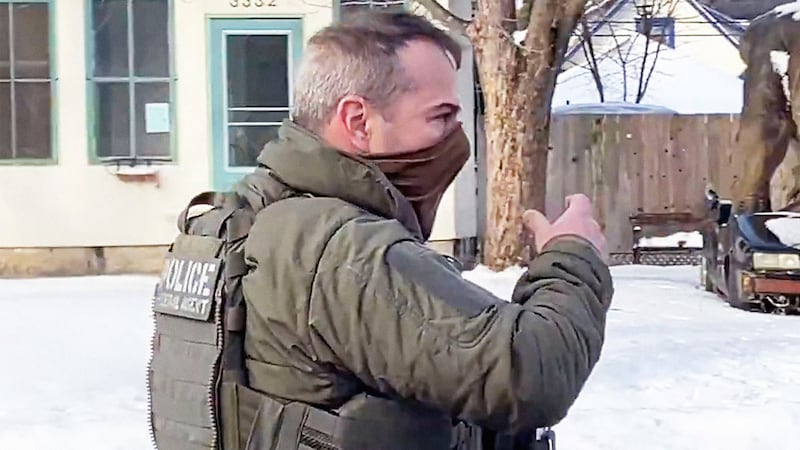
In video footage of the deadly altercation, Ross can be seen walking away from the scene after fatally shooting Good. It does not appear that Good’s car hit him before, or after, she was shot to death.

Since Good’s death and Wednesday’s shooting, protests against ICE in Minneapolis have spread across the city as ICE continues to ramp up its operations. Local and state officials have asked the agency to leave the city and state.