Donald Trump fired off a fresh war threat Monday morning just before the markets opened after pulling the same move last week.
After backing down on the same threat last Monday in a move widely seen as designed to calm market jitters, Trump has now once again threatened to obliterate Iran’s power plants, oil wells, and Kharg Island in his latest ultimatum.
The president, 79, issued the warning in an early Monday morning Truth Social post, his latest announcement that seems geared more towards the markets than anything else. His post also came as back-channel peace efforts—which Iran’s government has publicly denied are even happening—continued to sputter.
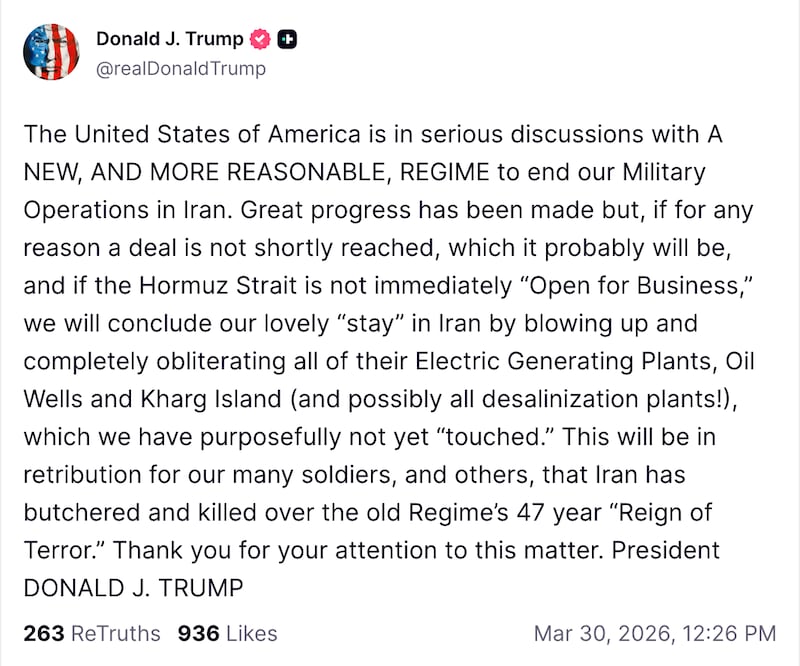
“The United States of America is in serious discussions with A NEW, AND MORE REASONABLE, REGIME to end our Military Operations in Iran,” Trump wrote. “Great progress has been made but, if for any reason a deal is not shortly reached...and if the Hormuz Strait is not immediately ‘Open for Business,’ we will conclude our lovely ‘stay’ in Iran by blowing up and completely obliterating all of their Electric Generating Plants, Oil Wells and Kharg Island (and possibly all desalinization plants!).”
He added that any such strikes would be “in retribution for our many soldiers, and others, that Iran has butchered and killed.”
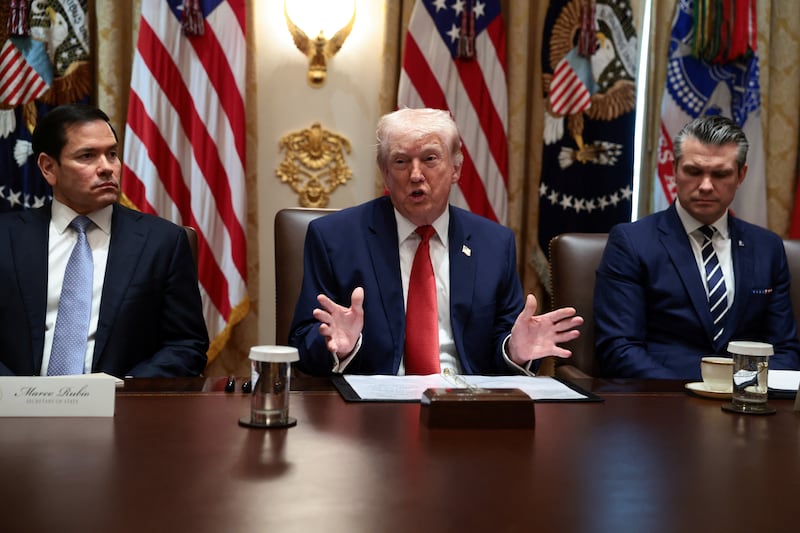
It is not the first time Trump has threatened to obliterate Iran’s infrastructure before quietly backing down. Trump issued an almost identical threat on March 23 before reversing course hours later, postponing the deadline and claiming “very good and productive conversations” with Tehran—despite Iran’s foreign ministry flatly denying any talks had taken place.
The president has long seemed to time his announcements to coincide with the financial markets, dropping his global tariffs last year just after markets closed and reassuring just before markets opened in January that the U.S. would not seek to take Greenland by force, a worry that had sent stocks plunging.
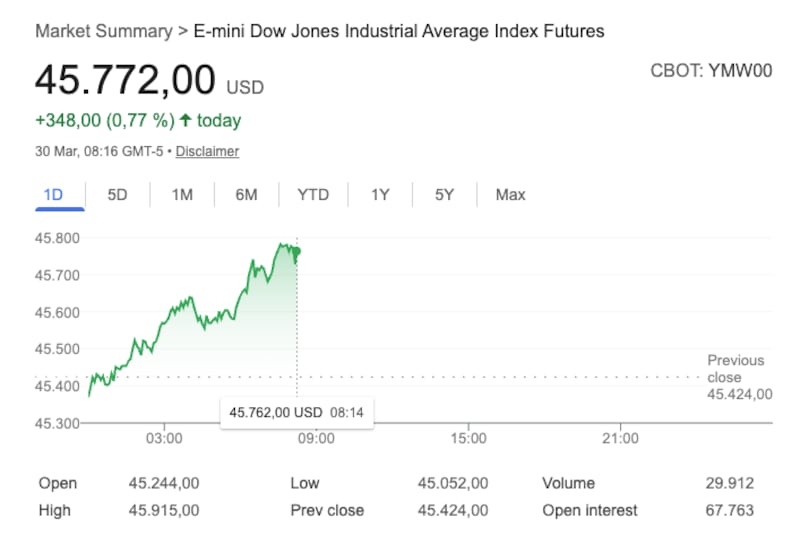
Trump’s latest Iran announcements have followed the same pattern. He backtracked on his threat last week after dire warnings about the devastating economic impact his escalation would have.
The president has been similarly erratic in his comments about the Strait of Hormuz, downplaying the urgency of needing to open it back up during a Cabinet meeting last week where he claimed it doesn’t “affect” the U.S. while also demanding its reopening. The 21-mile-wide chokepoint between Iran and Oman is the world’s single most critical energy corridor, carrying roughly 20 percent of global oil supply—around 20 million barrels per day—through its waters.
A campaign of drone strikes in and around the waterway was enough to cause insurers to pull coverage, making transit economically unviable for most commercial operators.
The standoff has sent the price of oil skyrocketing.
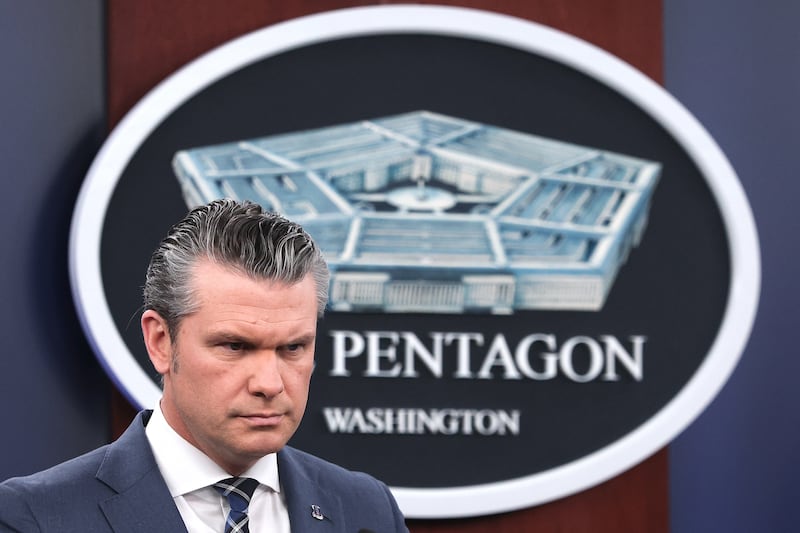
Monday’s post came as the Pentagon and White House drew up plans for a potential ground escalation that has alarmed even Trump’s most loyal supporters. Around 3,500 U.S. troops are already in the region aboard the USS Tripoli, with thousands more on the way—and the Pentagon has been preparing plans for raids by special forces and conventional infantry that would expose American service members to Iranian drones, missiles, and improvised explosives.
The war, which began on Feb. 28 when the U.S. and Israel launched coordinated strikes on Iran, has now cost at least 13 American lives and triggered a global energy crisis. The average national fuel price in the U.S. has climbed to $3.94 a gallon, and the Pentagon has asked Congress for an additional $200 billion to fund the conflict—a price tag Trump has dismissed as “a small price to pay.”
The prospect of ground operations has triggered a full-blown civil war inside MAGA. Former Georgia congresswoman Marjorie Taylor Greene, 51—who resigned from Congress in January amid a feud with Trump over the Epstein files—branded Fox News “fake news” and accused the network of “brainwashing boomers to support what we voted against.”
The war is also deeply unpopular with the U.S. public. A Reuters/Ipsos poll conducted March 17-19 found 59 percent of Americans disapprove of the conflict. Some 62 percent of Americans oppose sending in ground troops.
The Daily Beast has contacted the White House and the Pentagon for comment.