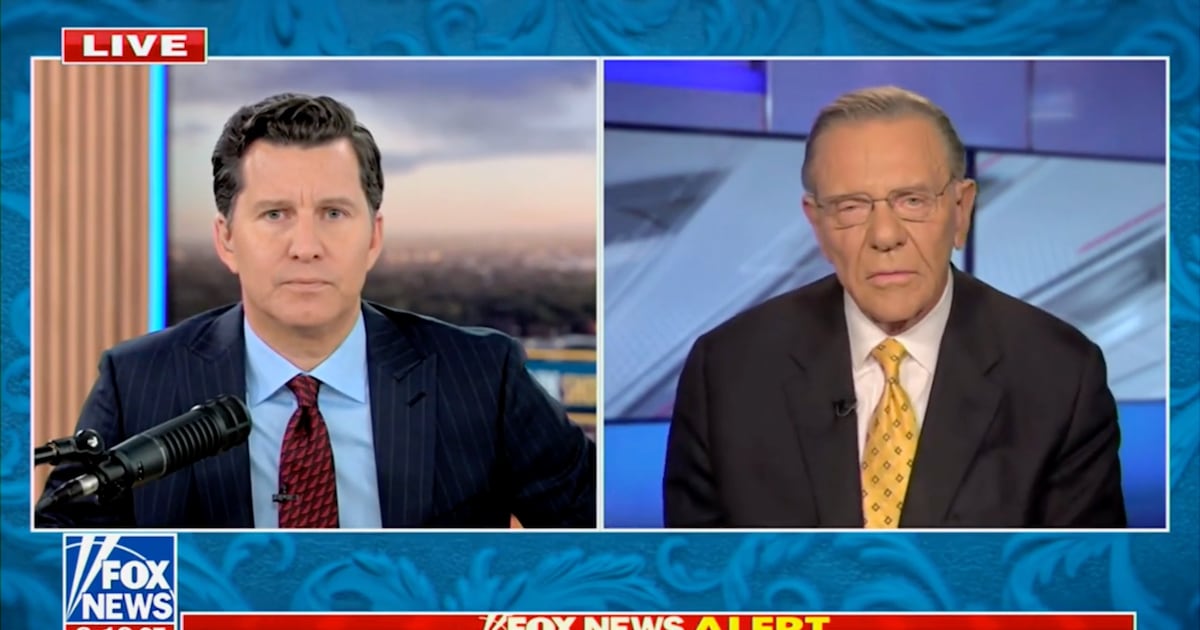
Kristi Noem’s rule requiring her personal sign-off on any Department of Homeland Security expenditure over $100,000 has delayed or left pending more than 1,000 FEMA payments to help disaster victims, a damning new Senate report has found.
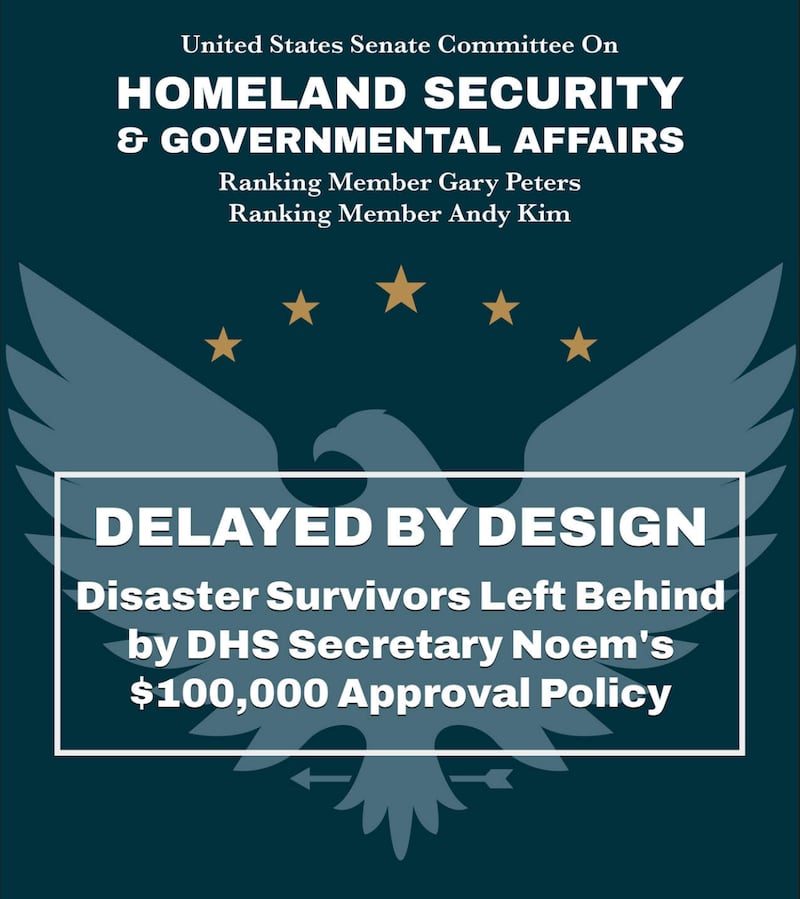
The concerning paper from the Democrats on the Senate Homeland Security and Governmental Affairs Committee, based on data from an internal DHS tracker provided to lawmakers by whistleblowers and released Wednesday, calls on the homeland security secretary to immediately scrap the directive she first issued last June.
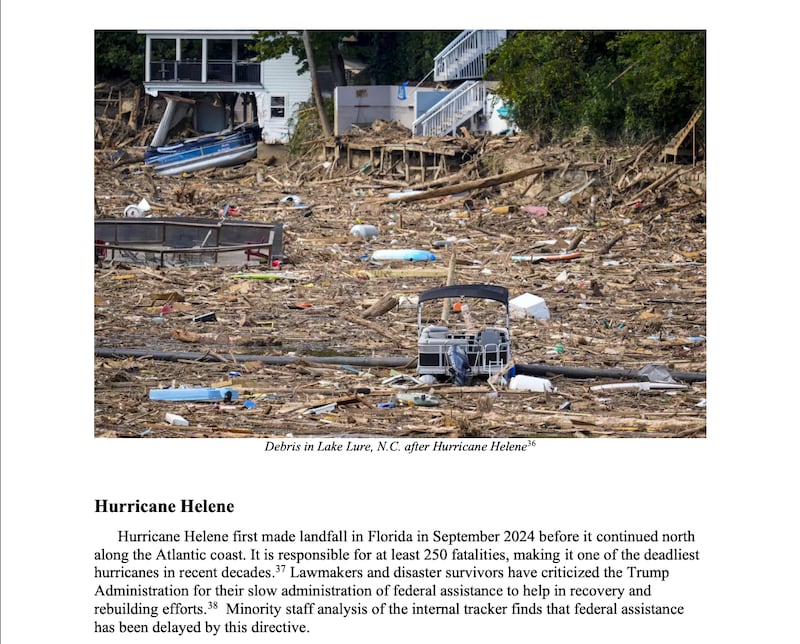
The report identified at least 1,034 affected spending items, including aid for survivors of last summer’s deadly Texas floods and Hurricane Helene, which hit the Southeast in late 2024.
“When disaster strikes, communities need critical assistance from FEMA as quickly as possible,” Sen. Gary Peters, who led the report alongside Sen. Andy Kim, was quoted as saying by The Washington Post.
“These delays created by Secretary Noem’s directive are not only failing to make government more efficient, they are causing serious harm. The policy must end immediately.”

The report comes after Sen. Thom Tillis, a North Carolina Republican not seeking re-election, told Noem at a Senate Judiciary Committee hearing Tuesday that he believed she was violating federal law by bottlenecking recovery funds to his state.

Tillis had previously torched Noem’s management of DHS in stark terms, calling her approach “amateurish” and describing her thinking as that of an “assistant manager.”
Among the specific programs the senators say were affected were rental housing for Hurricane Helene survivors; search-and-rescue operations in North Carolina; housing inspections for storm-damaged homes; and disaster unemployment assistance for communities in Oklahoma, Kentucky, and Texas.
The report also asserts that FEMA staff appear to have structured spending requests to come in under the $100,000 threshold to sidestep Noem’s review—a finding that echoes a separate analysis by the Project on Government Oversight, which found that the number of DHS contracts priced at exactly $99,999 jumped sharply after the June 11 directive took effect.
The Beast has been reporting on the damage caused by Noem’s approval rule since it first emerged last July, when four FEMA officials told CNN the policy had stalled the agency’s response to the Texas Hill Country floods, which killed around 135 people.
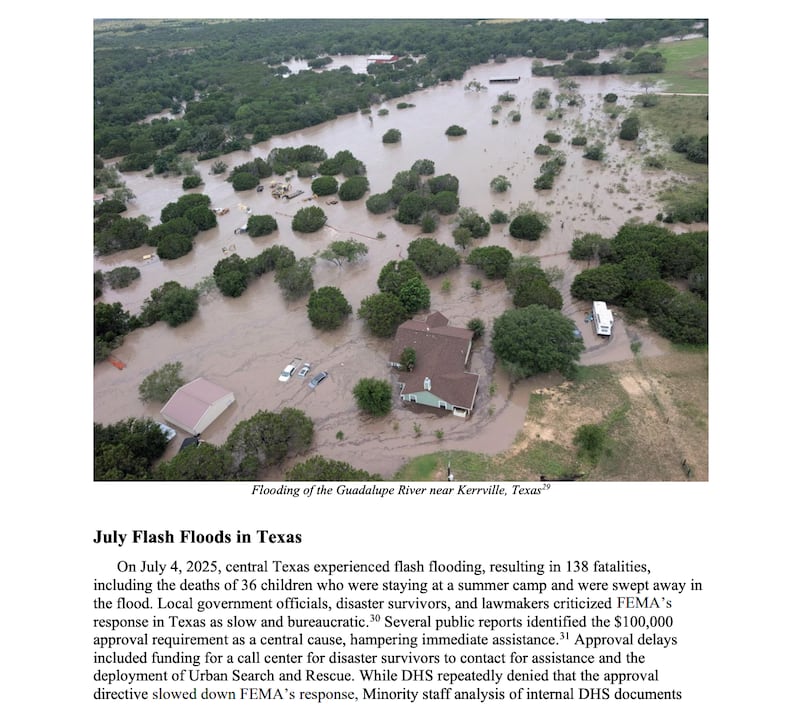
Among the most striking consequences was Noem waiting more than 72 hours to authorize the deployment of FEMA’s Urban Search and Rescue teams after the waters began rising.
In the days that followed, FEMA’s chief of urban search and rescue, Ken Pagurek, resigned in frustration. While flood victims scrambled to reach FEMA for help, thousands of calls went unanswered because the contract with FEMA’s disaster call center had not been renewed.
The implications have kept mounting. A federal judge ruled last October that Noem had tried to “bully” states seeking disaster funds, and Republican Sen. Ted Budd, whose state of North Carolina was devastated by Hurricane Helene, declared war on Noem’s policy in September, threatening to place holds on DHS nominees until North Carolina’s outstanding reimbursements were paid.
In January, Noem’s office was reported to have accumulated roughly $1.3 billion in approved but unreleased hazard-mitigation projects. Former FEMA chief of staff Michael Coen called the blockage “reckless” and “a breach of duty.”
Wednesday’s Washington Post report adds fresh details to the picture. FEMA’s main survivor registration website, disasterassistance.gov, went down for hours in January after an IT maintenance contract lapsed without Noem’s renewal—forcing about 12 employees to scramble to restore it, with DHS cutting an emergency check for approximately $20,000 to cover contractors for roughly six hours of work.

Other tools the agency depends on for day-to-day functions are also expiring, according to two current agency officials who spoke to the Post. States have been forced to raid their emergency reserves to cover disaster unemployment payments that FEMA had pledged but not yet delivered.
A veteran FEMA contracting official told the Post that the current DHS process leaves agency leadership and those managing contracts “in the dark”—a far cry from the rigorous, transparent approval process that has historically governed federal disaster spending. “We had no idea when things would get approved or denied and for what reasons,” the official added.
In a statement to the Post, Assistant Homeland Security Secretary Lauren Bis rejected the report’s findings, saying there was “no evidence of such” multi-week delays and that “FEMA continues to actively process and release billions in aid.” Bis added that Noem’s review process “was specifically designed to break through bureaucratic red tape and expedite funding requests that had previously languished for years under prior administrations.”
Wednesday’s report also argues that Noem’s directive violates the Post-Katrina Emergency Management Reform Act of 2006, which prohibits actions that “significantly and substantially” reduce FEMA’s missions, authorities, and responsibilities—an allegation that DHS has not directly addressed.
The Daily Beast has contacted DHS for comment.