Netanyahu’s New Coalition More Likely To Bomb Iran
The prime minister’s new coalition government is aimed mostly at solving domestic issues. But Netanyahu also could be circling the wagons inside Israel.

Lior Mizrahi / Getty Images
Get the Beast Digest newsletter delivered straight to your inbox
By clicking “SIGN UP” you agree to our Terms of Use and Privacy Policy.
Israeli Prime Minister Benjamin Netanyahu’s deal to bring the opposition Kadima Party into his government mostly addresses domestic problems that Bibi has faced. A broader coalition allows him to deflect pressure from ultra-Orthodox parties, tamp down a rebellion by hardliners in his own Likud Party and coast through the next 17 months of his term. With the new configuration, Netanyahu’s government controls 96 of the 120 seats in Parliament, the kind of legislative majority no Israeli government has had since the 1980s.
But it also enhances, if only slightly, the possibility of an Israeli strike on Iran’s nuclear program between now and the U.S. election in November, a specter that has Washington and much of the world on edge.
The attack scenario gains momentum for two reasons. First, the sheer size of the new coalition allows Netanyahu to fend off a recent groundswell of criticism from former intelligence and military officials who say an attack is unnecessary and might even be reckless. Last week, former prime minister Ehud Olmert added his voice to the opposition, which includes the former heads of Mossad and Shabak, Israel’s foreign and domestic intelligence agencies. As long as Netanyahu’s government enjoyed only a relatively small majority, the critics had been able to undermine the rationale for an attack.
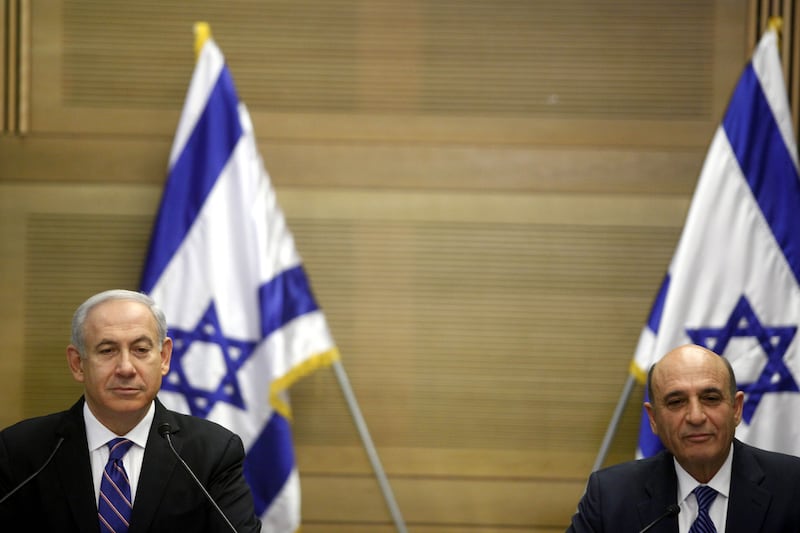
With a dramatically more robust majority, Netanyahu can argue that opposition to military action is a marginal phenomenon. The head of Kadima, Shaul Mofaz, who defeated Tzipi Livni in a primary election last month, is a former chief of Israel’s military. He will be the third member of Netanyahu’s government to have held the position. That kind of cumulative experience can be a powerful force in Israel, where the opinions of generals carry much weight.
The second reason is bound up with the precedent of national unity governments, as the broad left-right coalitions are called (this one is more center-right). They tend to come together when weighty issues are in the balance. The best example was in 1967, when the ruling Labor Party brought in opposition figures on the eve of Six-Day War. In 1984, Labor and Likud formed a broad coalition to cope with an economic crisis that included 400 percent inflation.
The fact that national unity governments have coalesced around big decisions in the past doesn’t necessarily mean that Netanyahu’s broad government will take dramatic military steps. But the backing of more than 80 percent of the Parliament gives Netanyahu more room to take risks. In the case of a strike on Iran, the risks include planes being shot down, an almost inevitable counterattack on Israel’s home front, and a rift in the relationship with the United States.
Ironically, Washington had lately felt the prospects of Israeli action ahead of the American election were diminishing. Netanyahu had been signaling in the past week that he would dissolve parliament and schedule early elections for this September. Most analysts believed that would mean putting the strike plan on hold at least til October and probably through the election. This would have been a boon to Obama, who could have planned to ramp up pressure on Israel post-election without worrying about losing the votes of Israel supporters. Netanyahu’s maneuver is likely to alter the assessment.
In other ways, the broader coalition should please Washington. Mofaz is thought to be more prone to compromising with the Palestinian than Netanyahu. The new coalition deal gives him authority over the peace process, according to a Kadima spokesman. Though he’s unlikely to have free rein, the presence of Kadima will diminish the relative weight of more hawkish parties in the coalition.
Bottom line: Netanyahu’s decision to dramatically expand his government should not be seen as a certain prelude to an attack on Iran, but it does make one more likely.
See more of our coverage in your search results.

Got a tip? Send it to The Daily Beast here.
Unlock a year of full access to The Daily Beast for $35.
Monthly
$1
First month then $5.99/month
Annual
$35
First year then $59.99/year
Premium
$79
First year then $119.99/year
*Substack access provided by the next business day, using your subscription email. Choosing the Premium plan constitutes your permission to share your subscription email with Substack and your agreement to Substack’s Privacy Policy.
Looks like you already have a subscription!
- Account (completed)
- Payment (completed)
- Confirmation (completed)
You're all set!
Thanks for subscribing.
- 1Account
- 2Payment
- 3Confirmation
Sign in or create an account
Register below to read this article for free or subscribe
to unlock unlimited access to The Daily Beast.
Monthly
$1
First month then $5.99/month
Annual
$35
First year then $59.99/year
Premium
$79
First year then $119.99/year
*Substack access provided by the next business day, using your subscription email. Choosing the Premium plan constitutes your permission to share your subscription email with Substack and your agreement to Substack’s Privacy Policy.
Already have an account? Sign In
Looks like you already have a subscription!
- Account (completed)
- Payment (completed)
- Confirmation (completed)
You're all set!
Thanks for subscribing.
- 1Account
- 2Payment
- 3Confirmation