
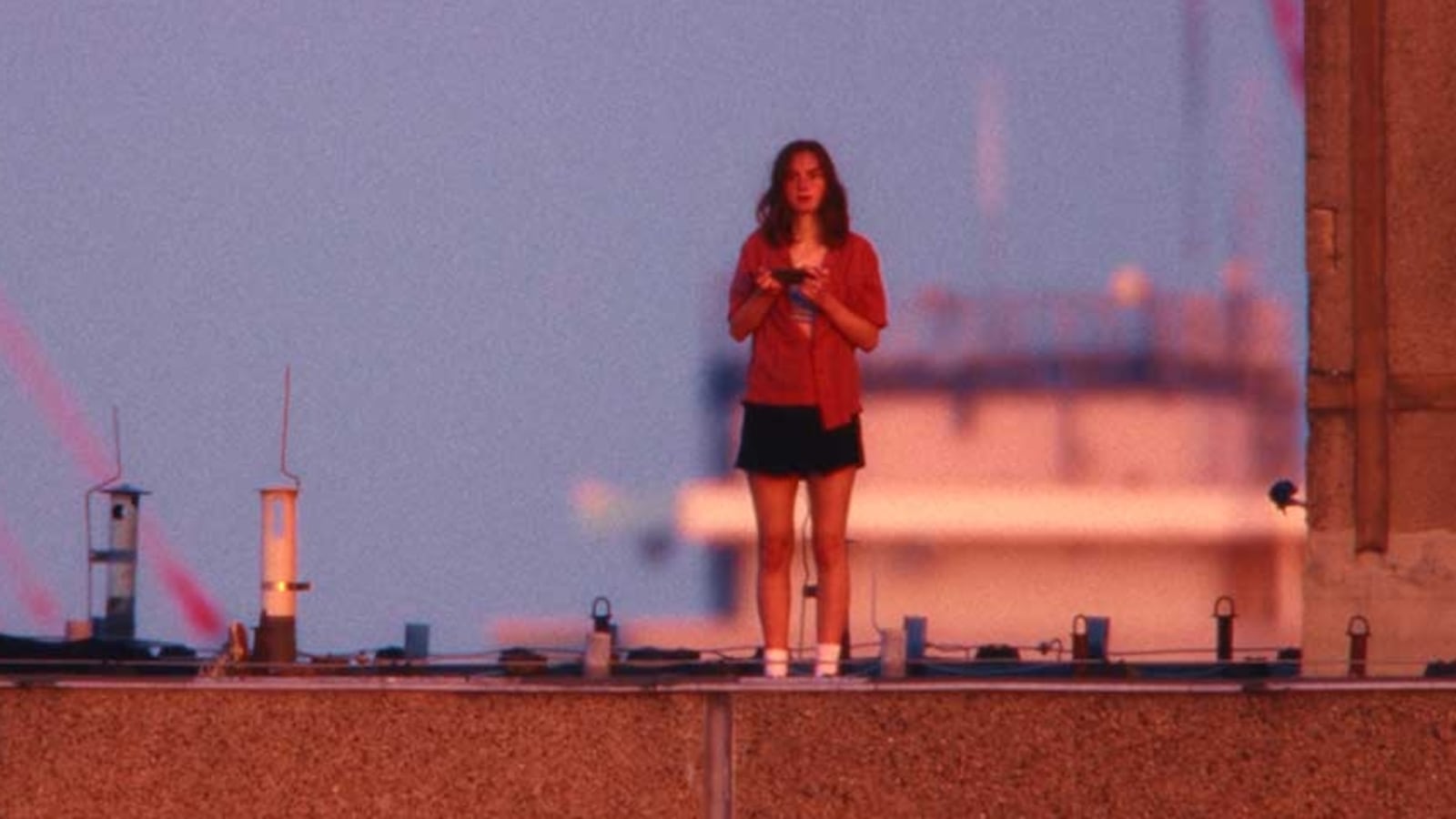
Loss creates a void that’s both external and internal, and Everytime attunes itself to its heartrending echo.
Winner of the Un Certain Regard prize at May’s Cannes Film Festival and making its North American premiere on Sept. 15 at the Toronto International Film Festival, Austrian writer/director Sandra Wollner’s third feature (after 2016’s The Impossible Picture and 2020’s The Trouble with Being Born) is as deeply felt as it is logically comprehended.
Evoking the crushing, transformative emptiness born of tragedy, this riveting drama stays achingly poignant through its surprising transition from the real to the unreal. Moving even when it’s baffling, it’s a standout of shattering proportions.

In Berlin, Ella (Birgit Minichmayr) is preparing to take her two daughters, teenager Jessie (Carla Hüttermann) and adolescent Melli (Lotte Shirin Keiling), on vacation. Their destination is the Canary Island of Tenerife, where—as home movies will soon elucidate—she visited years earlier when Jessie was a child, and the girls’ father was still in the picture.
That man’s absence is the first of Everytime’s unspoken, if powerfully sensed, vacuums. However, it’s nothing compared to the hole that opens up in this clan’s life when, after sneaking out the night before their departure to be with her boyfriend Lux (Tristán López), Jessie plummets to her death off a downtown building’s roof.

This horror punctuates one of Wollner’s many long, winding, deep-focus pans, and—as a truly unforgettable sight—it hovers over the remainder of Everytime. The story subsequently leaps over the usual funereal formalities and grieving to find Ella taking a work call as she tends to her daughter’s grave in a cemetery that, with overgrown foliage and flowers, resembles a garden.
Back at their apartment—a series of tight rooms connected by a hallway which the director visualizes, tellingly, as constricting and compartmentalizing—Melli continues to scribble at the dining table. Meanwhile, Lux returns to Berlin on a train with a new girlfriend who’s clearly won his affections.
Wollner’s abrupt fast-forward is part and parcel of Everytime’s slippery portrait of time, which captures the means by which, in the aftermath of trauma, one’s perception of reality goes wonky. Snippets of Jessie and Melli’s video game heighten the material’s illusory atmosphere.

Nonetheless, relatable, shellshocked sorrow bubbles just beneath the material’s surface. Whether it’s Melli complaining to her mom about an ice maker that’s crowding their car’s backseat, or Ella’s brother not-so-subtly objecting to the company his sibling is keeping, these characters’ misery is ubiquitous, no matter that it’s stifled beneath everyday trivialities or manifests itself in petty arguments.
Epitomized by an aerial trip around a 2D game landscape that plummets through the ground and mountains, Everytime is a film about individuals unmoored from themselves and the world around them. For extended stretches, Wollner sits with them as they try to cope with their new circumstances. Those efforts are clumsy, to say the least, most notably Ella’s desire to keep Lux in their lives.

Yet “desire” may be too strong. Rather, the forlorn single mother seems compelled (out of a yearning to cling to what was lost? Or because of self-loathing? Or due to vindictiveness?) to involve herself with the boy, who’s caught between pressing onward and grappling with his responsibility for this misfortune.
Anyone who’s experienced the death of a young relative will find segments of Everytime excruciatingly on-target, as when Ella, her stone face masking an anger and desolation that knows no bounds, watches Lux accept a motorcycle as a birthday present—a vision of one life unjustly continuing when another’s has been cruelly cut short.

At no point, however, does Wollner unduly press on her characters’ wounds to manipulate her audience. Rather, her approach is patient, and her perspective is at a slight remove, gazing at Ella, Melli, and Lux from a distance before slowly creeping toward them to get up-close-and-personal with their despair—a tactic employed to empathetic effect in two separate scenes involving Ella and Lux, the latter of whom can’t squash his guilt.
There’s no telling where Wollner and cinematographer Gregory Oke’s camera will go, and that unpredictability is as relevant to the protagonists’ condition as the compositions of them stranded alone in space or trapped in the corner of the frame. Mirrors are an additional recurring motif, not only literally but figuratively; drawn to trace her daughter’s last steps, Ella has Lux guide her on the same drug-enhanced path that ended Jessie’s life.

Still, such parallels are less straightforward than oblique, not to mention jarring, so that when Ella impulsively decides to take Melli and Lux on the never-realized trip to Tenerife, it’s another jolt in a film rife with them.
The past and present are in constant dialogue in Everytime, and thus it’s not altogether stunning when, during the trio’s holiday, things take a hallucinatory turn. Building off the photos and home videos that had previously helped flesh out the tale’s emotional tapestry, the film makes a big gambit that serves as the catalyst for a descent into more overtly dreamlike territory.
Wollner neither sets the table for this segue nor holds her viewers’ hands as they reconcile what came before with what’s presently taking place. Even with the preceding material’s unconventional storytelling, it’s a bold gesture that renders the action as much a (wish-fulfillment) memory piece as a straightforward narrative.

It’s also, ultimately, a masterful maneuver, heightening the film’s sharp focus on its characters’ anguish, longing, and confusion via incidents and revelations that, on a basic level, are impossible and inexplicable. There’s no rational way to explain how any of Everytime’s closing moments could possibly be. Yet what they say about Ella and Mellie’s feelings is never difficult to decipher. That combination of the tangible and the imagined is as assured as the closing vistas of the setting sun are beguiling.
With her latest, Wollner exhibits a formal command that’s second only to her gift for haunting, redolent mood. No matter its title, Everytime is one of a kind.