
Forget the major studio blockbusters. One month into summer 2026, horror has made the multiplex the place to be. And arriving on the heels of indie breakouts Hokum, Obsession, and Backrooms, Leviticus continues the genre’s seasonal domination.
In theaters June 19 following its premiere at January’s Sundance Film Festival, Adrian Chiarella’s thriller is a nightmare of intolerance, fear, repression, and loneliness, all of which are omnipresent in this story about two Australian teens’ forbidden same-sex relationship and the demon (and humans) that externally and internally preys upon them.
Cannily threading supernatural terror through a relatable tale of persecution, self-doubt, and betrayal, it’s a confident and unnerving allegorical gem. And it suggests that its writer/director is another up-and-coming talent to watch.
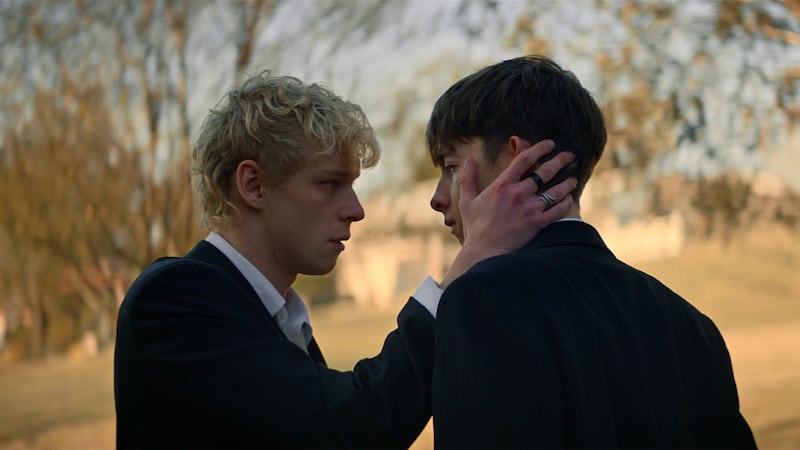
In a remote Australian town dominated by farms and a factory, Naim (Joe Bird) and Ryan (Stacy Clausen) spend an afternoon in and around an abandoned mill, with the former boasting a timidity—toward everything, including a snake with a frog in its mouth—that stands in sharp contrast to his compatriot’s cocky poise. Inside the derelict building, Ryan’s antagonistic shoves and insults are a pretext for exploratory kisses—the first (but not last) instance in Leviticus in which violence and desire commingle.
Naim is new to town and lives with his mother Arlene (Mia Wasikowska), who moved them to this middle-of-nowhere outpost after finding Jesus so she could join the local fundamentalist church. As the congregation sings along to a Christian rock performance, Naim looks lost and out of place, and throughout his debut feature, Chiarella frames the kid in isolating compositions that underscore his outsider-dom.
While the blonde-haired, blue-eyed Ryan is more self-assured, he also doesn’t fit in with the religious crowd, save that is, for Hunter (Jeremy Blewitt), the preacher’s son, whom Naim spies throwing rocks at Ryan (and vice versa) before the two passionately make out.

Homosexuality is a shameful sin in this backwater enclave, and with concise and evocative aesthetics, Chiarella conjures an air of narrow-minded fanaticism. In such an environment, gay lust and love must be hidden, and motivated by jealousy over his new beau’s two-timing, Naim weaponizes the town’s homophobia by ratting out Ryan and Hunter to the latter’s father Rod (Ewen Leslie).
To combat this evil, Rod calls in a “deliverance healer” (Nicholas Hope), a mad-eyed zealot who conducts a ceremony with a Zippo lighter, culminating in Ryan and Hunter writhing and screaming on the ground, their faces and bodies as contorted as Naim’s own visage, guilt-stricken and terrified.
The church’s remedy, it turns out, is a malevolent curse, as Naim discovers when he sees Ryan talking to and taking photo booth pictures with an invisible figure that—upon being interrupted—tosses Naim like a rag doll. A short time later, he watches Hunter engage in similar uncanny behavior with an unseen partner. When that ends in tragedy, Naim admits to his own clandestine feelings for Ryan, thereby earning him a visit to the deliverance healer and, with it, the same unholy affliction that plagues his classmates.
This evil takes the shape of the thing Naim and Ryan most covet, which turns out to be each other, and in that regard, Leviticus is about the way friends, family, and faith leaders turn homosexual men and women’s desires against them. Separating its targets from their loved ones and peers and attacking them when they’re alone, the deadly entity is homophobia incarnate. That it appears in the form of a paramour merely underscores its insidiousness, and Chiarella generates terrific unease through multiple scenes in which it’s unclear whether Naim is interacting with the real Ryan or his monstrous doppelgänger.
Central to Leviticus is the rapport shared by Bird and Clausen, whose gentle intimacy provides a foundation for the eventual hurt, distrust, and fury that threatens to tear their characters apart. Whether paired or on their own, the actors exude genuine confusion, panic, self-loathing, and desperation, and Chiarella emphasizes their fraught circumstances through sharp visuals, such as images of Naim behind barred gates and in front of crisscrossing power lines, which impart a sense of imprisonment and entrapment.
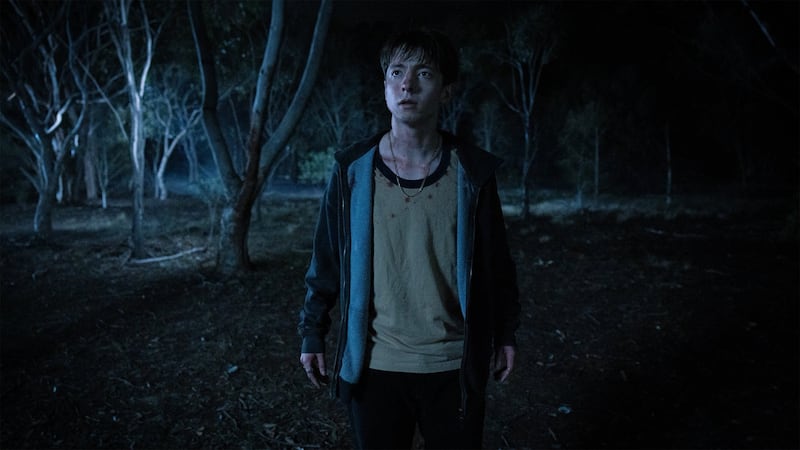
Even at its most studied, the film is never stilted, and, energized by set pieces that recall both It Follows and Talk to Me, it proves consistently suspenseful.
There’s only one true jump scare in Leviticus, and it’s a nerve-rattling doozy. Otherwise, its disquiet and anxiety are the byproducts of the oppressive cruelty faced by Naim and Ryan, whether it’s courtesy of the demon that taunts and abuses them or moms and dads who care less about love and empathy than about purging their progeny of supposedly wicked urges.
Wasikowska’s stern Arlene is one of those callously selfish parents, and while she never quite comes into three-dimensional focus, she does, in a late confrontation with Naim, resonate as the material’s most unassuming (and nastiest) villain.

As so often happens in films such as this, Naim and Ryan eventually learn about the nature of their dilemma from those who’ve suffered identical fates. However, in a clever twist, Chiarella doesn’t afford the duo an easy answer that will magically rid them of their misfortune. Rather, he recognizes that the sole thing that protects one from solitude, prejudice, insecurity, and hate is companionship.
Leviticus is ultimately a bittersweet portrait of the power of togetherness, and the fact that the director manages to find a measure of hope amid so much ugliness is almost as impressive as his skill in maintaining taut tension throughout the saga.
Like its current horror contemporaries, Leviticus is a model of efficiency and dexterity, and proof that imagination is always more valuable than CGI bells and whistles. Better yet, it’s the latest in a long line of stellar genre efforts that thrive by making the unreal an outgrowth (and manifestation) of the real.
Things that go bump in the night may be frightening, but as this haunting film demonstrates, there’s nothing more chilling than a world that hates you and, worse, makes you hate yourself and those you hold most dear.