

It’s a struggle for a man to live up to his father’s example. Oftentimes, that leads only to lingering in his shadow. For the sons of Hollywood royalty, that outcome’s likelihood is higher than most, though they’re at least able to console themselves with inherited piles of money. If they fall short of their dads’ talent, they’re nonetheless right in line with his accumulated wealth and clout. Call them nepo babies if it helps you sleep at night; sticks and stones won’t break their bones, and if they did, they could afford the hospital bill.
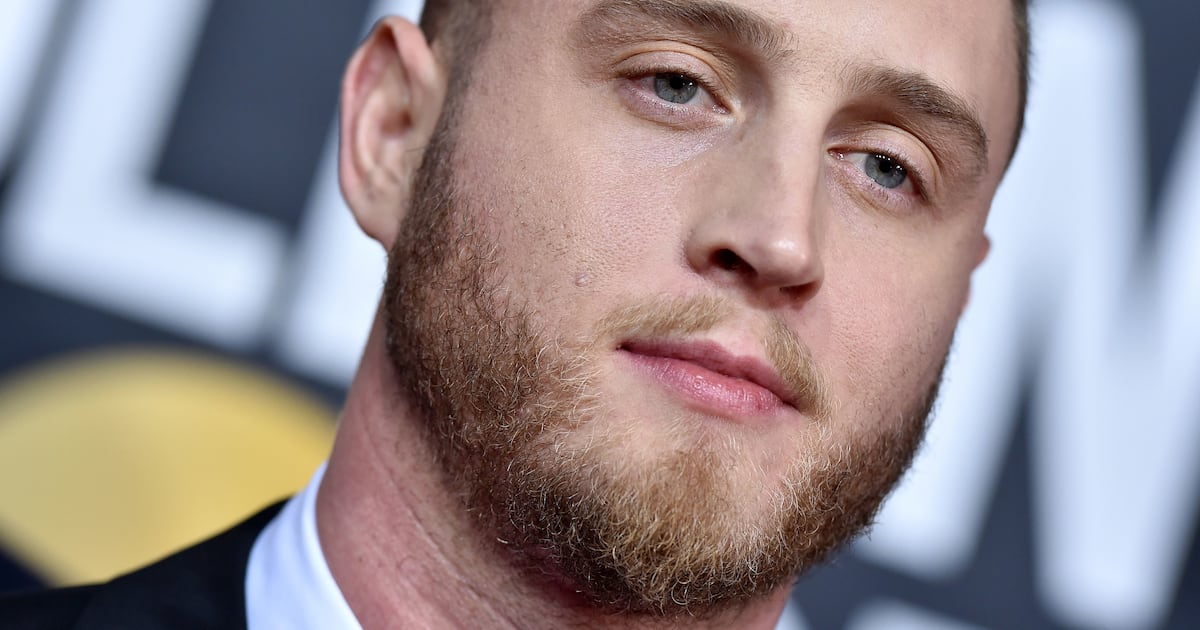
Among the industry’s incoming generation of silver screen gentry, Ray Nicholson stands out immediately. Nicholson: the name is forever associated with the greatness embodied by his living legend sire, Jack, decades removed from his prime and years removed from his final film role. (James L. Brooks’ 2010 romantic comedy How Do You Know. Hang onto that for your next pub trivia night.) The gaps don’t matter much, but they put a premium on each new credit Ray notches on his belt; his name can’t help catching eyes, whatever movie he stars in.
His latest, Borderline, the feature debut of writer-director Jimmy Warden (out this Friday), may feel that pressure more than most of Ray’s projects, on account of his lead role as the heavy; placing him at center stage raises the stakes. Consider that Jack, through the course of his career, left an impression on the movies felt by at least three generations proceeding, from the baby boomers (Tom Cruise), to the Gen Xers (Joaquin Phoenix, Leonardo DiCaprio), to the millennials (Robert Pattinson, Alden Eherenreich), who in turn have left, or are continuing to make, their own impressions on the movies. (Even Morgan Freeman, born the same year as Nicholson, cites him as an inspiration.)
Overstating the effect of Jack’s work on modern screen acting is impossible, which puts Ray, his second child with actress Rebecca Broussard, in an awkward spot. How’s a guy supposed to live up to that degree of industry-shaping influence? So far, by not trying at all; instead of emulating his dad, Ray seems content with being himself. Maybe he can’t make his name the same way as an up-and-comer who lacks famous ancestry. He can, however, make a parallel connection to Jack, like component parts in a circuit. If Jack is his source of voltage, Ray can still carry his own current.
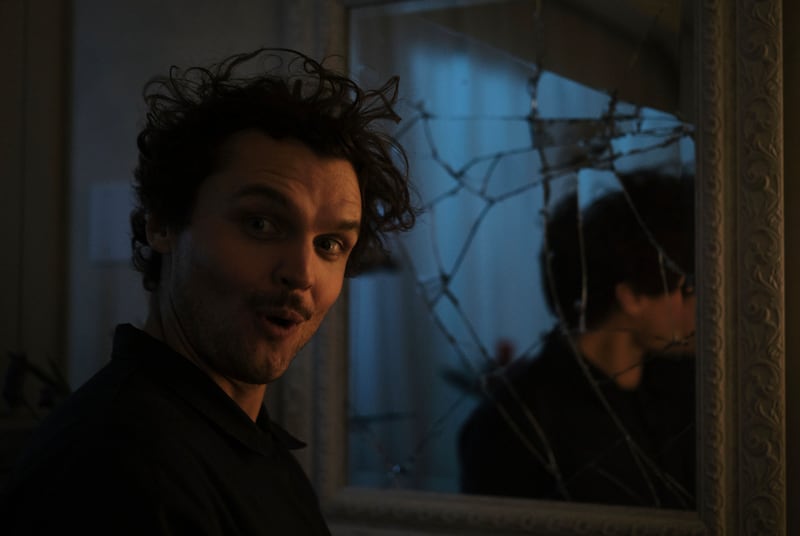
Maybe the best proof of Ray’s selfhood, in fact, is how rarely he’s leaned into being Jack Nicholson’s child over the course of his filmography, to date best described as “slim, but burgeoning.”
The most attention Nicholson has drawn so far is for his supporting part in Parker Finn’s Smile 2, where he plays the late boyfriend of Naomi Scott’s troubled pop singer, memorably menacing her across a crowded room, flashing his dad’s trademark wicked grin all the while. If you weren’t aware of their relationship beforehand, Smile 2 gives it away. There’s no mistaking the specific Nicholson family tree Ray belongs to: in his brief screen time in Smile 2, he is Jack’s spitting image.

The unimpeachable resemblance more or less ends there. If anything, Ray’s inclinations as an actor read an awful lot like a reaction to Jack’s persona as the coolest man in the room, no matter what room he’s in.
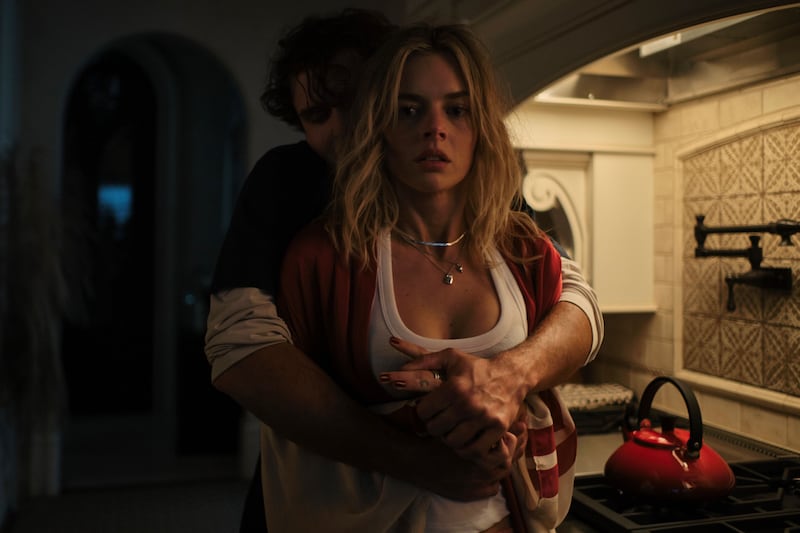
Where Jack was rakish, Ray is nebbish; where Jack was wolfish, Ray is sheepish. Smile 2 is the exception that proves the rule. In Amazon’s small town pseudo-dystopian series Panic, he plays a competitor in an actual game of life or death; in Neil LaBute’s Out of the Blue, a patsy; in Cazzie David and Elisa Kalani I Love You Forever, and in Daryl Wein’s Something from Tiffany’s, a cad. But even when in full scoundrel mode, Ray expresses deep-seated anxiety, nerves bundled beneath a suave, classically handsome exterior.
The contrast makes a compelling puzzle, and with Borderline, Warden has quite possibly solved it. If Randle McMurphy, Jack’s protagonist in One Flew Over the Cuckoo’s Nest (and the performance that scored him his first Oscar win), was actually crazy, he might have resembled Paul Duerson, Ray’s chronically nervous lead in Borderline.

But Randle stood for something, an unlikely anti-authority hero subjected to draconian psychiatric practices. Paul stands for Paul, the obsessed fan cum stalker of mega-star Sofia (Samara Weaving). He’s infernally convinced that they’re in love and set to wed, and won’t take a reality check for an answer. Hence the movie’s opening scene, where Paul stabs Sofia’s bodyguard, Bell (Eric Dane), then blitzes through her mansion like a disturbed kid in a candy store.
Flash forward six months and Paul is at it again, escaping a mental institution with his own psychotic groupie, Penny (Alba Baptista), in tow; a henchman, J.H. (Patrick Cox), waiting for him on the outside; Bell convalescing after his injury; and Sofia completely unaware of the imminent danger she’s in.
At a glance, Paul doesn’t strike as particularly dangerous; he never stops smiling, admittedly a minor sign that he’s a sandwich short of a full picnic basket, and he is constitutionally skittish, as if constantly on the lookout for a harassing gadfly. That restiveness is deceptive, though. In truth, Paul is self-assured of not only his delusion, but his plan to carry that delusion to its conclusion: Sofia standing at the altar, saying “I do.”
Jack might’ve leaned more into Paul’s stealth confidence. Ray plays with that confidence as a buttressing characteristic for Paul’s fantasy. It’s not that Ray eschews “cool;” rather, he reconfigures “cool” to suit Paul’s own idea of what “cool” looks like: He dresses to the nines in hideous, ill-fitting suits, wears a ceremonial dagger at his waist as an accessory to his groom’s getup, and speaks with an approximation of smooth talk that betrays just how deep he’s sunk into his self-deception.

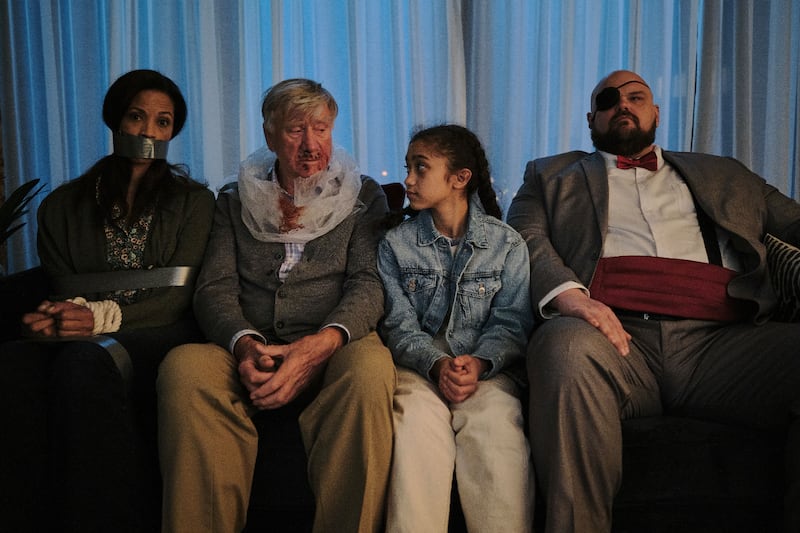
Forget looking cool. Paul doesn’t know what cool sounds like. He greets his wedding’s “guests”–including Bell’s daughter, Abby (Yasmeen Kelders), and her aunt, Eleanor (Catherine Lough Haggquist)–with a failed slide down a stairway bannister, walking off the fumble like a cat saving face after falling off a refrigerator, then plies them with hors d’oeuvres and spectacularly bungles the pronunciation. This is not a cool man. This is a terribly unstable man capable of anything, including orchestrating violence done by his crew. (Penny especially is a frighteningly gleeful livewire.)
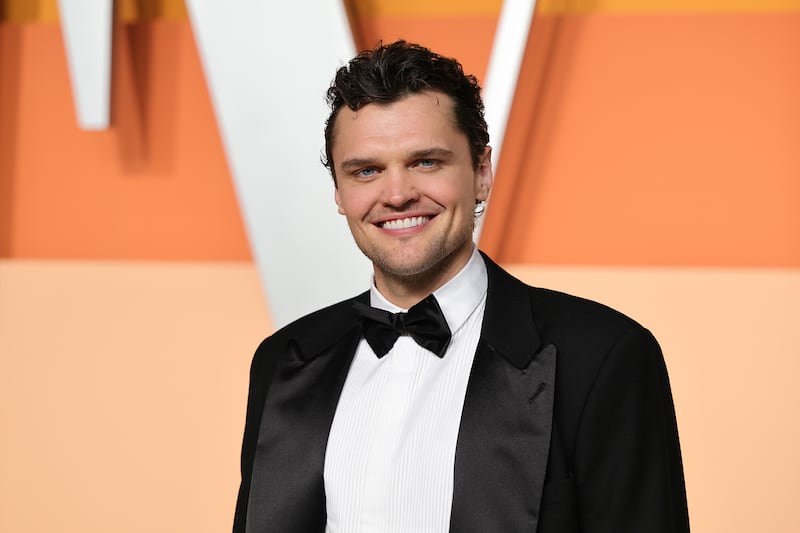
But Ray moors each of these details to one broader defining quality, the best proof of his parentage: irrepressible Nicholson charm. Ray is Jack’s son, no doubt, but he isn’t Jack. He appears neither to want to nor try to be, either. He’s a Nicholson in his own jittery, guileless, and utterly disarming way instead.