This summer has been a historic one for horror, with low-budget indies Obsession and Backrooms setting one box-office record after another while films like Hokum, Leviticus, and Evil Dead Burn solidified the genre’s hold on theaters. It’s rarely been a better time to love scary films, which is why it’s disappointing to find that the season’s latest highly anticipated release—from one of cinema’s up-and-coming auteurs—stops this remarkable hot streak in its tracks.
Jane Schoenbrun makes horror movies unlike anyone else. However, with their first two features—We’re All Going to the World’s Fair and I Saw the TV Glow—such novelty produced uneven genre fare about identity, media, and body and gender dysphoria.
Those subjects are again at the forefront of the director’s third feature, Teenage Sex and Death at Camp Miasma (August 7, in theaters), whose florid title is in keeping with its self-conscious riff on Friday the 13th and its slasher ilk.
Schoenbrun’s most conventional and obvious effort to date, the writer/director’s third film is an autobiographical critical essay with plenty of throwback style but minimal insight and even less suspense. In a summer of scary standouts, it’s the season’s biggest letdown.
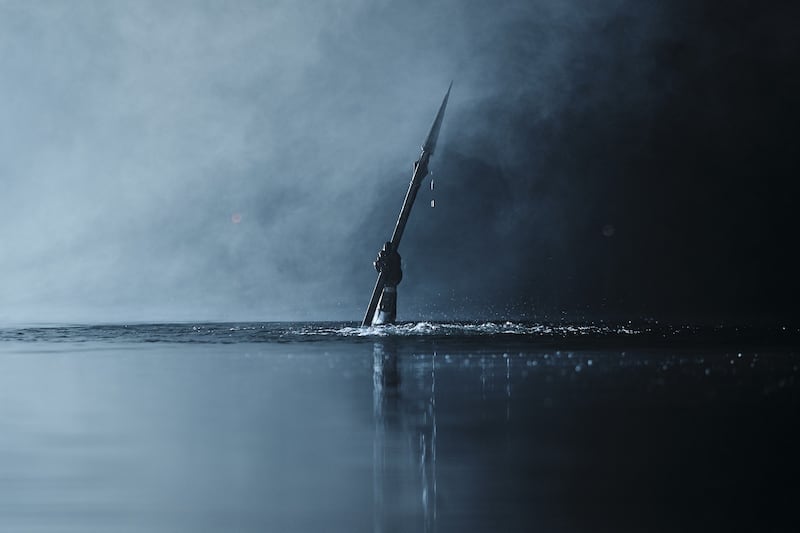
Teenage Sex and Death at Camp Miasma’s credit sequence uses VHS cassettes, newspaper clippings, toys, arcade games, and additional relics to recap the history of the fictional ‘80s Camp Miasma franchise. That series’ premise—a killer emerging from a summer camp lake preys upon counselors and kids with a double-sided spear—is an underlined riff on Jason Vorhees’ legend, to the point that one of its sequels involves its fiend (who wears a helmet that looks like a ceiling air vent) taking Manhattan. Such kitschy fetishism is endemic to Schoenbrun’s newest, extending to an obsession with candy and popcorn that resonates as another of the filmmaker’s primal childhood fixations.
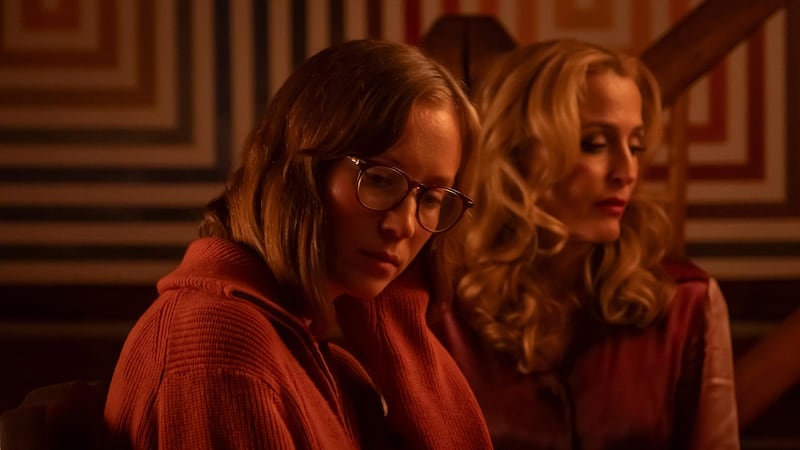
Kris (Hacks’ Hannah Einbinder) is an independent director whose prior effort was a retelling of Psycho from the shower curtain’s perspective. And at the start of Teenage Sex and Death at Camp Miasma, she’s on her way to the Pacific Northwest home of Billy Presley (Gillian Anderson), a recluse who starred in the original Camp Miasma, lives on its set, and is thrice likened to Sunset Boulevard’s Norma Desmond.
Kris knows that, as a queer artist, she’s been hired to resurrect the horror series in order to counter its notorious transphobia (courtesy of a boogeyman who was raised by psychotic hermaphrodite parents to be both genders at once). Nonetheless, she views the gig as an opportunity to revisit an adolescent favorite and, in particular, to meet Billy, whose most famous scene (in which she’s stabbed while orgasming during sex) made a lifelong impression on her.

Eyes are a recurring motif in Teenage Sex and Death at Camp Miasma, and that’s fitting given how incessantly the film winks at its audience. Kris is a Schoenbrun proxy who gives voice to their mixed-up feelings about slasher cinema (recognizing it as both fundamentally problematic and deeply alluring), the connection between eroticism and terror, and the fantasy of transfiguration via the movies.
Yet this academic life-imitating-art conceit comes off as leaden from the start. Moreover, it isn’t aided by satiric chitchat about IP, a late Zoom call with studio executives (led by Dylan Baker’s bigwig) who receive Kris’ reconfigured pitch with bug-eyed confusion and revulsion, and a tasteless Jamie Lee Curtis joke.
Kris is caught between wanting to reinvent dim-bulb ‘80s horror for the progressive age and loving its antiquated, disreputable visions of lust and murder. Teenage Sex and Death at Camp Miasma underscores the relationship between those two forces by naming Camp Miasma’s baddie Little Death—a synonym for an orgasm.
Whereas Schoenbrun previously embraced ambiguity, they abandon subtlety here, spelling everything out via heavy-handed exposition and look-at-me formal mimicry, the latter of which takes center stage during a prolonged screening of Camp Miasma that’s full of print blemishes and reel-change cigarette burns.
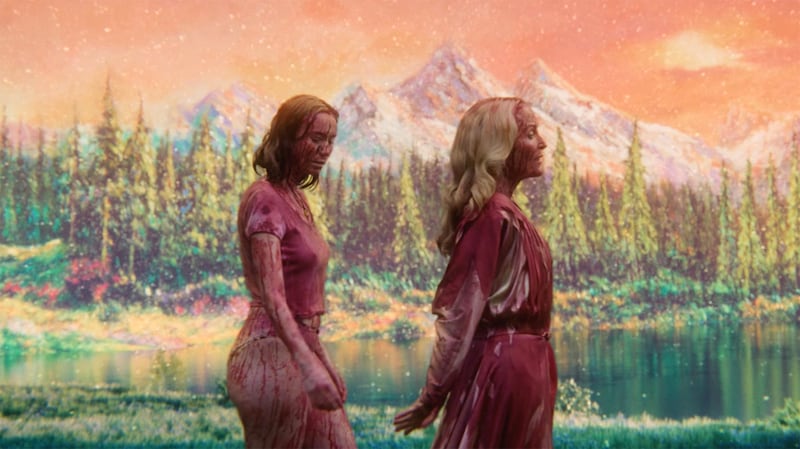
That extended sequence peaks with Teenage Sex and Death at Camp Miasma’s lowest point: a showy massacre by Little Death that boasts more modern aesthetics than any other part of Camp Miasma, and which is set—in a vain bid for amusingly ironic counterpoint—to Counting Crows’ “A Long December.”
Schoenbrun never stops calling attention to themself, not least because Kris is a mouthpiece for their opinions about horror movies. Unfortunately, the observations they proffer are second-rate regurgitations of ideas popularized decades ago (by, among others, critic Robin Wood) and imbue the film with an off-putting know-it-all energy.
Teenage Sex and Death at Camp Miasma seems to have been fashioned for the neophyte-cinephile Letterboxd crowd, italicizing its points while blurring fiction and reality until the two overlap. Einbinder achingly caresses film reels and gazes lustfully at clips of Camp Miasma and, especially, at Billy, but her performance is all superficial gestures that are meant to be understood rather than felt.
Anderson likewise keeps everything on the surface, delivering a campy turn that’s all licentious looks and exaggerated cackles. Though she strikes a memorable figure as the enigmatic Billy—who’s equal parts pot-smoking mentor, carnal muse, and illusory icon—she’s more a concept than a character.
Afraid that its early symbolism might go unnoticed, Teenage Sex and Death at Camp Miasma eventually boasts a giant vaginal hole in the lake and a narrow vaginal hole in a Blockbuster-ish netherworld lair, all as phallic weapons penetrate the innocent at the moment of climax. Kris is a typical Schoenbrun heroine who yearns to simultaneously be multiple things—watched and watcher; killer and victim; herself and dreamy matinee idol Billy—and in case that weren’t apparent from the action at hand, the director spells it out through dialogue that’s as blunt as the production design’s painted backdrops are corny.
Teenage Sex and Death at Camp Miasma fits comfortably into Schoenbrun’s oeuvre of genre-remixed investigations into the trans condition and the nature of self. Yet it also stands apart from its ancestors thanks to its transparency. By the conclusion of her tale, Kris gets to have the experience of being in her beloved movie that Schoenbrun clearly craves.
But there’s little euphoria to her endless self-reflexivity, which peaks with a slow-motion run through the woods that allows her to realize her dream of being the boob-bouncing, nipple-showing final girl. Worse, despite Kris and Billy’s sapphic canoodling, the film lacks legitimate steaminess—a fatal flaw considering that “desire” (writ large in Kris’ notebook, in case you couldn’t figure it out yourself) is the material’s prime focus.
Ultimately, Teenage Sex and Death at Camp Miasma is an on-the-nose (if layered) expression of its maker’s foundational cinematic preoccupations—and thus proof that being deeply personal and candid only gets one so far.