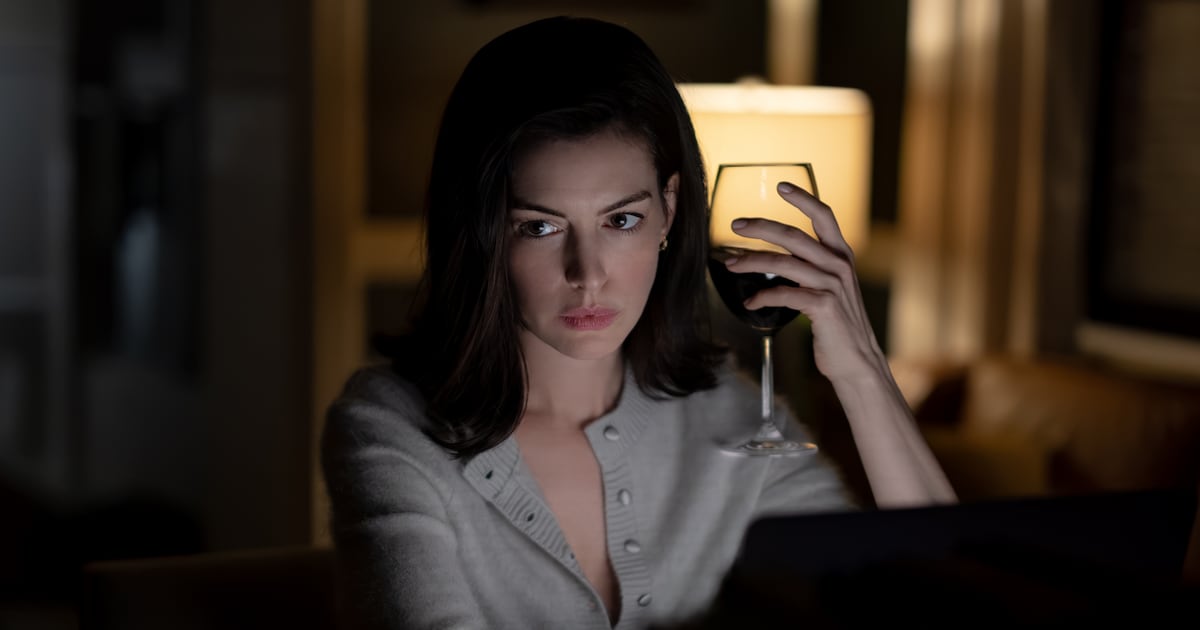
Anne Hathaway has had a rollercoaster past four months, with the lows of Mother Mary and, to a lesser extent, The Devil Wears Prada 2 followed by the towering high of The Odyssey. It’s fitting, then, that she now goes full theme-park cinema with The End of Oak Street, a rollicking hybrid of The Outer Limits and Jurassic Park whose goofy thrill-ride instincts are its greatest strength.
It’s a tad too self-conscious to truly stand on its own, but as far as monster-mash throwbacks go, it boasts considerable bite.
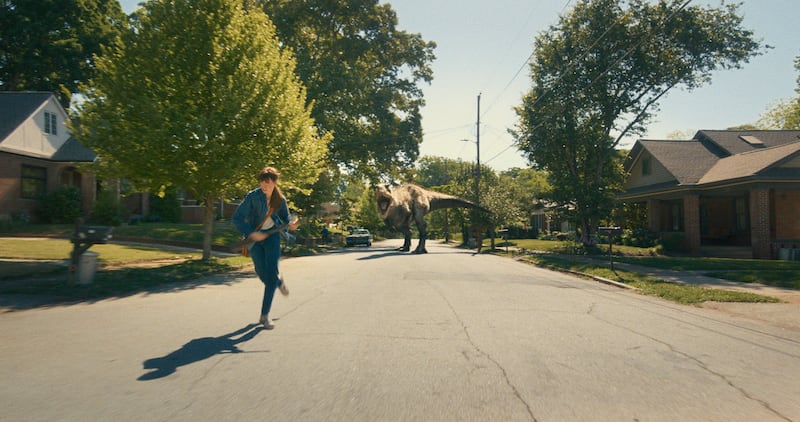
Producer J.J. Abrams’ Amblin-loving fingerprints are all over The End of Oak Street (August 14, in theaters), whose story is set in a Spielberg-ian 1982 suburb where kids evade bullies on their bicycles, adults use Polaroid cameras and watch The Love Boat on cathode ray tube TVs, and families live in houses with copious wood paneling and get together for summertime fun at block parties.
At one such event, the Platts appear just like the rest of their community members, laughing as they participate in a three-legged race and performing their best limbo routines. They’re the picture of All-American perfection, although beneath the surface, cracks are forming.
Writer/director David Robert Mitchell (It Follows) swiftly establishes his protagonists, whose sunshiny exteriors mask roiling tensions. Denise (Hathaway) is on the verge of divorcing Greg (Ewan McGregor), who—much to his wife’s consternation—is delivering pizzas to earn extra cash and generally ignoring her wishes. Behind her family’s back, Denise is writing a (clearly autobiographical) novel about a wife and mother on the precipice of abandoning her loved ones, while older daughter Audrey (Maisy Stella) is pining for a love that isn’t reciprocated.
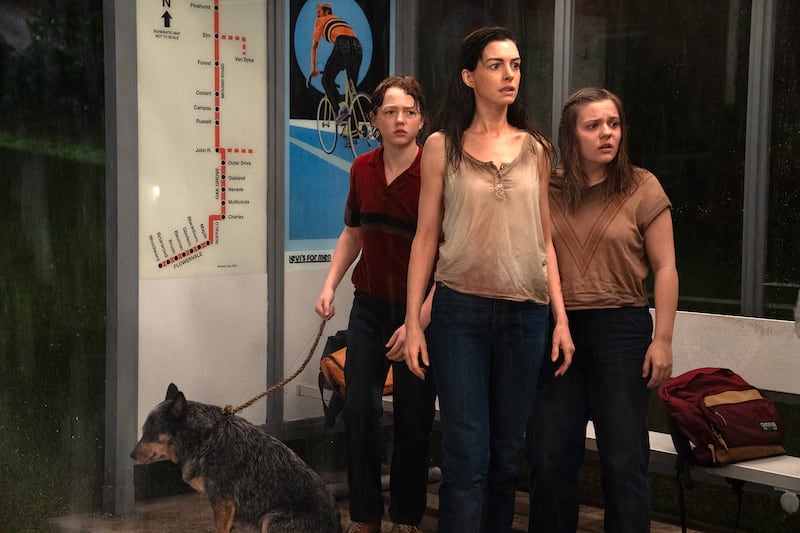
Thirteen-year-old son Brian (Christian Convery), on the other hand, is fixated on his beloved dog and avoiding the angry older brother of a classmate whose arm he broke—hence the ostensible reason he carries a bow-and-arrow wherever he travels.
Mitchell’s soft-focus visuals (courtesy of regular cinematographer Mike Gioulakis) give the early proceedings a decidedly E.T. vibe, and a number of additional touches—a running feud between the Platts and next-door neighbor Mel (P.J. Byrne), for example—further the impression that the filmmaker is playing with homage.
Especially in its first third, The End of Oak Street resonates as another Abrams-esque simulacrum of ‘80s sci-fi and fantasy movies, complete with a Michael Giacchino score that rumbles, soars, and blares with John Williams-style flair.
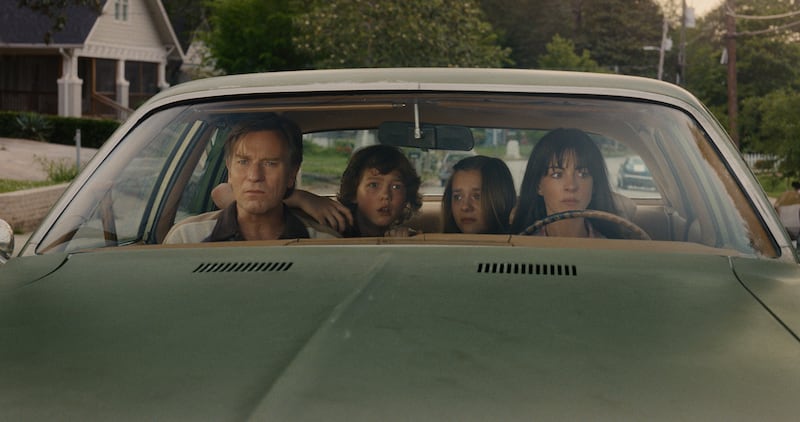
If the film doesn’t initially feel original, however, it doesn’t dawdle, and it picks up the pace during an evening storm that climaxes with a blinding light that knocks out the area’s power. This is baffling, and yet it’s nothing compared to the family’s bewildering realization, the following morning, that their street is now home to not only strange foliage but a wide array of living, breathing, intensely hungry dinosaurs.
Denise and Greg’s initial discovery of their situation is a dexterous highlight, and Mitchell maintains a steady gait as they and their kids attempt to figure out precisely what the hell has happened and how to respond.
The End of Oak Street’s conceit is loosely borrowed from The Outer Limits episode “A Feasibility Study,” insofar as both concern a suburban enclave that’s magically transported to a different reality. Mitchell’s film distinguishes itself from that predecessor by leaping backward to the past rather than to the cosmos and, additionally, by refusing to proffer a reason for this phenomenon.
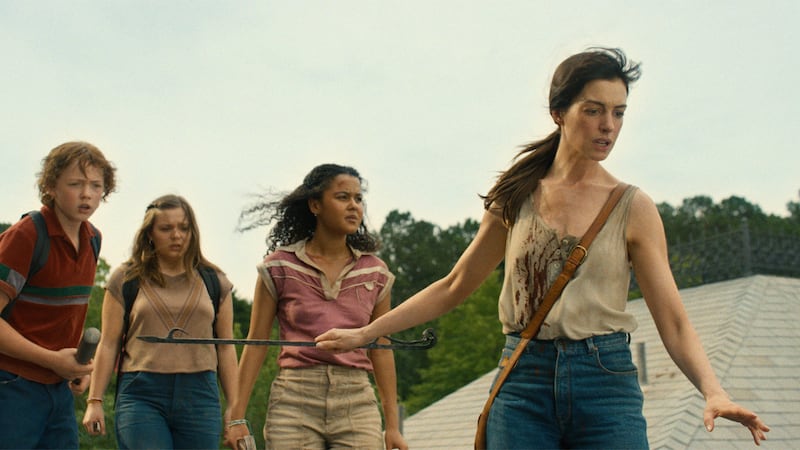
Rather, his premise is merely a vehicle for non-stop set pieces in which Denise, Greg, Audrey, and Brian venture outside their (increasingly fortified) home and wind up being pursued by all manner of titanic beasts, beginning with feathered bipeds and culminating with a run-in with every dinosaur movie’s main attraction, the T-Rex.
There are a host of uniquely conceived dinosaurs in The End of Oak Street, and Mitchell employs them to nail-biting effect, his camera dashing alongside his humans as they navigate ruinous front and backyards transformed into hunting grounds for the prehistoric goliaths, and house interiors retrofitted into makeshift strongholds.
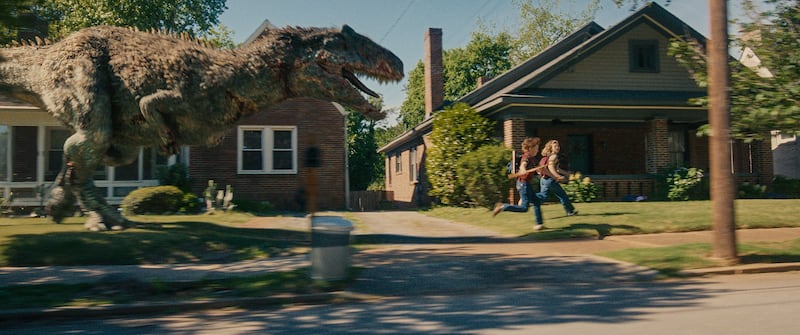
Moreover, he colors his action with just enough evocative details to give these harried individuals some personality, be it Greg’s secretive coping mechanism for stress, Brian’s interest in new girl Jeannette (Jordan Alexa Davis), or Audrey’s clandestine romantic feelings for another and fondness for Steve Winwood’s “Valerie.”
Mitchell leans into his story’s inherent outlandishness, both by interjecting doses of overt humor and by staging suspenseful sequences that have a carnivalesque gleefulness and not-so-subtle nasty streak. Carnage and cruelty are omnipresent, lending the material a sharp edge.
Outclassing anything in the Jurassic World sequels, The End of Oak Street’s showstoppers are squeal-inducing, taking great pleasure in putting its characters in grave peril and scattering them about this terrifying territory. Simultaneously, it knows when to take a breath and deliver a strong joke, the finest of which involves an impromptu photo session with a one-of-a-kind backdrop.
The film’s harried momentum means that Hathaway and McGregor can only nod to Denise and Greg’s personal and marital issues. Nonetheless, they do much accomplished bug-eyed freaking out and screaming, as do Stella and Convery as teenagers who are smart enough to understand the insanity of their circumstances and yet not so bright that they don’t have a habit of stupidly putting themselves in danger.
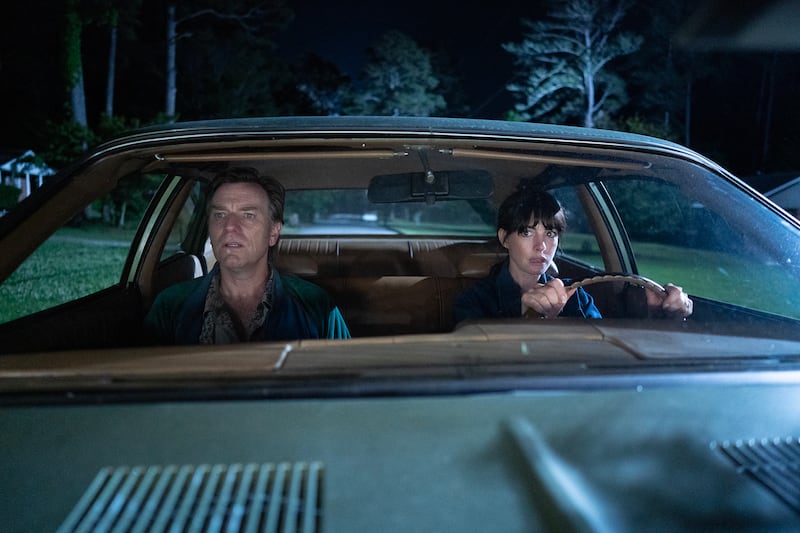
With a bit more room to stretch, The End of Oak Street might have sold these characters better—but, admittedly, the trade-off would have been a loss of its breakneck momentum and gonzo pulpiness, the pinnacle of which is Denise’s use of a shotgun in a showdown with a rampaging dino.
If The End of Oak Street isn’t quite as inventive as Mitchell’s It Follows and Under the Silver Lake, it demonstrates his skill at melding large-scale CGI mayhem with gee-whiz heart. Similarly, the film is confirmation that Hathaway is as comfortable fleeing and fighting fantastical behemoths as she is playing pop stars, fashion industry journalists, and regal Greek queens.
Unlike the last of those, this fearsome and funny B-movie is unlikely to earn her much attention come awards season. No matter—it continues her impressively diverse 2026 and, in the process, marks her as an A-lister of uncommon big-swing daring.