For more than four decades, John Turturro, 69, has been so consistently and distinctively superb—in projects as varied as Do the Right Thing, Barton Fink, The Big Lebowski, Quiz Show, The Night Of and Severance—that his greatness is often taken for granted.
Even so, it would be impossible to ignore his brilliance in The Only Living Pickpocket in New York, a throwback noir which puts him front and center as an inveterate thief caught in a dangerous predicament of his own making.
At once shrewd and shifty, resilient and resigned, hard-headed and regretful, Turturro delivers a performance as terrific as any in his career. Fortunately, Noah Segan’s film (premiering Sept. 16 at the Toronto International Film Festival ahead of its Oct. 16 theatrical release) matches him step for sleight-of-hand step, capturing both the essential spirit of its chosen genre and the metropolis on which it lavishes its affection.

Harry Lehman (Turturro) spends his waking hours traversing New York’s sidewalks and subways searching for marks from whom he can pilfer wallets, jewelry, and other valuables. Of particular interest to Harry (and the film) are old watches—a fitting focus considering that he’s a precise vintage instrument who’s at once outdated and on the clock.
As he reads a newspaper at a diner counter, Harry instinctively draws a pepper shaker closer by using his fingers to pull the napkin on which it sits, and that small but dexterous maneuver, spied in The Only Living Pickpocket in New York’s opening minutes, tells us all we need to know about his sly skillfulness.
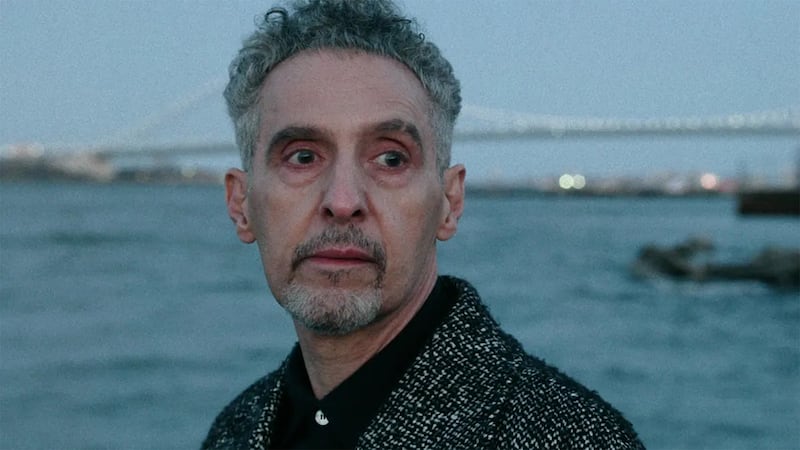
Robbing well-off strangers is the way Harry provides for himself and his wife Rosie (Karina Arroyave), who’s suffering from an undefined ailment that’s left her immobile and unresponsive. Carrying her up the stairs of their Bronx apartment (thanks to a broken elevator) and tending to her medical needs before reading to her before sleep, Harry is a vision of solitary altruism who serves, without fanfare, as breadwinner and caregiver.
It’s a life at once full of love and sadness, and the sight of him putting on a ‘70s disco LP and dancing for his spouse—his fluid moves indicating that, once upon a time, he and Rosie could cut a rug—is as quietly joyous as it is melancholy.

One evening, after putting Rosie to bed and asking his neighbor to keep an eye on her, Harry hits the streets. First stopping at a bodega where he buys a Yoo-hoo and offhandedly complains about the rising cost of everything, he spots a gorgeous 1969 car pull into a parking lot. With a nifty trick involving sticking a penny into the door handle, he gains access to it. Inside, he grabs a bag, and though he has no use for the pistol he finds, he pockets some cash, a luxury modern watch, and a strange thin card.
Harry’s main means of turning goods into money is Ben (Steve Buscemi), a pawn shop owner who’s as old-school New York as Turturro’s protagonist. Writer/director Segan’s film buzzes with Big Apple energy courtesy of numerous authentic touches, be it Ben’s faulty front-door buzzer, a random citizen scoffing at a Harry request, or the quickly heard sound of the Mount Airy Lodge TV commercial jingle. Also aiding that cause is Giancarlo Esposito as Detective Allan Warren, whose relationship with Harry is more that of a long-time pal than a cops-and-robbers adversary, and who shares the crook’s rueful view of his growing obsolescence.

The Only Living Pickpocket in New York deliberately and elegantly follows in the footsteps of The Killing, Le Doulos, Bob Le Flambeur, Le Samouraï, The Driver, The Killer, Ghost Dog: The Way of the Samurai, and Drive (among others). Harry never speaks about the code that governs his work and life, yet it’s clear from his every meticulous movement and decision that he lives by one.
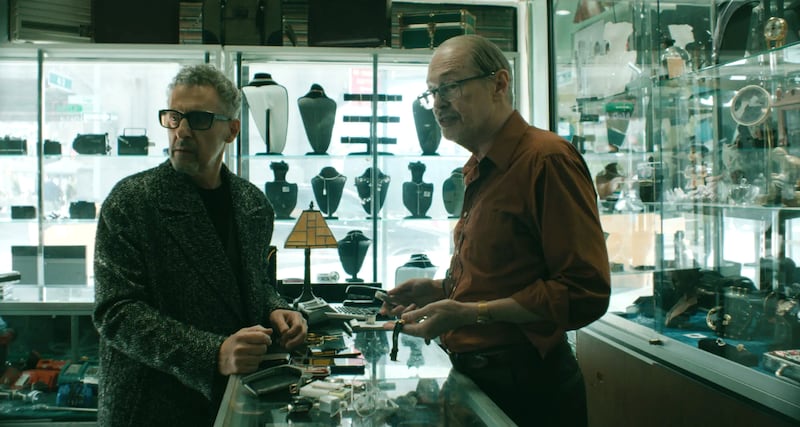
Alas, as is invariably the case with such figures, adhering to ritual isn’t enough to keep him out of trouble, and it comes knocking the morning after his car heist via the vehicle’s young, cocky owner Dylan (Will Price), who’s none too pleased with him—and, specifically, wants his card (which is really a USB drive) returned.
With Rosie’s safety in jeopardy, Harry is forced to try to retrieve that item. His mission proves difficult in The Only Living Pickpocket in New York, whose actions take Turturro’s thief around the Five Boroughs, including Queens, where he has an unexpected reunion with his daughter Eve (Tatiana Maslany).
Their single intense scene together is a masterclass in saying just enough while letting what’s unspoken linger heavily in the air. Turturro’s mixture of remorse, longing, and recognition that the wounds he’s caused can never be healed is overpowering, lending weight to a character who’s been crafted from bits and pieces of classic noir criminals.

Cool and calculating even when the odds are stacked against him, as well as funny, selfless, and sorrowful—about a life comprised of mistakes and triumphs, especially in the “bad old days” which he misses—Turturro is magnificent in The Only Living Pickpocket in New York.
His tour-de-force turn is facilitated by Segan, whose understated stewardship enhances the material’s mournfulness. Set to Gary Lionelli’s somber score of jazzy horns and percussion, the film is an expertly efficient 88-minute character study-cum-mood piece, and if its moves aren’t pioneering, it’s never an act of mimicry; on the contrary, it’s a legitimate progeny of its illustrious ancestors.
For genre aficionados, The Only Living Pickpocket in New York is close to the platonic ideal of a crime movie. It’s also a reconfirmation that Turturro is one of American cinema’s under-sung titans, an artist whose presence in a project is not only always welcome, but a sure sign that something unexpected and electric is about to take place. Here operating in an aptly fatalistic mode, the actor exudes cunning grace, dignity, and soulfulness, elevating Harry’s saga to the realm of touching tragedy.
He’s rarely, if ever, been better, and no matter the omnipresent air of doom, he transforms Segan’s feature into a heartening reminder of his own excellence.