President Donald Trump has presented Iran with a 15-point peace plan in a frantic bid to end the war he himself started before it spirals further out of control.
According to two officials who spoke to the New York Times, the plan was delivered to Tehran via officials in Pakistan, which is trying to broker an end to the conflict.
While the Times reporters did not see a copy of the plan, the officials, speaking on condition of anonymity, said it addressed the issue of Iran’s ballistic missile and nuclear programs, two concerns Trump has repeatedly mentioned when asked why he chose to launch strikes on Iran on Feb. 28.

In joint strikes with Israel since then, the U.S. has targeted Iran’s missiles, launchers, and production facilities, as well as the country’s nuclear program, which was initially targeted and significantly damaged in strikes last June.
The officials who spoke to the Times said that the plan also discusses maritime routes. Iran’s blockage of the Strait of Hormuz, the only shipping lane out of the Persian Gulf, has hit global supply chains and sent crude oil and natural gas prices soaring.
Trump, 79, has admitted that he did not expect Iran to launch retaliatory strikes at U.S. and allied targets in the region, nor to close the Strait of Hormuz, which winds around between the coasts of Iran and Oman.

The president has failed to persuade key Western allies to commit forces to the conflict, which has fractured his political base back home as critics in the MAGA movement question the justification for the war and could cost the Republicans control of Congress in November’s midterm elections.
On Saturday, Trump threatened to “obliterate” Iran’s power plants if the country did not reopen the Strait within 48 hours, only to reverse course on Monday evening, claiming in a Truth Social post that “very good and productive conversations” with Iran prompted him to postpone the planned strikes.
Iran, for its part, denied that any talks had taken place, and warned that it would “irreversibly” destroy critical infrastructure belonging to its neighbors if Trump followed through with his threats.
On Tuesday, Iran once again denied that talks had taken place, with Lieutenant Colonel Ebrahim Zolfaghari asking the U.S., “Has the level of your internal conflicts reached the state of negotiating with yourselves?”
“Don’t call your failure an agreement,” he added, according to the Fars news agency, noting that there would be no return to normal “until our will is done.”
“This will be created when the thought of taking action against the Iranian nation is completely erased from your dirty minds,” he said. “Our first and last words from day one have been, are and will be: No one like us will get along with someone like you. Not now, not ever.”
Earlier in the day, Trump claimed that Iran had sent him “a very big present worth a tremendous amount of money” that was “oil and gas-related,” but would not go into detail or reveal what the present was, only noting that it was “significant.”
As Iranian officials insist that negotiation talks are not taking place, the White House has doubled down on its claims that diplomacy is underway, with Press Secretary Karoline Leavitt telling the Times, “As President Trump and his negotiators explore this newfound possibility of diplomacy, Operation Epic Fury continues unabated to achieve the military objectives laid out by the commander in chief and the Pentagon.”

The Daily Beast has contacted the White House for comment.
According to the New York Times, Pakistan’s army chief, Field Marshal Syed Asim Munir, who has close ties to Iran’s Islamic Revolutionary Guard Corps, has been acting as the primary messenger between the U.S. and Iran, with Egypt and Turkey both encouraging Iran to engage constructively. Trump has previously described Munir as his “favorite field marshal.”
Munir has reportedly proposed that Pakistan host talks between Iran and the U.S. Pakistani Prime Minister Shehbaz Sharif wrote on social media on Tuesday that his country “fully supports ongoing efforts to pursue dialogue to end” the conflict.
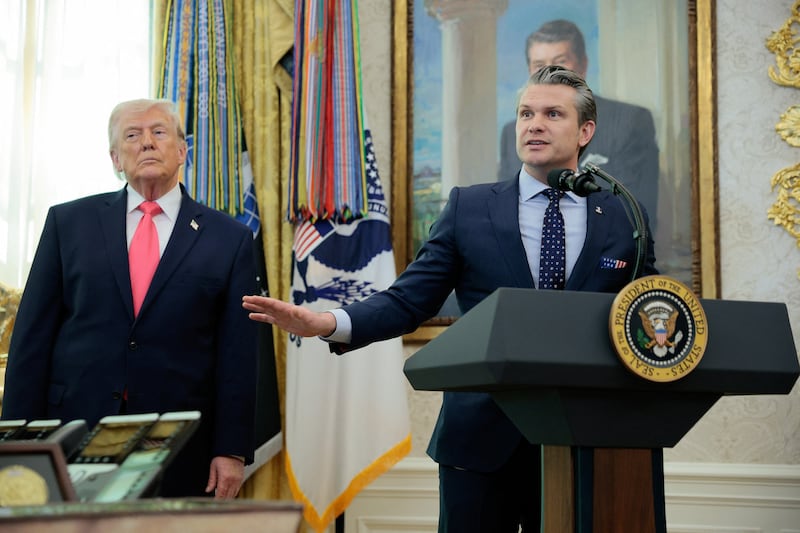
While the president’s messaging around a potential timeline for an end to the war has been mixed, he claimed on Tuesday that Defense Secretary Pete Hegseth wanted the war, which has killed 13 U.S. service members and more than 1500 Iranians so far, to carry on.
“You know, the only two people that were quite disappointed, I don’t want to say this, but I have to,” Trump said after swearing in his new secretary of homeland security, Markwayne Mullin. “I said, ‘Pete and General Razin Caine, I think this thing is going to be settled very soon,’ and they go, ‘Oh, that’s too bad.’”
“Pete didn’t want it to be settled,” Trump laughed.