

President Donald Trump has repeatedly pointed to the economy as one of his administration’s signature successes, but new figures suggest that claim does not hold up under scrutiny.
Inflation-adjusted wages for most workers have risen by just 0.1 percent since Trump’s return to office in January 2025, according to Axios, meaning workers aren’t actually better off in real terms.

Rising real wages have been repeatedly used by the White House to argue that the economy is strengthening.
“In President Donald J. Trump’s first five months in office, real wages for hourly workers have seen their largest increase under any administration in nearly 60 years,” the White House said in a 2025 statement. “Blue-collar workers have seen real wages grow almost two percent in the first five months of President Trump’s second term.”
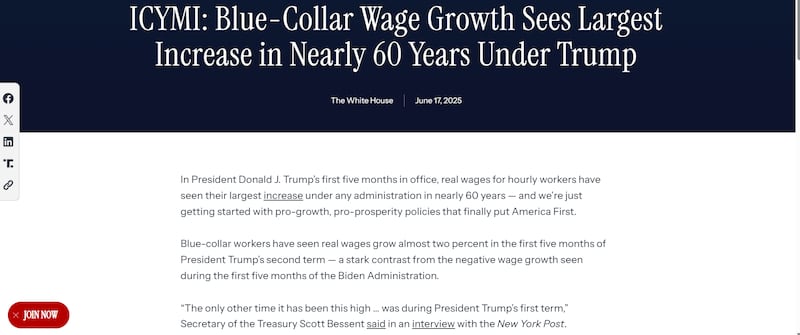
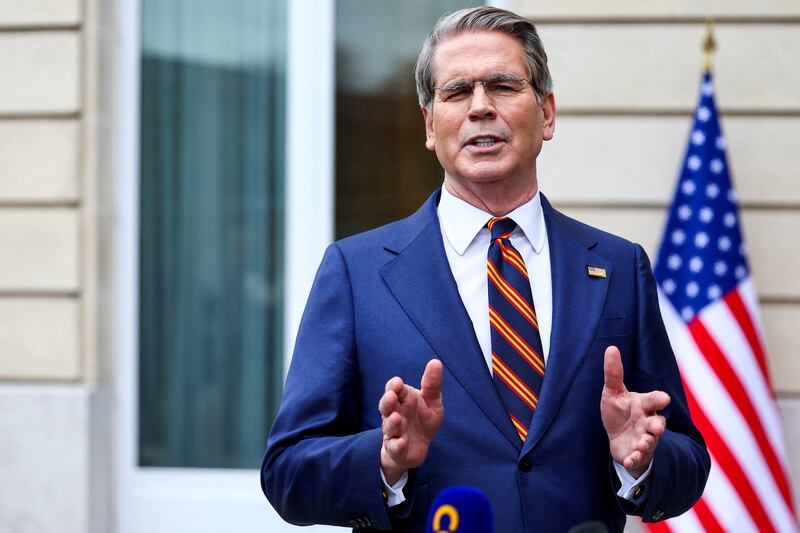
The administration amplified that message through senior officials, with Treasury Secretary Scott Bessent telling the New York Post: “The only other time it has been this high … was during President Trump’s first term.”
He also appeared on a New York Post podcast to promote what he described as a near-record-setting economic performance.
But any gains in wages that built up over the year have essentially been wiped out in the past few months due to inflation.
While average hourly pay for production and nonsupervisory workers—a common stand-in for working-class private-sector employees—has risen by about 4.9 percent since January 2025, once rising prices are factored in, those gains largely disappear.
In real, inflation-adjusted terms, wages for the same group are effectively flat—up just about 0.1 percent, according to Axios.
That is because inflation rose 4.2 percent over the 12 months through May, the fastest rate since April 2023.

The Daily Beast has contacted the White House for comment.
Energy prices were a major driver of the increase, as the Iran war disrupted global oil markets and pushed fuel costs sharply higher.
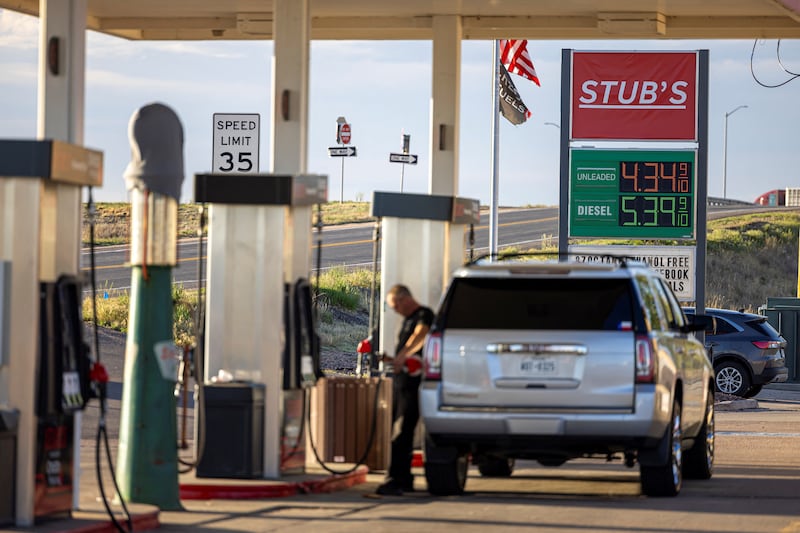
The national average price for regular gas has climbed above $4.50 a gallon, according to AAA. In seven states, the average price of gasoline has exceeded $5 per gallon.
Meanwhile, oil prices have surged by about 35 percent. Overall, energy prices are up 3.8 percent.
In total, the war in Iran has cost U.S. households $100 billion so far. That amounts to nearly $750 a household.
Amid the price rises, polls have shown that Americans are feeling more negative about the economy than ever.
A recent Reuters/Ipsos survey found 70 percent of Americans disapprove of Trump’s handling of the cost of living, compared with 22 percent who approve, with his economic ratings slipping below those recorded for Joe Biden at the end of his term.
A separate Edward Jones/Gallup survey found that roughly one-third of Americans describe themselves as financially stressed. Meanwhile, a Marist poll found that 70 percent say the cost of living in their area is not very or not at all affordable.
Still, Trump has dismissed any concerns about price increases.

In remarks from the Oval Office this week, Trump downplayed concerns about the latest inflation data, insisting the economic picture was positive. “The numbers were great,” he said when asked whether he was worried about the report.
He went on to double down on his assessment of prices, saying, “I love the inflation,” and later argued that energy costs would soon ease, adding that oil prices were “going to come down like a rock” once the war ends.