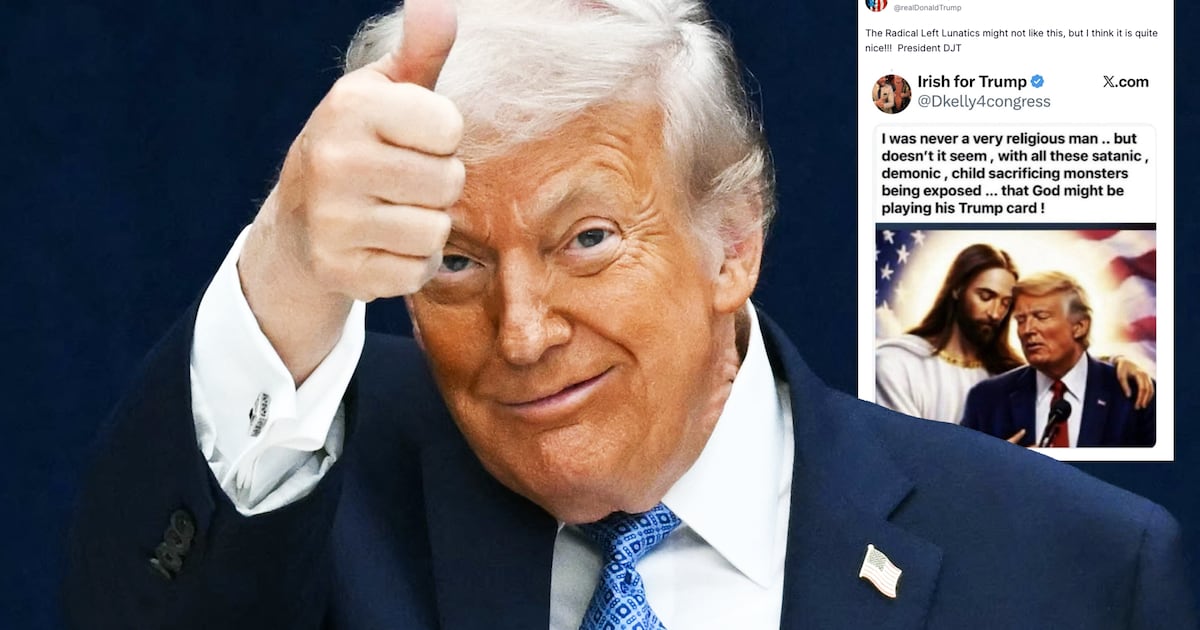
President Donald Trump’s support among young male voters has collapsed in recent months, according to new polling, signaling a potentially serious challenge for Republicans as the midterm elections approach.
A new poll conducted by center-left group Third Way and shared with Politico shows that just 32 percent of men aged 18-29 approve of Trump, while 66 percent disapprove.
That 34-point deficit marks a dramatic reversal from Trump’s 2024 performance, when he carried male voters aged 18 to 29 by 14 points en route to reclaiming the presidency. That was a far cry from 2020, when former President Joe Biden won the demographic with 52 percent of the vote.
An astonishing 68 percent of independent young men disapprove of Trump’s job performance, along with 27 percent of Republicans and 23 percent of his own 2024 voters.
The president also holds a 63 percent disapproval rating with young Latino men and 79 percent disapproval with young Black men.
The poll, which was conducted among 1,462 male registered voters between December 8-22, also shows that 8 percent of young men who voted for Trump in 2024 say they will vote for a Democrat in 2026.
Polling on the generic ballot among young men aged 18 to 29 also shows a sharp tilt toward Democrats, with registered voters favoring the party 54 percent to 36 percent over Republicans.
Among likely voters, the gap widens even further, with Democrats leading 61 percent to 31 percent, suggesting that enthusiasm among young male voters is heavily weighted toward the Democratic Party.
The polling is a warning sign for the Republicans ahead of this year’s midterm elections, where the GOP hopes to defend its slim majority.
Young men were an integral group in Trump’s victory in 2024. Young men of color, especially Latino and Black males aged 18 to 29, swung toward Trump, driving Republican advances.
Surveys have shown that a significant portion of young male Trump supporters viewed issues like the economy and job prospects as especially urgent, with many reporting dissatisfaction with cost‑of‑living pressures and negative views of the incumbent administration’s performance on economic conditions.
A Third Way focus group previously found that young men in swing states reported feeling abandoned by Democrats, saying the party left them with “resentment and hopelessness” about their economic prospects, driving them to vote for Trump.
But polling suggests that optimism about the economy under Trump is now fading. The Third Way poll found that 58 percent of young men believe Trump has negatively impacted their finances, compared to just 23 percent who say he’s had a positive impact.
That mirrors other recent polling, which reflects growing skepticism about the economy under Trump.
CNN polling guru Harry Enten said last week that a stark 55 percent of Americans believe the economy has worsened under Trump, while 54 percent say his top priority should be lowering prices.

"BATH, UNITED KINGDOM - SEPTEMBER 24: In this photo illustration, U.S. dollar bills are are pictured with British GDP £1 coins on September 24, 2022 in Bath, England. The UK pound sterling fell to its lowest level against the U.S. dollar since 1985, as concerns grew at the prospect of a surge in the UK government borrowing to pay for the multiple tax cuts, announced in Conservative Party chancellor Kwasi Kwarteng’s mini-budget. The fall in the value of sterling is also contributing to the UK's cost of living crisis, as inflation hits a near-30-year high. (Photo by Matt Cardy/Getty Images)"
Matt CardyMeanwhile, a nationwide survey from Talker Research for Current.com found that 90 percent of Americans believe the country is in the midst of a cost-of-living crisis. Despite this, Trump told reporters last Sunday that he was “very proud” of the U.S. economy.
Trump’s economic performance is not just affecting his support among young men. Polls have also shown him losing key voter groups like non-college-educated Americans, who voted for the 79-year-old after he vowed to revive U.S. manufacturing by using tariffs and stopping jobs from moving overseas.
But the data tells a different story: as of December 2025, manufacturing employment is down by 65,000 jobs compared with January 2025.
“What we’re dealing with is a Donald Trump message that’s not actually meeting the reality,” Enten said. “And that is why non-college voters have been going away from the president of the United States.”
Polls have also shown Trump’s support collapsing with Latino voters, who swing towards Trump by 14 points in 2024 compared to 2020.