

Doctors have been warned to be on the lookout for “imported” hantavirus cases as American passengers return home from a cruise hit by an outbreak of the deadly disease.
New Jersey joined five other states on Friday in announcing it was tracking residents who were onboard the MV Hondius, where eight cases of the illness were confirmed, with three deaths. Seven American passengers left the Dutch cruise ship last month, and 17 more are due to disembark in the Canary Islands on Sunday before being brought home.
A health security expert told the Daily Beast that “anyone that may have gotten off the ship earlier, or who may not be captured with ongoing contact tracing efforts” could potentially have brought the virus back.
“Healthcare workers like doctors and nurses are critical parts of our public health surveillance,” said Alexandra Phelan, associate professor and senior scholar at the Johns Hopkins Center for Health Security.
“It’s a prudent measure that means doctors are actively aware of what to look out for, including relevant travel history and symptoms.”
The Centers for Disease Control and Prevention said in a health advisory sent out late Friday that the risk of “broad spread to the United States is considered extremely unlikely at this time,” though “clinicians should be aware of the potential for imported cases.”
Phelan said it was “very likely that we will see more cases in the coming weeks.”
But “the general risk to the public remains low.”
That’s because the hantavirus doesn’t have the same capabilities as something like COVID to spread.
“The virus that causes COVID transmits significantly more easily between people and can do so in a ‘sustained’ manner because of the short periods between becoming infected and being contagious, and its ability to transmit with much more casual levels of contact,” Phelan explained.
“This is what made it able to cause a pandemic.”
Americans still on board the cruise ship where the rat-borne disease has taken hold will be brought home on a “medical repatriation flight” to Offutt Air Force Base in Omaha, Nebraska, the CDC said in a statement on Friday.
From there, they will be taken to the National Quarantine Center at the University of Nebraska, Omaha.
In a call with reporters on Saturday, however, the CDC said once back in the United States, passengers would be taken to the University’s Medical Center, but not the quarantine unit, to be “monitored and assessed for 42 days.” Some will be allowed to return home for monitoring.
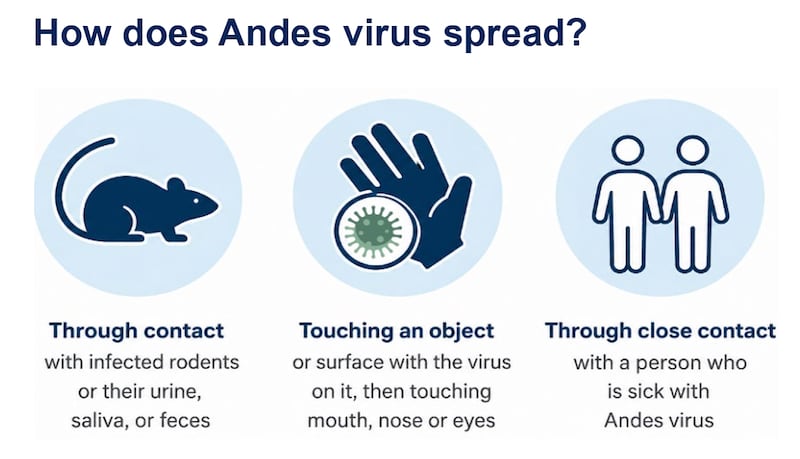
The World Health Organization confirmed on Wednesday that the type of hantavirus responsible for the outbreak was the Andes virus—the only known hantavirus to transmit person to person.
The Spain-bound ship, operated by Oceanwide Expeditions, left Argentina on April 1, carrying 147 crew and passengers, and crossed the South Atlantic via a number of remote locations, including Antarctica.
There is no vaccine or specific antiviral treatment for hantavirus.