Documents detailing FBI interviews with a Jeffrey Epstein victim who accused President Donald Trump of sexually abusing her when she was 13 are being kept under wraps.
More than three dozen pages remain missing, according to an NPR analysis, including “files related to allegations that President Trump sexually abused a minor.”
The Department of Justice, which has slow-walked its legally-mandated release of the Epstein files, published 16 pages regarding the accuser last week. However, 37 pages, including notes from the interviews, a law enforcement report, and license records, are still classified.
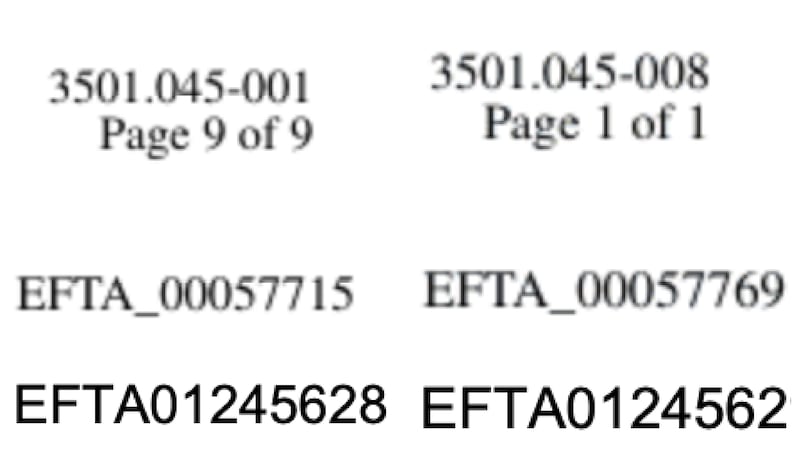
NPR discovered the hidden files by tracking the unique serial numbers that appear on each page of the Epstein files.
In doing so, it discovered dozens of missing pages amid FBI interviews of the Trump accuser that appeared to be catalogued by the DOJ but not shared publicly.
DOJ spokeswoman Natalie Baldassarre told the Daily Beast that no files are missing. Rather, she said the skip in serial numbers was the result of “duplicative notes, which contain the exact same information” as what is available online.
However the public will not be allowed to confirm the DOJ’s claim that the information is “duplicative.”
Baldassarre said members of Congress “are welcome to come view all duplicate files, including these pages, in the DOJ Congressional reading room.”
Baldassarre previously told NPR the missing files have remained classified because they are “privileged,” “duplicates,” or “relate to an ongoing federal investigation.”
A DOJ official told CNN last week the federal government was not currently investigating any individual in connection with the Epstein case, eliminating “active investigation” as an excuse to hold back documents that may paint Trump in a bad light.
Still, Deputy Attorney General Todd Blanche said in January that nearly three million documents are being withheld from public release in part to protect the privacy of victims.
Democrats on the House Oversight Committee have scoffed at that explanation, saying that the missing files are a “White House cover-up.”
Adding to the cover-up accusations was the revelation late last month that the DOJ was taking down files it had just released, including a document that included a photo of Trump’s commerce secretary, Howard Lutnick, hanging with Epstein on his pedophile island. The DOJ said the photo was flagged for containing nudity, despite everyone in the image being fully clothed.
An internal FBI document—released as part of the Epstein files—detailed the accusation against Trump. His accuser said he forced her to commit a sex act on him around 1984, when she was between 13 and 15, after she was recruited by Epstein and transported from her native South Carolina to New York or New Jersey.
The accuser told an FBI agent that she responded to the alleged assault by biting the future president’s penis. She said that Trump then punched her in the head and said something to the effect of, “Get this little b---h the hell out of here.”

White House Press Secretary Karoline Leavitt told the Beast that accusations against Trump are “completely baseless” and were made by “a sadly disturbed woman.”
No charges were ever brought against Trump.
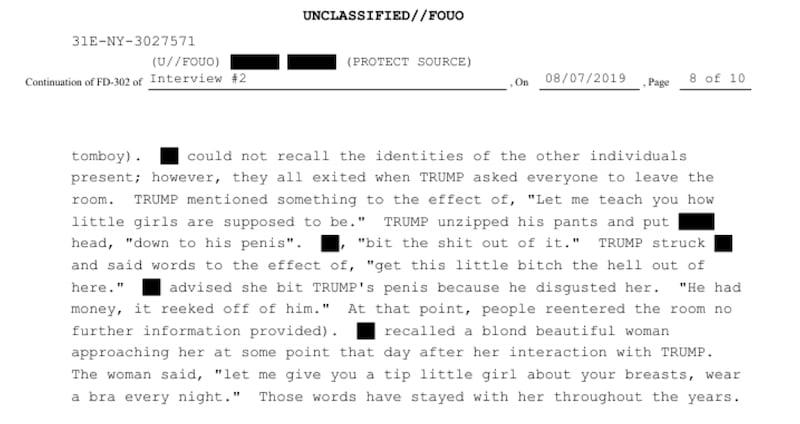
However, independent journalist Roger Sollenberger, a former Beast reporter, discovered that the FBI went on to interview the woman a total of four times in 2019, suggesting the bureau found the allegations against Trump credible enough to probe.
Sollenberger revealed in February that the DOJ had only released documents containing details from the FBI’s first interview with Trump’s accuser, which made no mention of the president.
The revelation amped up pressure on the DOJ to release additional files about the accuser. Last week, it released three additional interview summaries regarding the woman’s interviews with federal investigators. The DOJ claimed those summaries should have been released with the initial dump of Epstein documents, but were withheld because they were incorrectly labeled as “duplicative.”

Interviews with the accuser abruptly ended after she reported receiving threatening calls from unidentified people and, through her lawyer, asked the bureau to stop contacting her.
A report by The Post and Courier, a newspaper in Charleston, South Carolina, verified key details about the accuser’s life earlier this week.
The sexual abuse allegation is far from the only time Trump is named in the Epstein files. Just this week, the Daily Mail discovered an interview with an Epstein victim who claimed that the late sex trafficker was speaking to Trump on speakerphone in 2004 as he ordered her, then only 16, to undress and massage him.