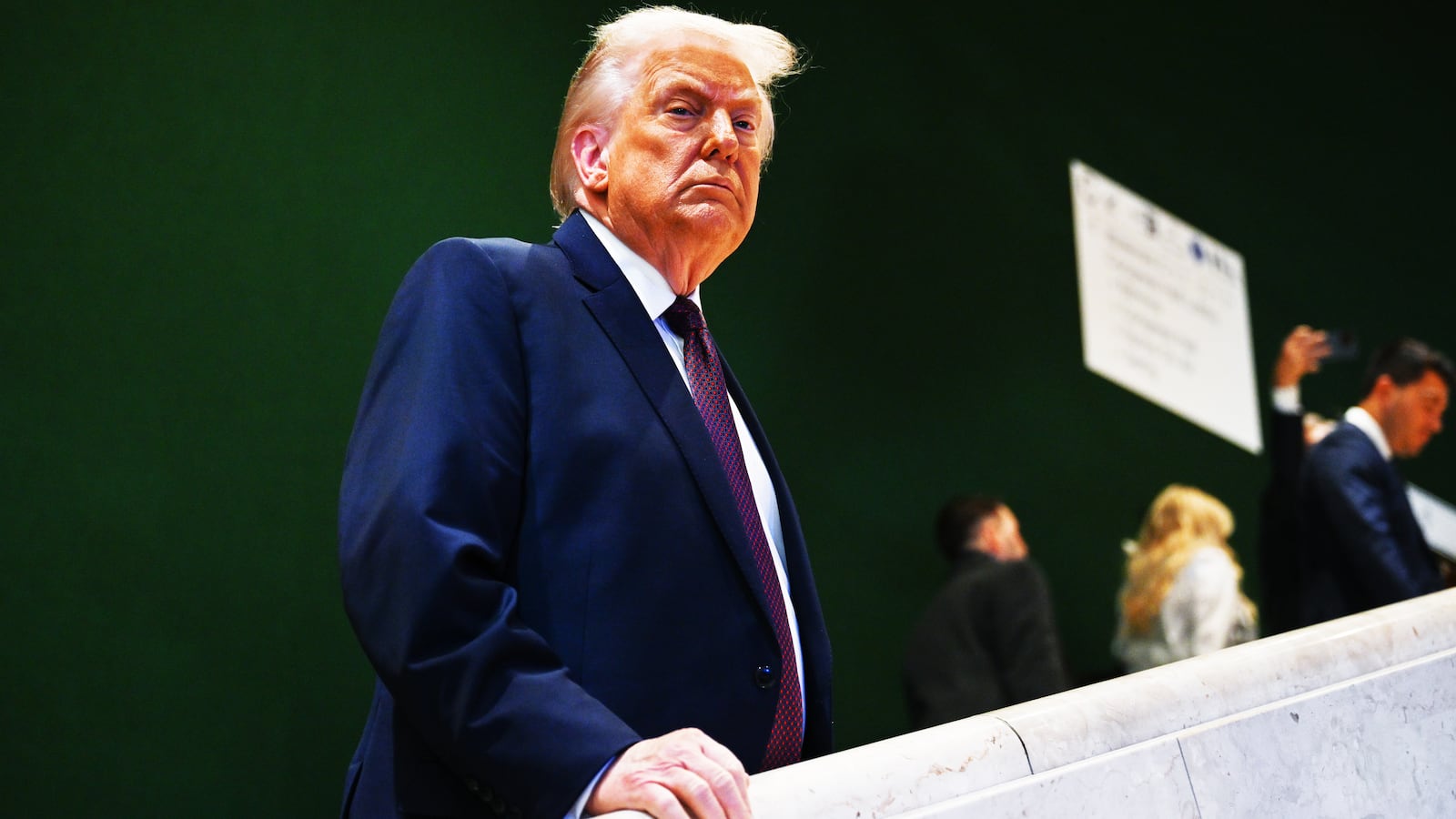
There he was, seated on stage with pen in hand, surrounded by other world leaders standing and applauding.
Normally this is the type of moment that President Donald Trump lives for.

But on this particular stage at the World Economic Forum in Davos, Switzerland, where Trump was hosting the signing ceremony for his newly launched “Board of Peace,” the 79-year-old president looked small, tired, and strangely alone.
Snubbed en masse by the U.S.’s long-standing allies and flanked by a group of strongmen and minor global players, it was a fitting end to arguably the most disastrous foreign trip of either of Trump’s two terms in office.
During his first trip to Davos since 2020, the president flopped by nearly every metric.
His official remarks were rambling and low-energy, his attempts to bully Europe into handing over Greenland failed spectacularly, and his humiliating “Board of Peace” launch showed that other leaders are no longer willing to suck up and placate him in hopes of avoiding the fallout from his worst impulses.
Things got off to an abysmal start during his official remarks Wednesday, when a visibly exhausted Trump repeatedly confused Greenland with Iceland, repeated his goal of taking over the island, ranted about wind farms, attacked Somalis in Minneapolis, and repeated false claims that the 2020 election was stolen.
“It’s time to take the keys away from Grandpa,” one Democratic lawmaker said in response to his performance.

But just hours later, the president made an about-face on the topic of Greenland following a meeting with NATO Secretary General Mark Rutte.
“Based upon a very productive meeting that I have had with the Secretary General of NATO, Mark Rutte, we have formed the framework of a future deal with respect to Greenland and, in fact, the entire Arctic Region,” Trump wrote on this Truth Social platform.
While official details of the new deal have not been revealed, sources told both The Telegraph and Axios that Greenland will remain an autonomous region of Denmark.
Trump had claimed repeatedly that the only way to protect Greenland–and the greater Arctic region—from Russia and China was if the U.S. had full ownership and control.
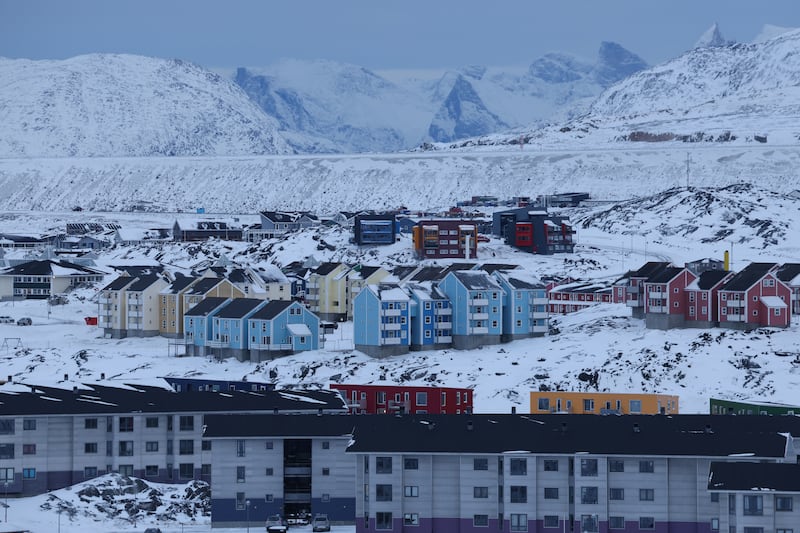
The president also dropped his threat to impose tariffs from Feb. 1 on products from eight European allies—Denmark, Norway, Sweden, France, Germany, the UK, the Netherlands and Finland—that had opposed his bid to “acquire” Greenland.
For months, European leaders have endured lectures from members of the Trump administration and tiptoed around the president in the hopes that if they only tried to appease him, he wouldn’t declare crushing tariffs on their exports.
But Davos marked a distinct turning point in the relationship, as Europe and other American allies finally seemed ready to shake off the mantle of being Trump’s whipping boy.
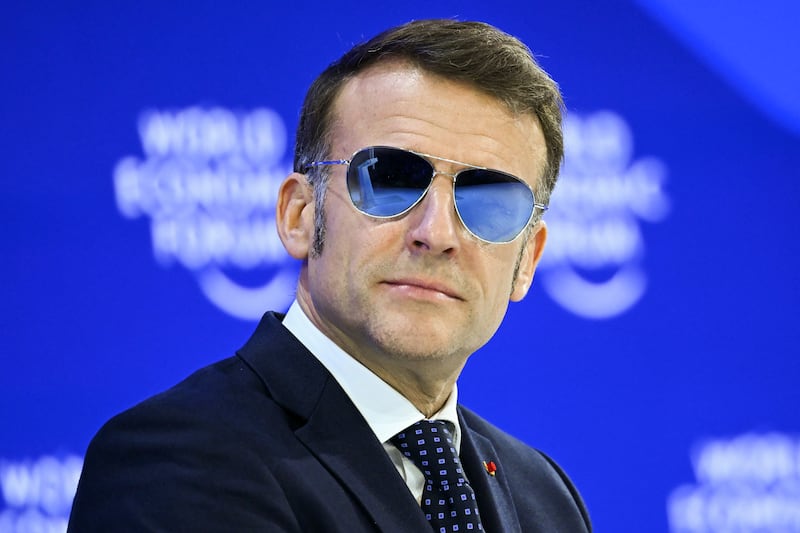
They’ve stopped mincing words, with Norway’s Prime Minister Jonas Gahr Støre saying it’s “unacceptable” for Trump to try to take land from a NATO country, and French President Emmanuel Macron calling for an end to bullying and other “crazy tactics.”
They’re openly declaring that the time has come to work together to oppose an American-led “might makes right” world order, with Canadian Prime Minister Mark Carney receiving a standing ovation after he urged “middle powers” to work together instead of competing for favor “in a world of great power rivalry.”
And they’re making it clear what they think of Trump’s lackies.
When U.S. Commerce Secretary Howard Lutnick spoke at a VIP dinner shortly after declaring that Trump was the “new sheriff in town,” he was heckled and jeered. European Central Bank President Christine Lagarde reportedly made a beeline for the door as he began speaking.
All of this was the prelude to Thursday, when not a single representative from Western Europe or North America attended Trump’s “peace board” signing.
Representatives from the G7 were conspicuously absent, as were the original BRICS countries, and most of the G20.
Instead, the president was joined on stage by leaders from the United Arab Emirates, Kosovo, Pakistan, Paraguay, and Bulgaria. Hungary’s authoritarian Prime Minister Viktor Orban was there, along with Trump fanboy Javier Milei of Argentina and a representative for Turkey’s Recep Tayyip Erdoğan.
Israeli Prime Minister Benjamin Neyanhu wanted to be there but couldn’t because he’s wanted by the International Criminal Court for alleged war crimes, the Financial Times reported.
Israeli President Isaac Herzog was in Davos but skipped the ceremony, as did European leaders who are wary that the group—which according to its charter is chaired by Trump, who has the power to handpick the organization’s members, approve the group’s agenda, manage its finances, and designate his own successor—will undermine the United Nations.
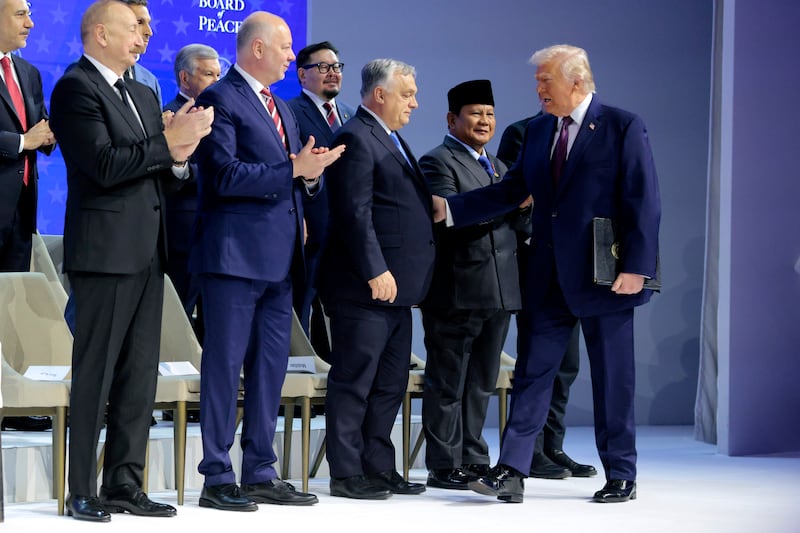
In the end, fewer than 20 nations made an appearance. Ahead of the signing ceremony, the White House had predicted that 35 countries would attend, and had said that Belgium was on the list of signatories. Belgium’s deputy prime minister, however, refuted that claim.
The president sounded hoarse throughout his speech, and even his spokesperson, Karoline Leavitt, who was emceeing the event, couldn’t seem to muster her usual enthusiasm.
Toward the end of the program, she called up the first two signatories, Bahrain’s Sheikh Nasser bin Hamad Al Khalifa and Moroccan Foreign Minister Nasser Bourita, to join Trump on stage to ratify the board’s charter, which would enter into force once three countries signed on.

“Congratulations, President Trump. The charter is now in full force, and the Board of Peace is now an official international organization,” she said as the three men held up the signed charters.
Even then, for several long moments, Leavitt was the only one clapping.